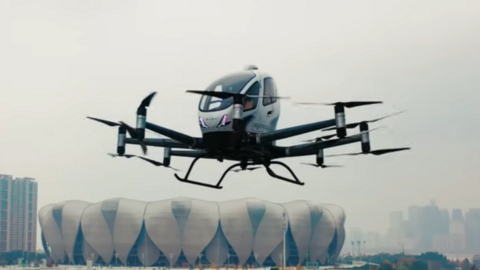
La China is ready to bring flying taxis outside the laboratories and inside the cities. According to the Financial Times, the EHang company, a world pioneer in the field of electric vertical take-off and landing (eVTOL) aircraft, plans to launch commercial services within three years from the main airports of the country, with tickets starting at $30A figure which, according to the company's intentions, should make accessible to a wider audience what until yesterday seemed like science fiction.
EHang, the first company to license unmanned air taxis
Founded in Guangzhou, EHang is the first company to have obtained the official green light from the Chinese civil aviation authority (CAAC) to operate fully autonomous air taxisThe authorization, granted in 2024, represents a historic turning point because for the first time an operator can carry passengers without a pilot on board.
For now the authorized flights are of a panoramic type, with departure and arrival at the same point, and the first selected destinations I am really Guangzhou e hefeiBut the company is looking beyond. "It won't just be a tourist attraction," he explained. Conor Yang, CFO of EHang and former banker at Goldman Sachs and Lehman Brothers, this is a new economy, not just an industry: it will serve urban transportation and public services.”
Passenger drones: technology, prices, and ambitions
Il flagship model is the EH216-S, a small, oval-shaped, two-seater electric aircraft capable of covering an urban route in just a few minutes. trip from Shanghai Hongqiao to Pudong, which takes about an hour by car, would be completed in twelve minutes.
EHang has also developed a proprietary software to coordinate hundreds of air taxis simultaneously, a sort of “digital control tower” that promises to manage urban air traffic like street taxis are managed today. The price? Between 200 and 300 renminbi ($28-42), just above a premium ride on apps like DiDi, but well below luxury transport fares.
According to Yang, the combination of innovation, stringent regulation and timing will give EHang a competitive advantage of at least two years over rivalsAirport flights should also be cheaper than scenic flights, because they are not subject to the constraints of tourist schedules.
The “low-altitude economy”: Beijing's new race
La The Chinese government's push is far from marginal. The so-called “low-altitude economy” – the economy of the airspace below a thousand metres – is become a pillar of Beijing's industrial strategy. Central and local authorities are investing billions of dollars in infrastructure, vertiports and logistics hubs, as well as creating a dedicated department for the drone industry.
In short, China doesn't just want to participate in the global flying taxi race, but lead it. This is also confirmed. Emerson Xu, CEO NexAvian, “it will be the first nation in the world with regular connections between airports and urban centers”.
However, there is no shortage of challenges. autonomy of the EH216-S, about 35 kilometers, is still not enough to cover longer routes such as the one between Guangzhou Airport and the financial district. Furthermore, other companies such as AutoFlight e Xpeng are close to obtaining similar licensesCompetition, therefore, will soon become fierce. "EHang's advantage is neither technological nor regulatory unassailable," warned Xu. "In the end, whoever can accumulate the most flight hours and gain passengers' trust will win."
Flying taxis in Italy: the dream is stalled.
As passenger drones prepare for take-off in China, in Italy the projects of urban air mobility I'm still on the ground. A Milan there was talk of flying taxis for the 2026 Winter Olympics, with four vertiports planned between Linate, Malpensa, CityLife and Porta RomanaBut a few months before the Games, the work was wrecked by the German Lilium, the project's technical partner, which is in financial difficulty (practically bankrupt) and SEA, the company that manages Milan's airports, which has frozen funds pending regulatory clarification.
A Rome, the first experimental flight took place in 2023 thanks to the collaboration between Rome airports and the German VolocopterThe aim was to fly the first air taxis on the occasion of the Jubilee 2025, but even in this case the regulatory and logistical complexities ruined everything.
On the cost front, the comparison with China is merciless if EHang tickets will cost around dollars 30, in Italy the first estimates speak of 120-150 euro per trip, with the aim of reducing it to 80 euros in the future.
If all goes according to plan, By 2028, Chinese flying taxis will be an everyday reality.For now, they remain a dream still parked at the gate.