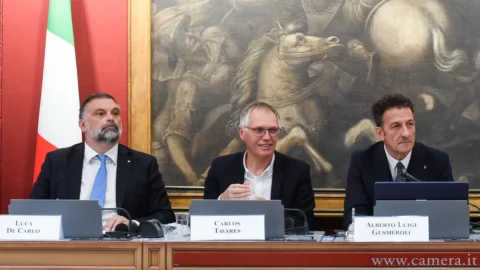
Carlos Tavares, CEO of Stellantis, first appeared in Parliament, during the hearing of the Chamber of Deputies' Productive Activities and Senate Industry Committees, with a clear message: "We are not asking for the postponement of the 2025 deadline, we are ready. We need regulatory stability to plan ahead. We need a stable and lasting environment." He also highlighted the "too high costs in Italy" and the need for "incentives to make electric cars accessible," warning of the growing financial pressure linked to the electric transition and Chinese competition. But the opposition lo they fail and ask to hear John Elkann.
The top manager landed in Rome directly from Detroit, after a board of directors among the most delicate of his mandate, during which the disappointing results of the group, of a top management reshuffle and of his own succession. The picture in North America is particularly critical, with a 30% drop in sales compared to last year and the prospect of closing 2024 below the threshold of half a million vehicles sold. Further complicating the situation is the struggling supply chain and the exodus of many multinationals, which are progressively abandoning the market.
Stellantis' top management shakeup: here are the new managers
To address this crisis, the Italian-French automotive giant has launched a deep reorganization of the management, unanimously approved by the Board of Directors, to give a boost to the company's sales and accounts, after the recent profit warning. Among the new the most significant ones stand out outputs di natalie knight, Chief financial officer of the group, after just one year, and of Carlos Zarlenga placeholder image, chief operating officer for North America. Doug Ostermann has been appointed new cfo, bringing with him over 19 years of industry experience, having also served as Chief Operating Officer for Stellantis China, while Saint Ficilli will take over the role of ceo of Maserati, currently in a sales crisis, and of Alfa Romeo, entering the Top Executive team Team to bring some new things to the house. Maserati's current CEO, Davide Grasso, will remain with the company, but his new role will be announced later.
Antonio Filosa, Already Jeep CEO, takes the reins of the North America, a region crucial to the group's profits, replacing Carlos Zarlenga, whose future remains uncertain. Jean Philippe Imparato will continue as CEO of Pro One and will also take on the role of chief operating officer for the 'Enlarged Europe, succeeding Uwe Hochgeschurtz. Gregoire Olivier has been appointed coo for China, also continuing as Liaison Officer for Leapmotor, leveraging his experience in the Chinese market.
Another novelty concerns the transfer of the management of the supply chain leaders from the Purchasing Division, led by Maxime Picat, to Manufacturing Division under the direction of Arnaud Deboeuf.
After Tavares: The succession is already underway
While Stellantis is trying to respond to current challenges, it is already looking to the future. The process for the succession of Tavares has been started, and will be completed by the fourth quarter of 2025, in time for his departure, scheduled for 2026. The transition will be led by a Special Committee chaired by John Elkann, who reiterated the Board’s full support for Tavares’ strategic choices. The CEO described this period as a “Darwinian moment” for the automotive industry, in which only those who can adapt and innovate will survive.
John Elkann, chairman of the Stellantis board of directors, expressed the board’s unanimous support for Tavares and the changes announced. Elkann said: “We are confident that the steps we are taking to simplify the organization will strengthen our leadership team, which is committed to returning the company to industry-leading performance.”
Tavares in Parliament hearing: here's what he said
The manager, during his hearing in Parliament, highlighted the company's efforts to ensure compliance with regulatory requirements, saying: "We have done our homework, we have worked very hard to ensure that the cars and components we use are in line with the requirements set." He also highlighted how the merger between FCA and PSA has created a company of sufficient size to face the challenges of the market: "We have to face a number of challenges, including Chinese competition, but we must also note that without the right scale there is no future for any company."
Tavares: “The problem is the high costs in Italy. We need incentives and subsidies”
One of the main topics addressed was thecost increase linked to transition towards electric. “I have to be able to sell electric vehicles at the same price as internal combustion vehicles. So, in the current context, I have to consider a 40% increase in costs, that of electric technology,” Tavares explained. “With this 40% increase in costs, I am creating unbearable tension within the supply chain,” he added, asking political leaders directly: “You have to explain to me how I can manage these frictions due to the increase in costs.”
Going into the detail of Italian market, Tavares explained: “We have a precise plan that I shared with our partners, we have assigned new products to all Italian plants until 2030, in some cases until 2033. But it is not enough. The problem is the costs that are too high in Italy, 40% higher than those that our competitors have to sustain,” Tavares reiterated. And then: “In Italy the energy cost is very high, for example, is double that of Spain, and this is a factor that we must take into account. Producing vehicles that cannot be purchased by the middle class because they cost too much is useless,” he explained.
How do we solve the problem of electric car sales? By making electric cars affordable. How? With incentives e subsidies that make the purchase of an electric vehicle accessible to the middle class. In Europe, as soon as the incentives are stopped, there is a collapse in the purchase of electric vehicles. To support demand in Italy, significant injections of incentives are needed,” continued the top manager.
Tavares: “We are not asking for a postponement of the 2025 deadline”
Another crucial point addressed by Tavares concerns the deadlines imposed by the European Union. Tavares reiterated the need to ensure regulatory stability, without delays or changes, to allow companies to plan with certainty. While acknowledging that the EU strategy may have flaws from a social and environmental point of view, he stressed that “instead of arguing about regulations, we should work together to achieve common goals”.
This collaboration will be essential to address the challenges of the energy transition and technological innovation. “To comply with regulations, we need to update and change technologies. Change, especially if it’s fast and deep, can generate anxiety.” However, he was optimistic, saying Stellantis has a “very clear roadmap to drive this change forward.”
On the eve of Tavares' hearing, the political context heated up with the presentation of various motions by the parliamentary forces.
The relaunch of the Fiat 500 hybrid and union tensions
Before the hearing, Tavares met with the sindacati to announce the advance of the production of Fiat 500 Hybrid at Mirafiori, but not all the acronyms participated, only the general secretaries of Aqcfr, Fismic confsal and Uglm. Some, in fact, preferred to postpone the meeting after the demonstration on October 18, which will see the automotive sector workers in the square to underline the importance of the sector for the Italian economy
During the meeting, Tavares illustrated the challenges of the American market and the plan to strengthen competitiveness in Europe. He confirmed the implementation of the Gigafactory in Termoli, but reiterated the need to rethink the timing to ensure cutting-edge technologies. Stellantis said it was ready to face the European deadlines on the ban on internal combustion engines, believing that any postponements could favor competition.