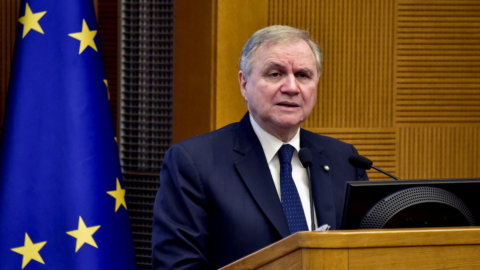
Is it better to risk doing too much or too little? There are no doubts for the Governor of the Bank of Italy, Ignazio Visco, who spoke at the Frankfurt school of Finance & Management. The tightening of monetary policy of the euro area” must continue to ensure that a temporary increase in inflation caused by a supply shock does not become a more persistent phenomenon supported by demand factors”. But we must "balance the risk of too gradual a recalibration (doing too little), which could cause inflation to become entrenched in expectations and wage-setting processes, with that of excessive tightening (doing too much), which would have significant repercussions on economic activity, on financial stability and, ultimately, on price developments over the medium term. In line with our symmetrical price stability objective, I believe that both risks should be given equal weight. The number one in via Nazionale distances itself from the hawks and calls for caution.
Is monetary policy “late” in the euro area?
“The Governing Council of the ECB started the process of monetary “normalisation” at the end of 2021, when it considered that the progress of the economic recovery and the achievement of the medium-term inflation target was sufficient to allow the start of a reduction gradual of the rhythm of the asset purchases. Why didn't we start sooner? And why didn't we start increasing i rates before July 2022?”
The Governor of Via Nazionale retraces all the steps that have brought us to today. “In June 2021, while in the US headline inflation was already above 5% and core inflation was 4,5%, driven by demand factors, in the euro area, despite gas prices already higher, headline inflation was still below 2% and core inflation was below 1%”. High inflation, therefore, seemed to be concentrated mainly overseas.
This started to change in September 2021, “when gas prices moved from the already high level of 50 euros per megawatt hour to around 100 euros (a 'supply shock'). At the time, however, futures quotes predicted that gas prices would fall very sharply by June 2022” and inflation with them. And instead of declining, prices soared, reaching record highs. “The Russian invasion of Ukraine had transformed one temporary shock in one Persistent, justifying an acceleration of monetary normalization”.
In early 2022 the process accelerated. “However, we managed to avoid the potentially dangerous effects of swinging our position too sharply, also in view of the great uncertainty caused by the conflict in Ukraine. The end of our purchases was brought forward to 1 July and, shortly after, we started to increase our official reference rates significantly, with the aim of anticipating the exit from their highly accommodative levels, which are actually still negative ”.
Did the ECB make policy or forecasting mistakes? And if so, why?
In discussing the high level of inflation reached in the euro area, "some commentators have paid less attention to the sudden onset of the energy shock, its size and its persistence, instead pointing the finger at the central bank delays in initiating monetary tightening” and criticizing “the errors in the inflation projections made by the ECB/Eurosystem staff in 2022”.
Visco admits that the forecast errors of changes in consumer prices over the last year "were indeed considerable" but i energy prices – the most important exogenous variables in the forecasting model, whose variations are usually inferred from the market price of futures contracts – explain, directly and indirectly (i.e. through their effects on production costs), 70% of the overall error committed”, a percentage that rises to 80% “if we also consider the effects of the prices of food products, the other volatile component of the consumer price index”.
Le quantitative assessments they are still useful, “but their insights need to be evaluated alongside the information that will gradually become available on inflation expectations and the evolution of wages and profits”.
In any case, the Governor doubts that "a delay of a few months in the effective implementation of the decision to stop asset purchases and start raising rates would have had substantial consequences on consumer price trends in the euro area , which mainly reflect energy and food costs”.
Is it better to risk doing too much or too little?
“On the one hand, doing too little would cost the economy if it leads to the need for a stronger and more prolonged tightening of monetary policy. On the other hand, however, the costs associated with the opposite risk could be significant if "doing too much" were to lead to an undershooting of the objective and perhaps lead to serious debt-deflation phenomena, triggering perilous non-linear amplifications. Faced with these two risks, central bank decisions should continue to be characterized by wisdom ed equilibrium and be guided by careful quantitative assessments of incoming data.
For Visco one recession it is not always inevitable when it comes to reducing inflation. "Communicating a strong commitment to bring inflation back towards target quickly is key, but doing so while minimizing costs to the real economy is no less important." And therefore a cautious approach is advisable, especially in the current context of uncertainty.
Potentials too risks to financial stability require a good deal of caution. “Unprecedented coordinated hikes in policy rates around the world can create spillover effects that are difficult to quantify, but not negligible. The risks of financial instability are particularly relevant in the Economic and Monetary Union, whose incomplete architecture – in particular the decentralized fiscal policy and the delays in the completion of the banking and capital markets unions – expose it to a possible fragmentation of the financial markets”. concluded the Governor of the Bank of Italy.