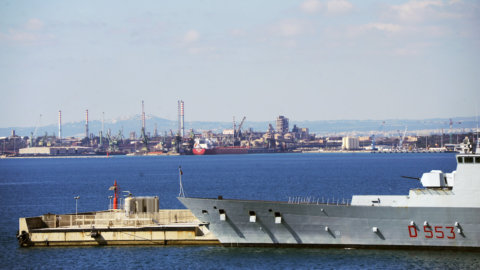
A just transition for Taranto and its steel held court for three days in Brussels. Taranto Euro-Med Resilient City: a new vision for the Mediterranean yes is closed Yesterday. It was a political and industrial event important for identifying the most suitable solutions for the survival of the productive tradition di one of the largest European manufacturing poles. The Apulian institutions went to illustrate the most innovative projects. The great plan of the EU Just Transition Fund (jtf), in Italy it revolves around Taranto and the Sulcis pole in Sardinia. Puglia's interest is focused on 796 million euros of investmentthe. And for the city of two seas, the occasion of the Transition means structures, technological innovation, competition and new sources of energy. “The mission – said the President of the Region Michele Emiliano – symbolizes the stage of approach to the rebirth of Taranto and the metropolitan area. We hoped together with the European Union to transform the city into the Italian capital of hydrogen also thanks to the Just Transition Fund, which however is still in a condition of unused by the Italian government”. The bet to be won is the Mediterranean Games of the Italian Republic in 2026. Three years to give a new face to everything. The production of hydrogen is the medal that Puglia wants to hang around its neck in competition with Sweden. There the plan has a target of 2045, "but we can't wait for 2045" he said Rosa D'Amato member of the Greens-Efail group. The JTF must be implemented by bringing together environmental justice and social justice. Part of the expenditure of European funds will go to small and medium-sized enterprises which will be able to make a different economy, certainly faster than large industry.
The transition must accelerate
In the Region, the Asset Agency is the body that created the strategic plan with three levers of development: sea and ox economy; environment; cultural heritage. It is clear that there will be no more room for fossil fuels. However, it is unthinkable to build the future without carrying along the industrial history which in Taranto has meant oil, refining, steel, the presence of large companies and production distortions. The pollution and the blows on the health of the people of Taranto are the mockery of things that needed to be fixed in time. Now we need the technologies which, according to the policy, are being adopted by the University, the Cnr, the development agency, but also a lot of coordination. Brussels has been told that everything is ready. The determination brought to the heart of European politics has thus outlined economic benefits for the next fifteen years. Rachel Lancry Beaumont, head of the Coter unit of the Committee of the Regions, explained that "the Plan for Taranto does not concern only the iron and steel sector, but also high-emission industries such as automobiles, cement and paper". The city wants to emancipate itself "from the old vision crushed on the events of Ilva", the widespread sentiment is to grow collaboration and strategies with those who create wealth and developeco-sustainable. Everything is fine ecological rhetoricmust be set aside, especially in these months already projected towards the next elections to the European Parliament in 2024. God forbid that in a year's time the paradigms of sustainability change in Europe, without anything having been done in Puglia. Efforts to get away from the vision of a steel city are condensed into touching as little as possible employment, related industries, history. When workers blocked roads, ports and trains, they claimed what is on paper today and which was discussed for three days in Brussels. Everything should march together and with the same degree of awareness. The largest industry in the Region has had worthy pass money from the EU and must hold on to them. Because if they expire, they certainly won't be renewed and we'll go back to seeing roadblocks.