The arrival of Spring is always awaited with high expectations by nature lovers. This year takes on an exceptional value due to the effects of the government decree which colored most of the Italian regions yellow, restoring moderate freedom of movement after months of human, social and economic compression. The beautiful days arrive, the dark and rainy winter becomes a memory that we leave behind. Why not take advantage of a nice and healthy walk in the meadows, in the woods in the countryside to catch the awakening of nature but even more to pick wild asparagus that are springing up almost everywhere these days and will continue until June to prepare us a very tasty omelette? And we may also discover that they are not only much tastier than cultivated ones but also much more nutritious.
They knew it well Egyptians and later the Romans who made extensive use of asparagus. They even go back 200 BC the first cultivation manuals and bear the authoritative signature of Theophrastus, by Cato, who talks about it in his work "De agricoltura", describing its cultivation and planting techniques, of Pliny the Elder, even of Julius Caesar. And, of course, of Apicius the father of all gastronomes. And they all described in great detail how to cultivate them but also how to prepare them. The Roman emperors were so greedy that they mobilized special boats to ensure nourished supplies. When the Romans conquered Spain, they also spread the cultivation of asparagus which found its ideal habitat here; the Iberian peninsula is still today one of the most productive areas in the world.
During the Middle Ages they were almost completely neglected France started the first crops in the fifteenth century. AND with Louis XIV, it became a fashion to cultivate it in the Argenteuil area. A century later we find them in England. Then from the old continent they arrived in North America and today the United States and Peru with China are the largest producers in the world.
However, the name is of Greek origin: aspháragos, derived from the Persian asparag = sprout, from which it can be deduced that this plant had Mesopotamian origins.
Be that as it may, the fortune that has smiled over time on asparagus lies not only in their flavor but also in their remarkable health properties, which are much more concentrated in wild asparagus.
Very rich in provitamin A with antioxidant properties, protective of the skin and mucous membranes, and group B vitamins, powerful energy; And, give it important antioxidant properties, and K, essential for the functionality of the skeletal system and for blood fluidity and coagulation, not to mention vitamin C. Suffice it to say that 100 grams of asparagus provide 25 mg of Vitamin C as much as an occult person needs daily and 75% of folic acid, an indispensable vitamin for cell multiplication and the synthesis of new proteins.
Recent scientific research have also highlighted that two precious substances, the saponins (protodioscin and protodiogenin) which have proved able to inhibit and counteract the proliferation of cancer cells in the colon.
The list of nutraceutical properties of wild asparagus is surprising, it turns out that they have diuretic properties, thanks to asparagine, purifying, detoxifying, rebalancing the metabolism, remineralizing due to a good content of calcium, iron and potassium, antioxidants, invigorating the immune system . And for those with overweight problems also slimming, anti-cellulite and laxatives.
But it should also be recommended to use it moderately in those suffering from nephritis and renal insufficiency and kidney stones.
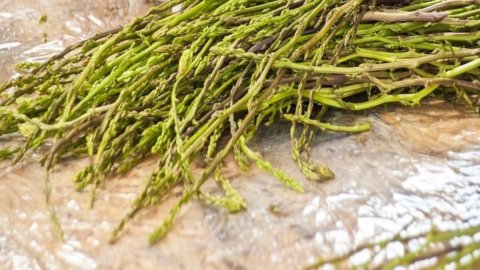
In nature and at all latitudes there are different types of wild asparagus but in Italy the most widespread is l'asparagus pungenteo Asparagus acutifolius, a name that well represents its morphology. In fact, it looks like a messy bush, defended by thorns which has a shoot at the tip, the shoot, which is caught with a clean cut at the base.
Moving on to the gustatory aspects, the great one Pellegrino Artusi, writer, gastronome and literary critic, author of the well-known recipe book: "Science in the kitchen and the art of eating well" maintained that "this herb, precious not only for its diuretic and digestive qualities, but also for the high price at which it is sold, boiled it can be prepared in various ways, but the simplest and the best is the common one of dressing them with very fine oil and vinegar or lemon juice".
Without taking anything away from Artusi's wisdom, to tell the truth, wild asparagus in the kitchen, due to its more intense and decisive flavor on the palate, tending towards bitterish, compared to cultivated asparagus, is very versatile.
In addition to the canonical omelette, they have found many applications in the kitchen, from being served raw in salads, or used to flavor pasta and risottos, soups and velvety soups, or as an accompaniment to main courses of meat or even prepared with fish and shellfish.
However, chefs recommend limiting their cooking to preserve their distinctive flavor. Another recommendation is to avoid cooking them with garlic which does not combine well with the delicacy of their taste.
At this point, all that remains is to organize yourself for a nice outing and stock up on tasty wild asparagus with one recommendation, however: first find out about the regional provisions in defense of the ecosystem of nature and the woods, which concern, as with mushrooms, harvesting periods and amount.
Another recommendation is to pay close attention to what you catch, there are some plants that resemble asparagus but are instead toxic to humans, such as the shoots of Clematis (Clematis vitalba) or the young shoots of Tamaro (Tamus communis). So read up well before putting them in the pot.
Finally, a curiosity: in the not so distant past in Abruzzo, due to their sturdiness, the prickly asparagus plants were used by chimney sweeps who, to clean the flues, rolled up the asparagus bushes to create a thorny ball tied to a rope that was lowered several times through the flue to scrape the soot from the walls and make the chimneys work better.