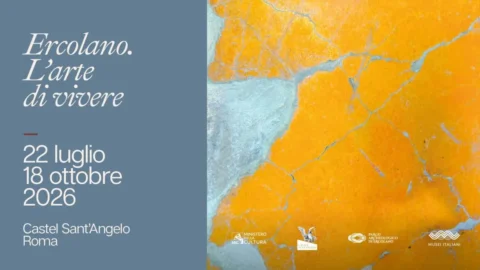
It is not an exhibition on archaeology, nor a simple reconstruction of the Roman world. Herculaneum. The Art of Living It is above all a journey into a civilization that, nearly two thousand years after its demise, continues to speak with surprising relevance. The exhibition invites visitors to move beyond their fascination with the tragedy of the eruption of Vesuvius in 79 AD and instead focus on what that catastrophe unwittingly preserved: the story of an extraordinarily modern everyday life.
Herculaneum in fact has a different nature from Pompeii
Smaller in size but better preserved, it conveys the image of a city where domestic spaces speak to the quality of life, aesthetic taste, and the relationship with luxury and well-being. The exhibition builds its narrative around this concept, demonstrating how Roman art was not confined to temples or public buildings, but permeated every gesture of daily life. Frescoes, mosaics, bronze and marble statues, furnishings, ornaments, and everyday objects interact in a display that avoids spectacularization. The narrative unfolds through the rooms of the Roman home, transforming the dwelling into a cultural manifesto. The dwellings of Herculaneum were not merely places of living, but spaces in which aesthetics, social representation, and the pursuit of harmony coexisted in perfect balance.
Among the most fascinating aspects is the role of decoration
The frescoes are not merely ornamental elements, but rather windows opening onto imaginary landscapes, illusionistic architecture, and mythological scenes that symbolically expand the domestic space. Roman painting reaches a surprising maturity here, anticipating perspective solutions that would return to prominence many centuries later in the Renaissance. Also of particular interest is the presence of refined bronze, glass, and silver objects that depict a society capable of combining functionality and elegance. Nothing appears to have been left to chance: each artifact bears witness to a sophisticated material culture, in which beauty coincides with utility, and artisanal quality represents an identifying value.
The exhibition also invites us to reflect on a particularly current theme today: the relationship between man and home.
The Roman home was not just a private space, but a place where relationships were built, social prestige was exercised, and a specific idea of civilization was manifested. In this sense, Herculaneum offers a lesson that remains contemporary, reminding us that architecture and design have always been tools through which humans express their vision of the world. Curatorially, the exhibition maintains a compelling balance between scientific rigor and informative impact. The artifacts are presented not as simple archaeological evidence, but as fragments of real lives. This narrative choice restores depth to the objects and allows visitors to recognize, behind the perfection of the works, the tangible presence of the people who created and used them.
The real protagonist of the exhibition is not a single find
It is the very concept of art of livingAn idea that runs through the entire exhibition and restores Roman culture to its most authentic dimension: that of a civilization capable of making beauty an everyday element, integrated into architecture, furnishings, objects, and even the most ordinary gestures. At a time when cultural heritage often risks being perceived as a mere memory of the past, Herculaneum. The Art of Living It demonstrates how archaeology can still speak to the present. Not through nostalgia, but through a reflection on the meaning of dwelling, the quality of space, and the centrality of culture in building society. This is why the exhibition goes beyond the documentary value of its finds: it transforms history into experience, reminding us that beauty has never been a luxury, but an essential component of civilization.