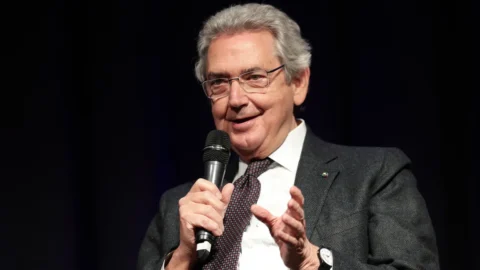
“The management of Telecom Italia learned about the change of hands of Telco from the press releases. To arrive at different choices, we all had to think about it beforehand”. There is much bitterness in this confession that the president of Telecom, Franco Bernabè, made to the Senate Industry Committee on the Spanish raid on the largest Italian telecommunications group, but there is also a transparent indictment before throwing the sponge. Up until its privatization, Telecom Italia was a goose that laid golden eggs and even today it remains an essential strategic asset for its network: admitted and not granted that the Spanish operation actually goes through, seeing it slip by like this is sad. But we should have thought of that first.
The loneliness of Bernabè, who had returned to the helm of Telecom for a personal revenge after the takeover bid by Gnutti and Colaninno who in 99 had ousted him after only a few weeks and which is at the origin of all the group's troubles, it is also the solitude of Telecom. But it is not surprising that this happened, because Telecom is a bit of a metaphor for Italy: many debts, scarce capital, few investments and a thousand snares and snares in a market in which the excess of operators and the excessive power of the over the top (Google in the lead) has upset the competitive paradigms.
The Telecom case is a school case: unfortunately in the negative. The leading telecommunications group in Italy has been the sacrificial victim of a capitalism without capital and of an intrusive or absent but always short-sighted policy. Now the country system can cry all it wants, but they are only crocodile tears. If he really succeeds in conquering Telecom, dribbling around golden shares and the risk of takeover bids and prevailing over the group that supports Bernabè and which is demanding the recapitalization of the company, it may well be that Telefonica, despite being burdened with 50 billion in debt, will over time be able to restore to Telecom but for the country it is already a lost game.
After all, the conquest of the Spaniards is only the last act of a story that starts from afar and which confirms how Italy, which in its provincial distrust of the enterprise, does not understand and does not like large groups, did not deserve a jewel like It was Telecom. Ever since it was public and was called Stet, the only concern of politics, with few exceptions, was to use Telecom as a great manger to invent bogus jobs or advocate rigged tenders for friends of friends.
Heaven knows how much resistance a gentleman of great finesse like Giuliano Graziosi met to modernize the Italian telecommunications system, whom Treasury Minister Nino Andreatta appointed CEO of Stet in the early 80s. In fact, after a few years, and above all after the famous Piano Europa and the alliances with the Americans of AT&T, Graziosi was first joined by other Christian Democrat and socialist managers interested only in the political dividend of Stet and then dismissed.
Then came - in the second half of the 90s - the season of privatization of what had become Telecom Italia arrived. According to current vernacular the privatization desired by Prodi and Ciampi was the cause of Telecom's decline but it is a historical falsehood. It may be that the haste to carry out the privatizations to join the euro was not a good adviser, but the real truth is that the weakness of the corporate structure of Telecom which came out of the privatization was mainly due to the reluctance of capitalists without capital and above all without vision that, after having invoked privatization so much, when it came to opening their wallets they preferred to turn their heads away or practice the awl policy.
The founder of the Clessidra private equity fund, Claudio Sposito, who at the time worked at Morgan Stanley to which the Treasury had assigned the task of collecting subscriptions for privatization, knows something about it. Sposito, who is an excellent finance man, spent the summer of 97 touring the seven churches but the resources raised were certainly not exciting. The famous Telecom nugget which included Ifil, the big banks, Mediobanca and a few private entrepreneurs was born this way.
With little money and above all no expertise in the sector, the new entries claimed to lead Telecom and soon ended up changing management by distrusting the CEO, who was Tomaso Tommasi di Vignano (a manager who had already demonstrated his skills in Sip and who he confirmed them by building piece by piece that jewel that has become the Emilian multi-utility Hera), and entrusting the group to an incompetent and a bit too loudmouthed manager like Gianmario Rossignolo. Then Ciampi, who in 98 was the minister of the Treasury and who felt responsible for the good performance of the mother of all privatizations, worked to convince Franco Bernabè to leave the leadership of ENI, which he had led successfully after the mists of Tangentopoli, and to assume the leadership of Telecom Italia, becoming its managing director.
But Bernabè's first season at the helm of Telecom lasted only a few weeks because the stock market fever that was circulating at the time prompted unscrupulous and capitalless financiers led by Chicco Gnutti to set up the tender offer in Telecom's debt with the support of Roberto Colaninno ( former CEO of Sogefi of the De Benedetti group), who then assumed operational leadership, and with the incredible financial support of Mediobanca and political support from the then Prime Minister Massimo D'Alema. When a takeover bid of the size of the one on Telecom is carried out and the costs of the operation are passed on to the prey company, ie Telecom itself, it doesn't take long to figure out where this is going.
And in fact Telecom, despite still enjoying a semi-monopolistic income, began to take on debt after debt that spliced its wings. D'Alema was convinced that Gnutti and Colaninno were "courageous captains" of a new capitalism alternative to that of the historical families and the so-called parlours, but it was a colossal blunder that got Telecom in trouble and jeopardized its future.
Then came the season of Marco Tronchetti Provera and the Benettons but it didn't go any better. Partly because the very Milanese idea that Telecom was only a former public bandwagon led to the dismissal of quality managers but above all because the high prices paid for the purchase of the control package by Gnutti and Colaninno immediately became – thanks to the collapse of markets three months later – a financial obsession for the new kings of the telephone group which prompted them to commit several missteps, the main one being the merger between Telecom and Tim.
When Bernabè returned to Telecom – and we are in the final years – he found a completely different group from the one he had left in '99. Telecom was a group that had 40 billion in debt, which had already lost many technological challenges, which was facing increasingly fierce competition and which was caged by a shareholding in which the blocking minority of Telco excelled, made up of Telefonica , Mediobanca, Generali and Intesa Sanpaolo.
The transition of Telecom from Tronchetti to Telco was imagined as a system operation but it was paid for dearly and was the basis of the subsequent difficulties of Telecom and Bernabè. Both because the presence of Telefonica immediately prevented us from thinking about the possible sale of Tim Brasil or the spin-off of the network, but above all because it was clear that almost all the new shareholders did not want to faint further for Telecom, even at the cost of denying it the resources for new investments and/or acquisitions.
Bernabè painstakingly tried to reduce the debt and management costs but never had the capital and free hands to really relaunch Telecom. He had to get by but his mission immediately proved to be an impossible mission. In the next few days he will decide whether to open the last battle to secure Telecom or resign. But, without a country-system that believes and supports the few large groups in compliance with the rules of competition and above all without far-sighted shareholders who believe in telecommunications challenge, Telecom could not and cannot go far. Telefonica was only waiting for the best moment to conquer it but the truth is that Italy hasn't lost Telecom since today but for a long time. Now he's just getting ready to pay the bill and it's a heavy bill.