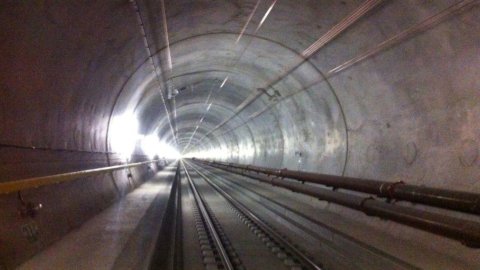
The delay, compared to the Swiss programme, in the construction of the Italian section of the new Italy-Switzerland multimodal corridor, which is part of the Rhine-Alps corridor on which the European Commission is aiming to make European transport more efficient and with a lower environmental impact, will have high costs for Europe and for Italy in particular. These were highlighted by a study by Certet Bocconi presented today and carried out in collaboration with the Swiss Embassy and the companies Apm Terminals Italia, Hupac Intermodal SA and Rivalta Terminal Europa spa. According to Certet calculations, the five-year period between the opening of the new Gotthard Pass (Switzerland), scheduled for the end of 2016, and the opening of the Third Pass in the Ligurian Apennines (2021) will cost Italy , between lost revenues for the tax authorities and lost earnings for companies in the sector and for the banking system, a good 1,2 billion euros a year, for an estimated total of 6 billion between 2016 and 2021.
For its part of the construction of the new multimodal corridor, Switzerland has made investments of 17,6 billion euros, which have already been fully financed. The end of the works is expected in 2020, but the milestone will be at the end of 2016 the opening of the new Gotthard. On the other hand, 2021 is the date, according to estimates, not before which the Third Pass could open (between Genoa and Novi Ligure) which represents an important stage in the reorganization of the railway system in the North-West of Italy and which would allow, together with the other investments envisaged, to make the Italian transport system more competitive, allowing the full exploitation of the potential of the Ligurian port hubs. The investment program for the Italian part of the corridor is worth 11 billion euros, only 3,75 of which, however, are currently actually available. The works have already begun but, according to estimates, the first fundamental stage of the plan, the opening of the Third Pass, would not be fully operational before the end of 2021.
“The Italy-Switzerland multimodal corridor is a fundamental system of works for the development of transport in Europe. The delay that will accumulate in the construction of the Italian part will have a high economic impact”, explains the director of Certet Bocconi, Oliviero Baccelli.
The Italian section of the corridor represents, at the moment, the weak link in the system. The context, in fact, sees on the one hand the more advanced development of the Swiss part of the corridor; on the other hand, the ongoing development of the Ligurian port system, which by 2020 will increase handling capacity from the current 4,3 million TEUs (already 80% exploited) to 6,6 million, thus rebalancing towards Southern Europe a part of the maritime traffic which today relies on the hubs of Northern Europe and thus increasing the Italian economic advantage. In the middle, therefore, the transport system that should connect the three ports of Liguria with Switzerland.
At this point, processing data from different sources (including Banca d'Italia and Fedespedi), Certet hypothesized how much the cost to productivity, first European and then especially Italian, of these five years of difference between the Swiss and Italian times.
As far as Europe is concerned, if the Italian corridor were completed in parallel with the Swiss times, allowing the rebalancing of traffic towards the Ligurian ports, it would lead to a total annual savings of 185,7 million euros, in terms of reduction of maritime distances (82 million euros), land railway distances (65 million) and reduction of the costs of goods immobilization (38,7 million).
For Italy, the 5-year difference in the time to market of the Third Pass, according to Certet, will produce a failure to recover the handling of the Ligurian hubs estimated at 300 TEUs per year, between imports and exports. And considering 7.100 euros for each TEU less handled on imports (of which 55% goes to the treasury) and 927 for each TEU of lost revenue on exports, we would arrive at 1,2 billion euros a year of lost revenue, over 650 million of which would go to the treasury.
“This shows how important the opportunities to be seized are,” continues Baccelli. "In addition to the completion of the infrastructure on the Italian side, which must be accelerated, an important step is the adaptation of the regulatory framework on rail transport, which can instead be done at no cost". The Rhine-Alps corridor, within which the Italy-Switzerland corridor lies, “connects the most important areas of Europe in terms of production. The fact that Italy is lagging behind is worrying not only for Italy itself but for Europe. The ports of Northern Europe handle enormous volumes but also generate large externalities, both from the point of view of congestion and the lengthening of the routes necessary to reach them; rebalancing traffic to the south would therefore be an advantage”.
Finally, from the Italian point of view, the corridor is not just infrastructure policy. "It is an investment that also has repercussions on the manufacturing sector, because it reduces import-export costs, and which has a positive impact both on the environment and on the quality of work of logistics companies".