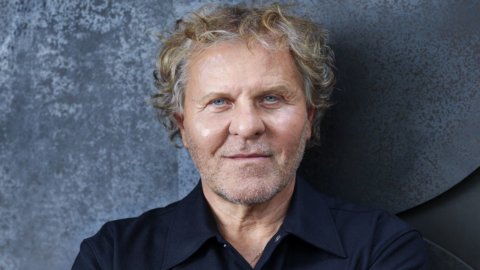
What he has in mind is a model of social enterprise and widespread factory with a decidedly Olivetti flavor Renzo Rosso (66 years old, fashion entrepreneur from Vicenza, known all over the world, founder and president of OTB, cold eyes but a philanthropist's heart, with 3 honorary degrees and an infinite number of curiosities and passions) as a new competitive paradigm that makes sustainability (environmental, industrial and above all social) not a rhetorical tinsel but one of the founding pillars of his way of conceiving the company. A model in which all the excellences that combine to create its industrial network (from the most obscure craftsman to Glenn Martens, the stylist who leads Diesel, the cornerstone of OTB - the Rosso holding company - and a constantly growing reality in the world of luxury and of fashion) are valued and inserted into an organic and at the same time original system.
The network model that Rosso has conceived and created is somewhat of an alternative response to those who criticize the Italian fashion and luxury industry for not having been able to create a giant like the French LVMH. Perhaps because it comes from the Northeast, a land of small, very small and medium-sized enterprises but very dynamic and strongly projected on international markets, the inventor of Diesel he does not pursue the gigantism of big industry, sometimes too slow and sometimes unmanageable, but has in mind a much leaner, faster, more flexible and above all captivating industry that always aims to create something “extremely cool”.
Rosso has come a long way since he created the Diesel jeans brand in 1978, passing through the most varied sectors, from pharmaceuticals, to the hotel industry, to low cost flights, to cars, but always with one idea in mind: to enhance and respect people and believe in creativity and work.
Rosso has achieved levels of excellence in his business, with various brands in the fashion sector (from Diesel to Maison Margiela, Marni a Viktor & Rolf, Amiri a Jil Sander and Staff International) and plans to take his holding company public, but also has a revolutionary industry model in mind. However, it has very deep roots in the Italian economic fabric and in particular in the Northeast. Here's what Renzo Rosso told FIRSTonline in this interview released a few days ago in the Milanese headquarters of Jil Sander, taken over last year by a complex situation and which has already reached break even this year.
Rosso, there is something Olivetti-like in your way of doing business, attentive not only to profit but to continuous innovation, respect for people and the environment: can you tell us how your entrepreneurial adventure began?
“Yes, gladly, but first I would like to make a confession. When I first saw the film about Adriano Olivetti's life, which I really liked, I said to myself: 'But that's me! Adriano did exactly what I would have done.' Now there is a lot of talk about sustainability, but for me it was already in my father's words when he taught me respect and attention for people. As for the beginning of my entrepreneurial history, let's say that it was all my mother's fault”.
In what sense?
“Because in the peasant family into which I was born in the Veneto region money didn't circulate in abundance and to save money my mother always made me wear the jeans my brother used before. It will seem incredible but from there my passion for jeans was born and the mad desire to have a new pair all for myself. So I made up my mind to produce the jeans myself. I made my first pair of low-waisted flared jeans when I was 15 with my mother's sewing machine. A crazy joy and a liberation: finally a new pair of jeans all for me and made by me. Then I started making them for friends and selling them at school. The origin of Diesel, which I founded in 1978 with Adriano Goldschmied, comes from there”.
Why Diesels? What's that got to do with jeans? And who chose that name?
“He was chosen for two reasons. The first was because at the time of the oil crisis of the XNUMXs, the word Diesel echoed alternative fuel and the Diesel brand could be perceived as the alternative brand in casual wear. Secondly, it was a word pronounced the same way around the world and perhaps this is why CNN said that “Diesel is the first brand to truly believe in the global village and embrace it with open arms”.
In 2013, the New York Times wrote that until then, i.e. 9 years ago, it was estimated that Diesel had sold 100 million jeans since its foundation. Did you expect such a success?
“Frankly not, but Diesel has made me aware that Italian creativity is a treasure that can work miracles, if combined with organisation, technologies and work ethics, and perhaps Italians are not fully aware of this I count".
Red, let's come to the present day and to the Ukrainian tragedy. In two months the war has changed the world, it has put peace on file, and at least for now, it seems to have decreed the end of globalisation. What is war for you and how are you experiencing it?
“It is a tremendous shock, which I did not imagine having to experience. And I see it above all in the eyes of the 440 Ukrainian women and children that my Only the Brave Foundation, managed by my wife Arianna, has welcomed here in Italy by accepting the appeal of the UN Refugee Agency. You look at them and you understand how great the tragedy of war is. So far we have given them a home, food, clothing, health care. Now let's think about their education and upbringing and, if the bureaucracy doesn't hinder us, we will also think about including them in our companies, obviously in compliance with all contractual rights. I take this opportunity to thank Minister Bonetti who immediately understood the problem and who is giving us a hand ”.
Does war also mark the end of globalization and that is of the dream that unlimited international trade can act as a lever for peace between peoples? What does it mean for a group strongly projected on the markets like yours?
“It's true, the war has created many dramas and great imbalances and we and our Ukrainian guests experience them very closely every day. But situations can be fixed, there is no black and white. And we are Italians: we have in our DNA the ability to manage business according to how things are going, indeed learning from new situations. As for globalization, I would be careful not to give it up for dead. So far it has been a very positive element because it has brought us, also thanks to digital technology, to the awareness that the world is no longer understood as a set of many countries, but as a single country, in which each one specializes and from which the exchange. As for our Group, the Russian market represents only 2% of our business and will not significantly affect our accounts".
Then we will go back to the accounts and prospects of your OTB, but let's stay on the possible competitive paradigm shift induced by the war and the shortening of the supply chains: for a production area made up of small, very small and medium-sized companies like the Northeast, what does everything mean This?
“Look, the Northeast and in particular the Veneto has suffered countless foreign invasions and has always tried to defend itself. But this struggle for survival has also triggered a crazy desire to work, to emerge, to do something really useful. Perhaps it was precisely its history that pushed the Northeast towards business flexibility and did not favor the creation of a large industry but a flourishing of talented craftsmen and medium-sized enterprises capable of excelling on all the markets of the world”.
An entrepreneur in his own sector such as Patrizio Bertelli who leads the Prada group argues that the lack of large companies is a limit for fashion but more generally for the Italian economy. What do you think?
“I know Bertelli's point of view but I don't think the same way. It's true that small isn't always beautiful, but being big doesn't mean being cool. I have in mind another business model which aims not so much at gigantism in size but at synergies between the many subjects of a network which is based on sharing, speed, courage, creativity, sustainability and the support of the whole production chain. Making synergy makes the work more profitable and more attractive. This was also seen during Covid and not just in fashion. Medium-sized companies buy sprint by making synergy with the supply chain. The others, if they want the supply chain, have to buy it”.
Is this the fundamental difference between large companies and your model of doing business through a network of excellence?
“Yes, big business can only reproduce a chain product. The craftsman – who is the basis of manufacturing – can instead make something truly unique, extraordinary and creative. I collaborate and join the artisans contractually but I don't want to buy them. Their entrepreneurial freedom is a value and we help them grow and improve, but we leave them in their place without absorbing them. I give them an attendance fee and I want them to know that they are sure they have a job. I guarantee them training, I bring them to a very high quality rating, I guarantee them financing at a competitive rate and I offer an uncommon level of sustainability which means showing how you work, how you treat your employees, how you pay them: this is corporate sustainability and the new world where young people want to work. Also thanks to technology, we link the medium-sized enterprise with the craftsman and build a value chain in a modern key that makes the industry leaner than the large ones, faster, more flexible and more attractive”.
But is your business model replicable outside your company and outside the fashion sector?
“Yes, it can be replicated in many sectors. And some entrepreneurs are applying it outside of fashion. The fundamental idea is to bring together the best in a network that has a direction and a vision and that enhances the alliance between medium-sized enterprises and artisans, while leaving everyone their autonomy. In my opinion, it is the new generation Olivetti business model. It is an enormous opportunity that the economic fabric offers to Italy which, from an entrepreneurial point of view, is unique and has a special mentality. When Enrico Cuccia was alive he called me every two months at Mediobanca to inquire about the growth of my company and the reality of medium-sized enterprises and he was enthusiastic about what I told him”.
Italian politics is often accused of being deaf to the needs of businesses, what judgment do you give of the work of Mario Draghi and the Governor of Veneto Zaja?
“Draghi is a gift from heaven. He has restored Italy's authority throughout the world and is trying to make the reforms we have never done. It is immediately clear that he is in Palazzo Chigi not to warm up the armchair but to do things that are useful for the country. Compared to Conte, the new government has made a huge leap in quality and Draghi would need not one but ten. Zaia also deserves a positive judgment not only because he is from Veneto but because he is wise and concrete: he doesn't talk much but does ”.
Rosso, your group has just presented its 2021 financial statements with all the economic and financial indicators showing a clear improvement - 1.530 million euros in turnover (+16,2%), 142 million in net profit (up by 141 million on 2020 and 140 million on 2019), 47 million investments and over 6 employees worldwide - but what does 2022 look like?
“If this continues, we expect it to be better than last year despite the war, the risk of recession and the tail end of the pandemic. As I said before, creativity pays off because for a company, especially in the fashion field, it's fundamental. Naturally, in addition to designing and creating new products, you must have a modern organization, projected towards the future and towards markets around the world, based on technologies and digitization but above all on people and the values of sustainability. And then there is vision. It's what we try to do every day and I won't deny that we are very satisfied”.
In the past you had promised to bring OTB to the Stock Exchange by 2024 but now that there is war and the risk of stagflation, does the listing program remain current?
“Definitely yes, because in a company that grows continuously like ours, there is a need for maximum transparency and the direct participation of all my employees who must be able to be members of a company that they have contributed to making it grow with me. Then the quotation also responds to succession reasons, because by now the first 3 of my 7 children have joined OTB and each one, if he is worth it, must have his space ".
His words are a hymn to confidence but football is giving her some pain: her Lanerossi Vicenza is at the bottom of Serie B and the fans are moaning. Did he regret buying it?
“No, I did it out of love for my land because 2 of my employees are huge fans of the city team and for some time they had been urging me to take over Lanerossi which had gone bankrupt. The football results, at the moment, don't reward us but let me tell you that today Lanerossi Vicenza is at the forefront as a club and sooner or later the results will come”.
Roberto Baggio is your friend and countryman: do you ever ask him for some football advice?
“Roberto is really a great friend but he is a very private person. But he does give me some advice. Unfortunately, we really miss Pablito Rossi, who was very fond of Lanerossi and who helped me a lot in the initial phase of this adventure. I hope he will also assist us from up there ”.