REAL INDICATORS
Watch out for stocks! In other words: supervise the overseers. In fact, even etymologically, stocks are set up in anticipation of future needs (from “scorgere” = show the way). But if the forecast turns out to be wrong, due to an excess of optimism or prudence? Or you are changes in the world around us suddenly make it expensive to hold that level of inventory, or pointless? They need to be reduced, and quickly.
Il inventory cycle it is from the textbook of the first course of macroeconomics. And yet, when it happens, he always surprises the analysts, focused on the determinants of the final question. With good reason, because inventories usually adjust quickly, in one or two quarters, and therefore do not produce lasting deviations from the economy. Will it be like this again? In answering we limit and specify.
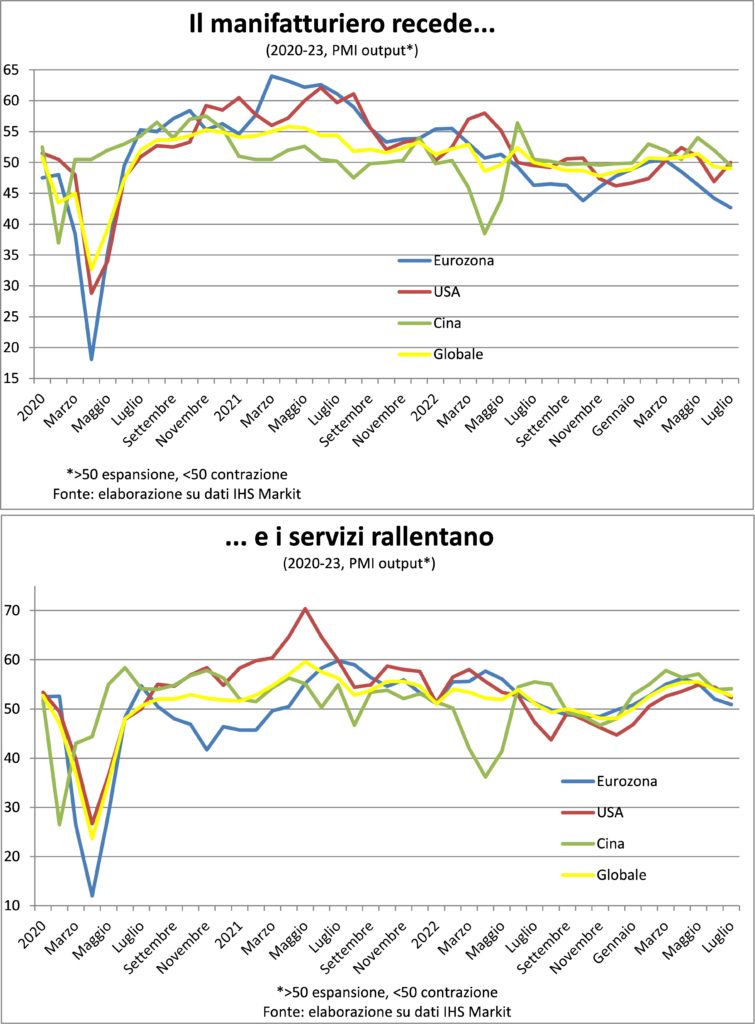
Inventories concern the sectors that produce material goods, which can precisely be accumulated in view of future needs. Mainly the manufacturing. In fact, it is difficult to stock up on theatrical performances, haircuts, train or plane journeys, restaurant lunches or dance parties, teaching hours… I services they are produced and consumed simultaneously, i.e. cooked and eaten. Therefore, the problem concerns the manufacturing sector, i.e. precisely the sector that at this juncture it is contracting and pulling the entire economy towards recession (“tug of war” as the July Hands headlined). And it particularly affects Europe, and below we explain the cause of this.
Because there are stocks in manufacturing proved excessive? For a variety of reasons related to anomalies created by the pandemic. First of all, in the first part of the recovery the question was diverted to artifacts, because social activities, which form a large part of the tertiary sector, were limited by law and fear. At that time, industrial enterprises were unable to fulfill all orders, because they did not have inventories of components and because they were struggling to get hold of them, due to disruptions in global value chains in the face of China's Covid-zero policy and other obstacles. That frustrating scarcity induced, as soon as possible, to increase supplies to cope with the fort request, present and imagined in lasting growth (just-in-case).
This was the first mistake prediction: actually many markets in advanced countries are of replacement (I buy a new kitchen, not a second kitchen) and therefore the boom of the time in demand for durable goods borrowed demand from the future. The second mistake of prediction was thinking that i low rates they would have lasted indefinitely: but the war and the energy shock triggered the rise in inflation that fueled unsatisfied demand for petrol and the central banks could not sit idly by. monetary policies overly accommodating they served to avoid the spiral of deflation and to support expansionary fiscal policies in times of pandemic; they became out of place when the danger spilled over.
With higher rates the cost of the working capital it rises rapidly and it becomes imperative to thin it. There lean production she was born for this. And the just-in-case, which looked like a structural change, is immediately sent to the attic in the changed scenario of normalization of monetary policies and value chains.
Manufacturing industry: after the forecast errors the perfect storm
Therefore, the focus was concentrated on manufacturing perfect storm: final demand down because it was partly borrowed from the boom that started in late 2020-early 2021 and because the rate hike penalizes the purchase of durable goods, financed with credit ((in primis) capital goods); turn of the just-in-case; disposal of excessive stocks which has repercussions on manufacturing itself because they are largely semi-finished goods of industrial origin, like a sort of dog chasing its tail.
Why theEurope is it more penalized than the USA? For at least three reasons. The first is that the pandemic hit both healthcare and the economy much harder here, in the sense that in many cases the restrictive measures taken were higher than those in the USA and the balance in terms of lives lost was not much better (far from the idea of reopen the debate on the efficiency of the restrictions!!!). The second reason is related to the first: thebacklog of travel and social activities and the desire to resume a normal life were much higher in Europe and therefore the anticipated demand for manufactured goods was even higher, so that today the consumption diversion towards the services it is higher; moreover, Europe has the highest density of tourist destinations of the globe and from all over the world travelers have flocked here as soon as possible. The third reason is related to energy shock and splits into two parts: the shock, in fact, was not only the price, but also the Europeans' fear of not having the energy and all the goods energy-intensive.
Il deterioration of the terms of trade in Europe, caused by the increase in the cost of energy raw materials, was much higher than in the USA (where in truth there has been an improvement) and has gradually been transmitted, in the form of higher consumer prices, to the whole system. And the show isn't over yet. This means that European families pay one higher inflationary tax and they have not received aid from their States as copious as that launched by the Stars and Stripes Administration from 2020 onwards. And therefore their consumption is more penalized.
On the other hand, the fear of not having enough energy and goods energy-intensive he had stockpiled for the winter. Which was mild, so that the devil turned out to be less ugly than he was portrayed. So today there is a greater need to decumulate stocks. It rains in the wet.
This reasoning serves as a key to understanding what is happening and that the economic data show. Of course, it is an a posteriori analysis, but a convincing one.
Indeed, the data says that in the USA the tug of war is turning in favor of the tertiary sector, thanks also to the power of the job machine American; which is indeed slowing down, but if 200 additional jobs per month seem few to you…
While in Europe the manufacturing recession the tertiary sector is cooling down, also because the latter too has to deal with the greater loss of purchasing power of households.
Then the question becomes: if inventory cycles are by their nature temporary, how much longer will it last the current situation and for how long will the European economy slow down?
To understand this, we need to look at the dynamics of three indicators, at the same time: production, orders and stock itself. As long as the orders fall more than production, stocks accumulate and must be disposed of, setting in motion a further round of stock reduction, which means fewer orders placed upstream of the supply chains. Thus, to see the end of the inventory cycle, orders must be better (or less worse) than production, so that inventories stop accumulating and perhaps, at some point, need to be replenished. And this is still not the case either at the global manufacturing level or, above all, in that of the Eurozone. Precisely because this cycle is anomalous (as pointed out several times by the Lancette), and the above analysis explains many characteristics and causes of this anomaly, the inventory cycle will last longer than usual.
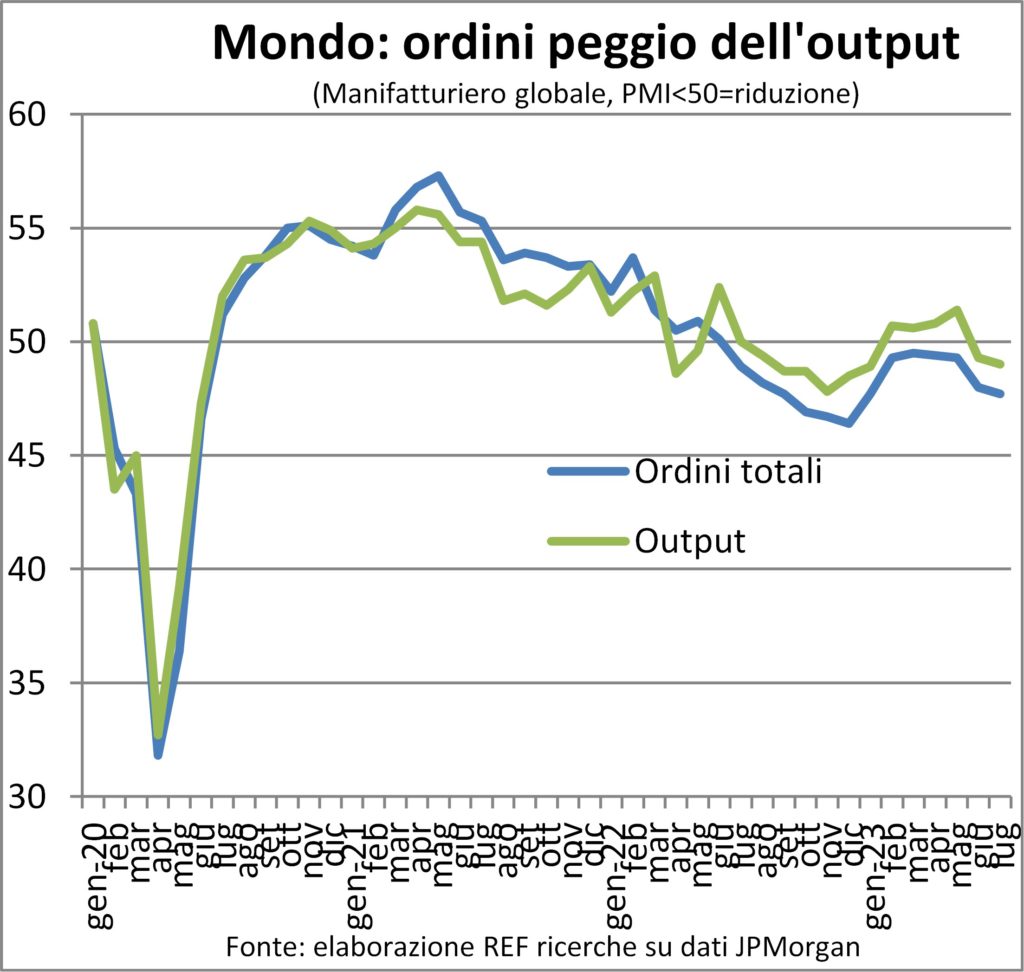
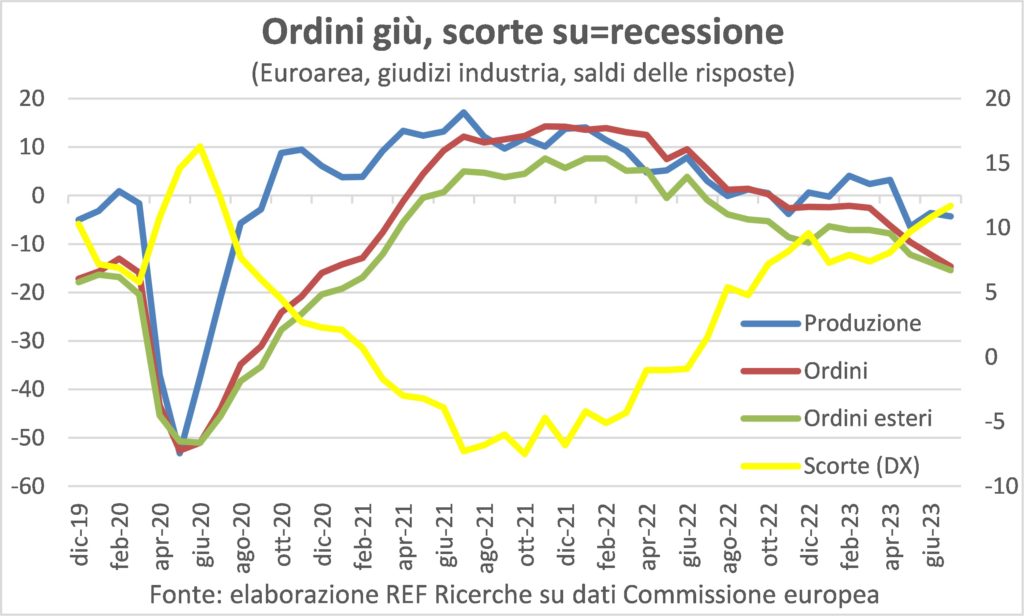
Certainly autumn will bring advice, like the night: when the fuss raised by the boom in travel and social spending settles and demand rebalances, then the latter will return to growth for manufacturing as well. Basically, the advance of purchases is like a hump that is reabsorbed. But it is probable, given the trend of production-orders-stocks that the picture could get even worse, before improving.
INFLATION
When you uncork one bottle of sparkling wine (the word champagne is banned because it is not very self-sufficient) the full power of the gas produced by the second fermentation is released (classic method, Martinotti or ancestral, according to places and tastes). Then, over time the fine perlage it runs out and the wine becomes still.
It's happening the same to inflation, with the lockdowns that capped demand and subsidies to families and yeast businesses, while the end of the pandemic was the sommelier who opened the bottle? Indeed, the price increases are much less bubbly now a year ago. For some reasons. First, because energy prices have fallen a lot, even if they have not returned to pre-pandemic levels. And the upheavals triggered on European gas prices by union unrest in Australia (the flutter of a butterfly in China causes a hurricane in the USA, according to the chaos theory) make it clear how fresh the wound opened by the Russian war on 'Ukraine in the sector of fossil fuels. However, on an annual basis the comparison will remain favorable for a while.
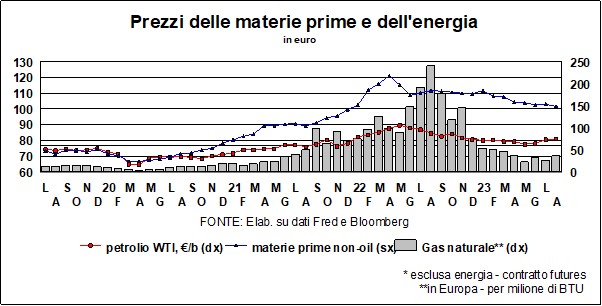
Then there is the rolling and rolling recession in manufacturing, which has recorded the greatest reductions in costs from energy and raw materials (it is commodity-intensive, otherwise it would not be called a "processing industry") and is generously transferring them downstream to support sales (generously up to a certain period, given the profits some have amassed). And to dispose of excess stock as quickly as possible.
Finally, there is the demand calming brought about by rate hikes and budgetary policies that become less expansionary (difficult to measure the quantum, because even the calculation of the structural balance is "polluted" by the strange cycle). The rate hike is a crude method because it mainly hits two sectors: the industry of durable and investment goods; and the buildings.
The alternative would be one budgetary policy that aims to tighten in general, better distributing the load of the adjustment. Let that government that dares, in the city and in the terrestrial world, come forward to propose such a budget.
So it falls to the central banks the thankless task, and also to act as a scapegoat. The art of guiding monetary policy is a dangerous profession, and moreover in unknown terrain: if there were a union of central bankers would seek compensation for strenuous work.
On the other hand, however, the bubbles are made more persistent by the vibrant job market. Employment continues to rise and unemployment to fall. The companies have been burned by the lack of manpower in the past two years and prefer to fill the vacancies. To do this they often have to increase wages, this means higher costs, which in the presence of good demand translates into higher prices. So the inflation carousel takes another round.
The question is in the tertiary, as described above. Which, incidentally, is also the more labor intensive. That is, the cost of labor has a greater impact on the formation of the prices of services. This is why core inflation, made up of ex-energy and food prices, has a harder time coming down. Indeed, the PMI survey shows a far greater spread of input and output price increases in services than seen in manufacturing.
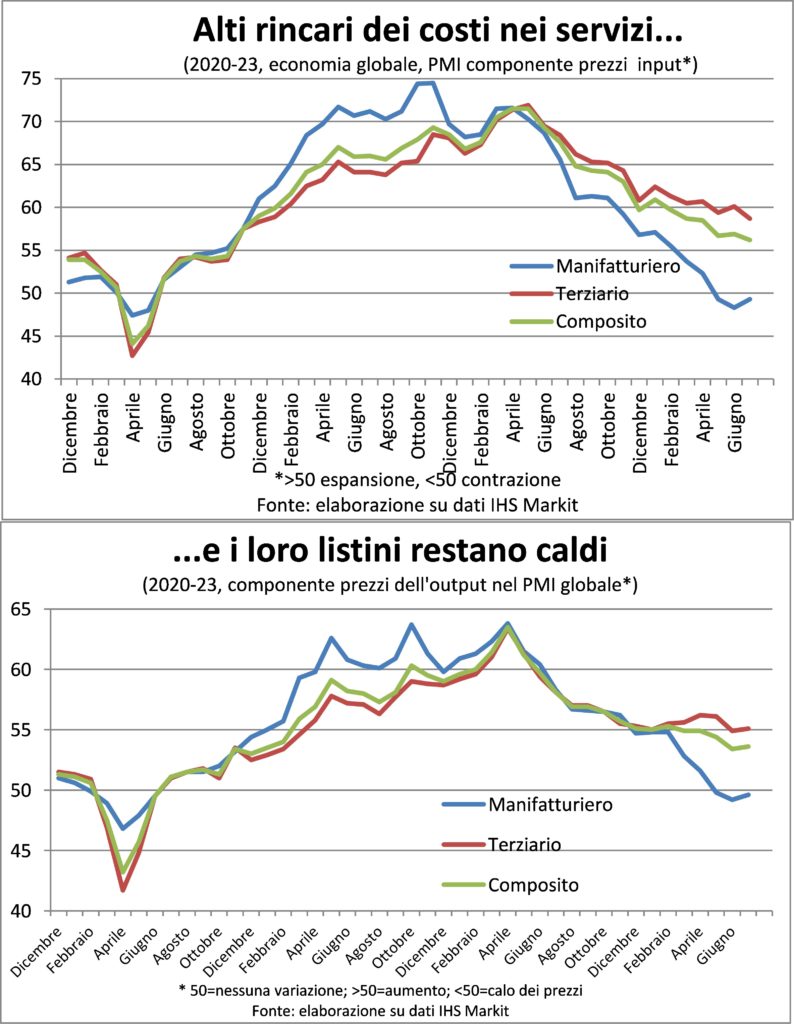
In other words, the drop in inflation up to now has been rapid because it was helped by the reduction in the price of raw materials and the discounts on manufactured goods. From now on it will be more gradual because it will need wage moderation, which is not yet seen either here or across the Atlantic. Or rather, something is observed in the USA, but the variation remains well above pre-pandemic levels.
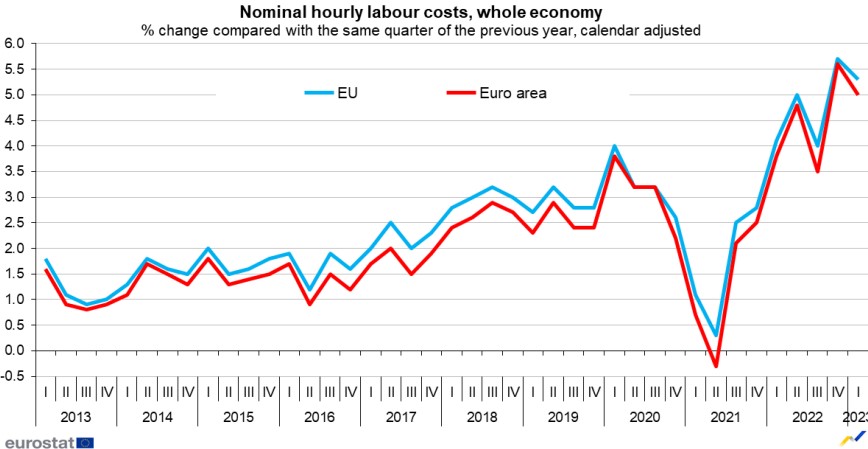
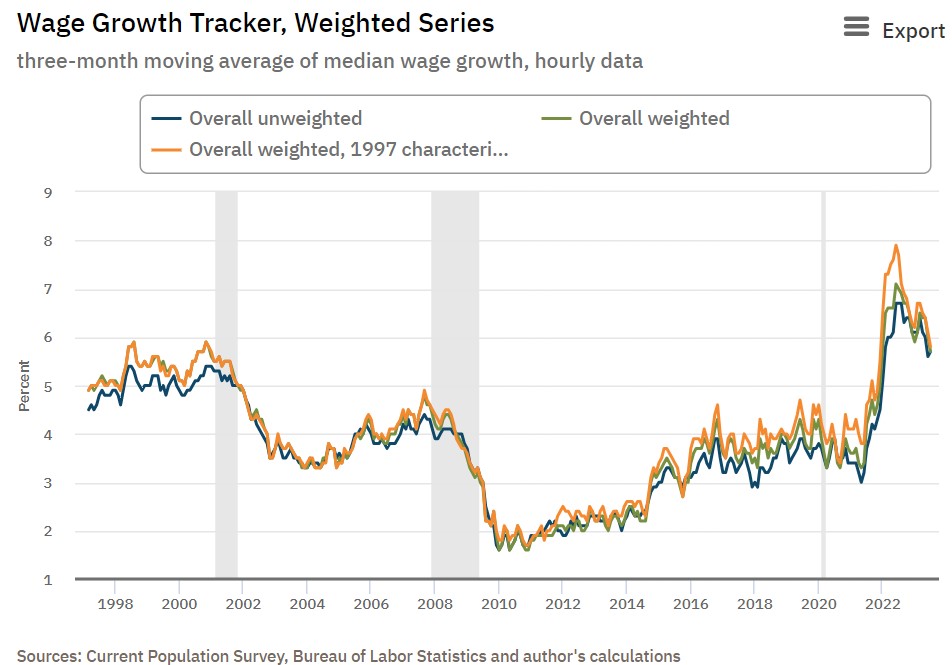
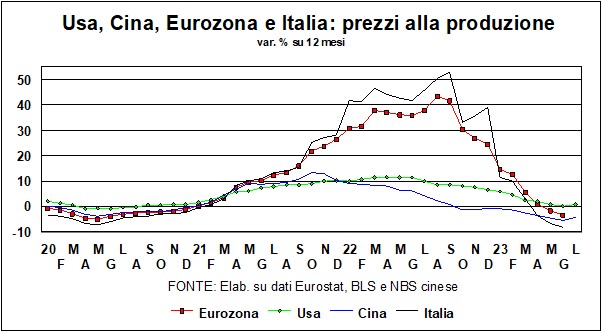
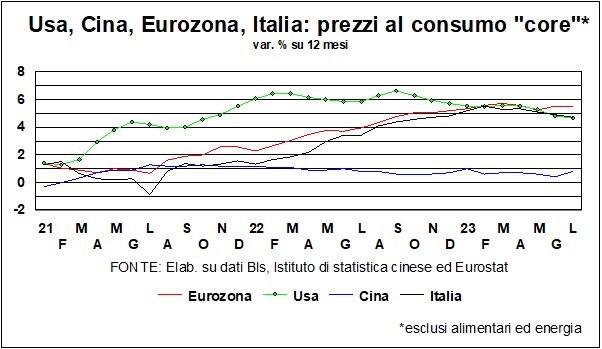
La cynical Phillips curve he says that more unemployment is needed to cool wages, but few dare, even among the most hawkish of central bankers, to declare that they want to pursue a lengthening of the ranks of the unemployed, albeit only as bitter medicine. With the wind blowing, they would risk defenestration, as happened in Prague in 1618 to the Catholic imperial lieutenants by the Protestant Bohemian nobles. It was the fuse that lit the Thirty Years War, one of the bloodiest (being of religion!!!) fought in central Europe: the siege of Magdeburg is its bloody emblem.
Then better wait for it demand moderation mentioned above weakens the demand for workers, so that wage inflation dies down without ideological battles. Calm and chalk, the pool players would say. And in the meantime, let's enjoy the champagne, pardon the sparkling wine!
RATES AND CURRENCIES
Six 'taxi-guide' serve, in fact, to guide the other rates, it can be said that the Fed did a good job: the 'guide' (Federal Funds) is at 5,33%, while, among the 'guided', the first installments in America it is 8,50%, well above inflation (and its real rate is also above the growth rate of the economy).
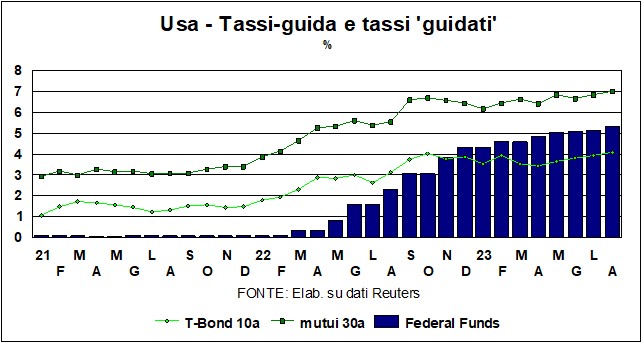
And, as can be seen from the graph, the most popular rate for home loans - the 30-year rate - has exceeded 7%, while, as regards the main borrower - the US Treasury - we are at 4 and something %, above the annualized rate of inflation Use in the last three months (whichever indicator you take). This suggests that the rate hike, which has not stopped (see graph), is close to an end, even if the Fed, perhaps encouraged by the resilience of the economy, lets the possibility of further increases leak ("better to insist on a medicine that has proved to be effective”…).
The same thing can be said about the 'guide rates' of the ECB? Both on both sides of the Atlantic, central banks are scrambling to ensure that from now on their moves will be dictated only by data. A wise posture, this, given that the economy - both here and there - proceeds on a narrow ridge and give a guidance on monetary policy under these conditions of uncertainty it would not be advisable.
However, yes, the same thing can be said – i.e., being close to peak interest rates – also for the ECB, albeit for different reasons than the Fed: for the latter, the reasons lie in the fact that rates have reached a level that is in decidedly restrictive territory (and we must not forget that the sale - or non-renewal - by the Fed of government securities in its portfolio is added every month to the maneuver on rates, which amounts to the destruction of liquidity). For the ECB, however, the reasons lie in the state of the economy who, if not comatose, is certainly less lively than in the United States. The yield on 2-year Bunds – which is very sensitive to ECB rate expectations – was 3,20% at the end of June, and has fallen to 3,02% in recent days. It is true that the Main refinancing rate of the ECB is at 4,25%, still about one point below inflation in the euro area; but the latter is destined to decrease between now and October, when the impact, estimated at half a point on inflation in the Eurozone, of the anomalous surge (over 3 points, month on month) of Italian inflation will disappear, impact linked to the unfortunate Italian procedure (now changed) of tying the energy prices of end users to spot prices, then rapidly rising. And, as in the case of the Fed, we must not forget that another restrictive measure is underway for the ECB, the Qt (quantitative tightening) linked to the reduction of securities held by the Bank.
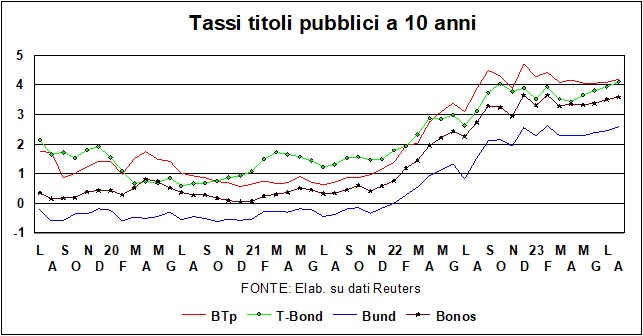
In these difficult times, ours btp he remains calm, judging by the spread, both towards the Bund and towards Bonos. Not even the twisted decision of the Meloni government to tax the excess profits of the banks has been able to dent the confidence of the markets in Italy. Speaking of trust, one more should be mentioned twisted decision, that of Fitch (not followed by Moody's but anticipated by S&P ten years earlier), to remove the Triple A rating from the United States. A decision that doesn't make much sense, and which in fact had no effect on the yields of the T-Bonds (apart from a bad mood that lasted only a couple of days): the only reason that can be shared in Fitch's judgment is that relating to the governance of American public finance, ruled by those absurd public debt limit procedures; events, those to which we have already, in the past, reserved (and poured) numerous invectives.
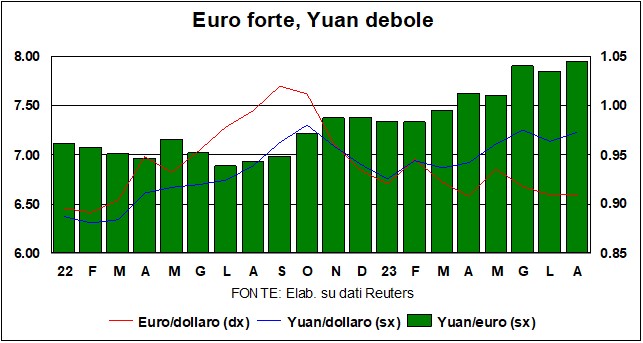
On the foreign exchange market, the dollar it revolves around 1,10 against the euro. The interest rate differential is in favor of the greenback (Elon Musk said i Treasurys short – which yield more than 5% – are a 'no brainer', which in 'American' means that you don't need to be Einstein to understand that they agree). And the growth differential is also in favor of the dollar. And the Big Mac index, which looks at purchasing power parities on the basis of a homogeneous product like the Big Mac? Here too, theeuro appears slightly overrated. In short, the dollar should strengthen, even if initiatives are multiplying in the countries of the 'Global South' (which include, defying geography, China), aimed at depriving the dollar of the advantages of being the main currency for cross-border payments . In the meantime, let's be content with the change of 1,10, which is in any case convenient for European producers.
It is yuan? It continues to be weak, both against the dollar and against the euro. Indeed, with all the problems China has, it is right and convenient, fair and healthy, that it has at least one competitive currency…
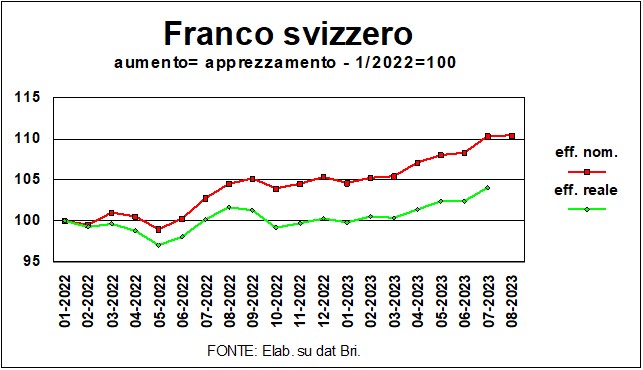
In the rest of the currency markets, it is worth mentioning the Swiss franc: the traditional resilience of the Swiss currency – a bastion of stability – has been confirmed in the last period (see graph, which traces the nominal and real effective exchange rate from the beginning of 2022 to today). The franc has recently partially retraced its rise against the euro and against the dollar. Against the single currency it had reached parity at the beginning of 2023, and has now fallen by around 4%. The strong underlying trend is due to its role as safe haven currencyespecially important since the ill-fated Russian invasion of Ukraine began. And the recent retracement certainly does not mean that the euro and the dollar are 'more safe haven currencies' than the Swiss one: it simply means that the Swiss franc had traded too much (even compared to the other currencies, as can be seen from the fact that there is no trace of retracement in the nominal effective exchange rate against 64 currencies), and it was not necessary to exaggerate: even Switzerland may have a competitiveness problem…
Furthermore, according to a different and authoritative explanation, the movements of the Swiss franc reflect the operations, more or less substantial, of thehedging on long positions in foreign sovereign bonds: when these lose value, i.e. when rates rise, the need for hedging is reduced and therefore there is a repurchase of foreign currencies by the managers of the substantial foreign assets (103% of GDP). Here what matters is not the differential in interest rates, but their level: the higher they are, the lower the value of the investments to be hedged, the lower the sales/higher the repurchases of foreign currencies, and the franc depreciates (Antonio Foglia docet). Now that long-term rates are rising again, the Swiss currency will lose its edge.
Speaking of safe-haven assets, the , as expected, does not hold the 2000 ($/ounce) quota, and every time it tries to exceed it, it is driven back downstream. Central Banks (mainly those of 'rogue countries', such as Russia) had supported the prices (with gold there is no danger of having frozen foreign exchange reserves), and China too is accumulating it. But those purchases can't go on forever, and there are alternative investments that yield more than zero (to which gold's yield is pegged).
Sui stock markets, the famous 'resilience' still rules: both the S&P500 and the EuroStoxx50 and the DAX (and Milan too!) are close to historical highs, which does not seem in line with the uncertainties of various kinds affecting the markets. Here too there is a 'tug of war', between bulls and bears, and it is probable that, in the short term, the stock exchanges will continue to stay on the sidelines. As usual, the caveat it concerns i geo-political risks. In this "flowerbed that makes us so ferocious" those risks are always lurking: the war in the Ukraine tends to spill over into Russian territory as well, and there is the danger of a escalation.