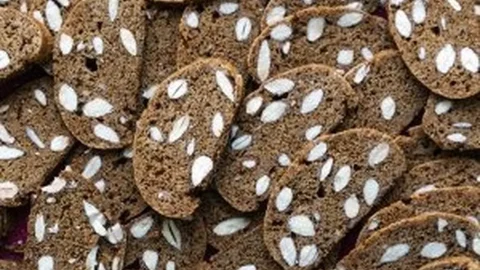
Only eight kilometers divide the two cities of the strait: Villa San Giovanni in Calabria and Messina in Sicily. But both cities maintain the confectionery tradition of particular and tasty dry biscuits with parochial pride: the Piparelle.
But even if they look across the sea every day, each one does them in their own way. Those of Villa San Giovanni, which have been produced for over a century, differ in their thin cut, the quantity of almonds in the mixture, the more sparing use of spices and the absence of some of these (for example pepper, which instead it often appears in the Sicilian recipe).
The name comes from cooking in wood stoves that…smoked like pipes
Theirs curious name derives from the cooking method which once occurred in wood stoves that smoked like pipes.
At Villa San Giovanni it was the brothers Antonio and Paolo Strati, master confectioners from the town on the Strait, who started production at the beginning of the 900th century. In the following years, other pastry chefs, such as Domenico Adamo, Carmelo Ventre, Federico Polistena, Antonio Bellantone and Pietro Greco, began to produce them regularly, preserving over time a confectionery tradition that still characterizes the local community today.
Proud of this tradition and to avoid the industrialization of the production process with the consequent loss of artisanal and traditional characteristics and the use of non-local or low-quality raw materials, the community of pastry chefs of Villa San Giovanni has created a Slow Food Presidium with the aim of making the piparelle tradition known and of developing production regulations that safeguard its Calabrian identity.
The ingredients of the piparelle are simple, but the preparation requires two days and two cooking times.
These are the characteristics of the ingredients: wheat flour grown in Calabria or nationwide, honey from beekeepers from the province of Reggio Calabria, almonds from Calabria, Sicily or Puglia, essential oil of Calabrian orange and obviously the manufacturing technique. But among the objectives there is also a further step forward to improve the production chain, using exclusively regional ingredients.
The ingredients of the piparelle are simple, but the processing requires two days and two cooking times. You need to mix the almonds, sugar, thousand flower or orange honey first. Spices such as cinnamon and cloves are then added, and it is perfumed with orange essential oil and finally wheat flour is added. The mixture is formed into a loaf of approximately 500 grams and baked at a temperature of 180° for 35/40 minutes. The next day we cut the loaf by hand, with a knife, thus obtaining thin slices of four millimetres, a very difficult step, because great skill is required so that the slice remains uniform and does not break due to the fragments of almonds present inside. Finally, the biscuits thus cut are baked again at 65 degrees for 10, 12 hours.
Excellent at the end of the meal as a dessert and accompanied with a glass of a good Passito
The piparelle of Villa San Giovanni they are enjoyed at the end of the meal as dessert and accompanied with a glass of a good Passito. They can also be enjoyed with drinks such as coffee, tea or almond milk.
Beyond the rigorous principles of the Slow Food Presidium, in recent times other innovative types of Piparelle have been found: flavoured, with organic chilli from Calabria, Liquorice from Calabria, Zibibbo from Costa Viola, Bergamot from Reggio Calabria, up to Piparella organic Italian Goji nutraceutical.