
Social security itineraries, the Study Center of which he is president Alberto Brambilla, continues, in his periodic reports, in the meritorious work of thinning out the "dark forest" of myths and commonplaces that conceal the effective function of the pension system (with its welfare corollaries) and which end up fuelling the false narrative which equates the condition of the pensioner with that of the poor, even though it contradicts a mountain of data confirming the fact that poverty is less widespread among the elderly than among young people and minors.
Obviously, even among the elderly and pensioners (the two qualifications do not coincide in all cases) there are conditions of indigence, but the pension/welfare system constitutes, despite its limitations, a shield of civilization.
Benefits and Income: How to Really Interpret Pension Data
The first issue addressed in the XVI Report concerns theinadequacy of the amount of benefitsThe media simplification of the data is expressed, in each publication of the INPS Observatory, in these terms: "In our country almost one in three pensioners earns less than 1.000 euros." A very widespread interpretation, which includes - according to Itinerari previdenziali - some truths but also numerous inaccuracies, both from a technical and communication perspective. For the purposes of correct information on the topic of the adequacy of benefits – as specified by the Centro Studi e Ricerche Itinerari Previdenziali – it is necessary to distinguish between Average pension benefit amount and average pension income per pensioner: the same individual can in fact be the recipient of multiple benefits, so much so that with over 23 million benefits provided, Italy has 16,3 million pensioners.
This is why the pension income figure should be considered the most accurate, although greater emphasis is often inappropriately placed on the average benefit amount, which is obtained by dividing the total value of pension expenditure (€364,132 billion for 2024) by the number of benefits and not by the number of pensioners. According to this latter approach, on average, each Italian pensioner receives 1,411 benefits: specifically, 68,1% of beneficiaries receive one benefit, 24% receive two, 6,7% receive three benefits, and 1,2% receive four or more benefits.
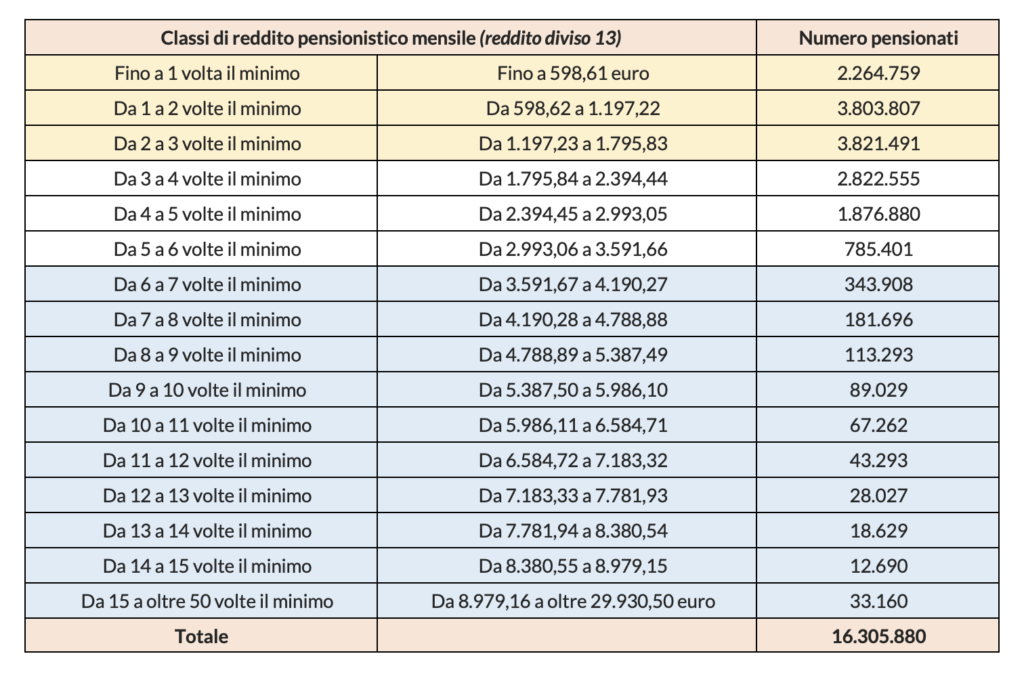
It is therefore certainly true that the individual performances below or at least close to 1.000 euros (for practicality, consider the threshold to be benefits up to twice the Minimum Benefit), are approximately 14,4 million, therefore over 60% of the benefits being paid, but it is equally true that the corresponding pensioners are approximately 6,068 out of 16,305 million (37,2% of the total), moreover almost all recipients of welfare-based benefits, that is, not supported by contributions or supported only in part by contributions. But the Report does not hesitate to deal with another issue embalmed in the list of clichés: the gender gap That is, data on amounts and incomes by gender that would penalize women. Of course, problems exist. With reference to 2024, women – representing 51,4% of all pensioners – received 44,1% of the gross amount paid for all benefits: 160.540 million euros, compared to 203.592 for men.
On the total performance (social security, welfare, and compensation) the annual per capita pension income of female pensioners amounts to 19.140 euros, a value that for male pensioners instead rises to 25.712. The difference is there and is visible to the naked eye. But it is necessary to consider other specific aspectsFirst of all, female pensioners receive a higher number of benefits per capita: an average of 1,5 compared to 1,32 for men. Specifically, women represent 58% of those receiving two pensions, 68,3% of those receiving three pensions, and 68,9% of those receiving four or more pensions.
The real issue: inequalities in the labor market
According to the XIII Report, the gap is then determined by the type of servicesFor example, women predominate in survivor benefits (approximately 85,7%) and benefits provided by "voluntary contributions," which are usually modest in amount due to low contribution levels. However, they more frequently than men benefit from minimum supplements (83,6%), social supplements (62,2%), additional payments, fourteenth-month pay, and other welfare measures covered by general taxation. Therefore, it is correct to state, with a basic division, that female workers receive lower benefits than men according to Itinerari Previdenziali, while clarifying that the Italian social security system does not inherently penalize women. Differences in pension income between genders If anything, they reflect the trend of a labor market that is progressively improving but still characterized, especially in the South, by employment rates, salary levels, and career advancement that are not favorable to female workers.
Indeed, given that for several years now the retirement age has been standardized For both genders, the Italian legal system—the Report points out—still offers women a few modest benefits (from a one-year reduction in contributions for early retirement to discounts for mothers who access their old-age pension through the contributory system). Therefore, the gender gap in the labor market is reflected in the pension system, which is not—as many pretend to believe—a sort of "masked avenger" ready to right all the wrongs suffered during working life.