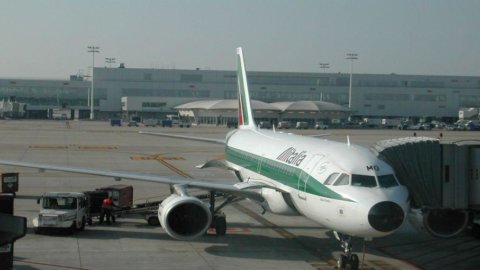
Even if the end of the game has not yet been whistled and even if the finish line has been postponed again by months, it is time to do some reflection on the rumored agreement between Alitalia and Etihad.
Let's also leave out the most remote chapter of the never-ending story of Alitalia (the one, to be clear, which concerns the 2001-2003 with the repeated and fatal union refusals and with the usual unwillingness of the governments of various times to come to terms with the reality of the company, its structure, its market, the underlying national airport system) and we set aside, for convenience of reasoning, also the following chapter even if less recent (that of 2008: the trade union refusal to accept the integration with Air France – Klm, paid for with a lot of hard cash and without a bad company and therefore the launch of the New Alitalia with the famous "brave captains" and with the bill paid by the taxpayers, the merger with Airone and the disastrous Phoenix Plan). Let's concentrate instead on the closest events of Alitalia.
The choice of the company and the Government to give priority the negotiation with Etihad was clear and gave rise to complaints from Air France-KLM, which, after all, had only asked to be able to carry out the same technical checks that Etihad was allowed to do. Why the Arabs yes and Air France-KLM no? This is a first obscure point which, sooner or later, will have to be clarified. But the story does not end here. The solutions that Air France-KLM hypothesized at that time - i.e. before due diligence - were less heavy than those then (apparently) imposed by Etihad on employment and bank creditors (we are talking about over 2.200 redundancies - effective and definitive - and loans to be restructured/repealed for over 550 million euros). So why was Etihad preferred to the Air France-KLM proposals?
The corporate/government choice it may in fact have a financial rationale (Etihad's investment capabilities are, at the moment, superior to the current ones of Air France-Klm, even if the doubts of European airlines are legitimate about the financial independence of the Arab investor from their own government; the concessions that probably will eventually be made by Italian banks will be more generous than those that Air France-Klm could have won, but leaves many perplexed from a strategic and operational point of view for a variety of reasons. Here are which ones:
1) Alitalia, like Air Berlin and Air Serbia and Etihad Regional, will essentially be governed by Abu Dhabi and presumably oriented accordingly from the point of view of the network (flights to Asia via Abu Dhabi?); and this while remaining Alitalia – as is legally necessary – a company at least formally under European control.
2) The consequences of Alitalia's choice on the alliance system both globally (Skyteam) and bilaterally (jv with Air France-Klm) are not clear at the moment and consequently it is not possible to make assessments on the risk that these economic synergies will come to missing or significantly reduced as a result of the alliance with Etihad. This risk could also be significant and for the moment it is not easy to hypothesize to what extent the alliance with the Arabs generates comparable volumes of economic synergies to replace those that may eventually be lacking.
3) The corporate structure of the operation is not yet clear: there has been talk of an operating newco in which Etihad has a 49% stake and the old Alitalia 51%; but, if the reasons are clear (linked to the restructuring of the financial contributions of the old shareholders and the need to preserve Etihad from the so-called past liabilities - i.e. the actual and potential liabilities of various Alitalia disputes - and from the economic results of the current year , which are expected to be heavy), the economic and financial consequences for the shareholders of this corporate reorganisation, including banks, Atlantia, Poste, Air France-KLM and the "residual courageous captains" are not yet clear.
4) The network choices, as it seems to be able to deduce from what has been read, aim to reduce the transport capacity on the b/m radius (-11 A320), in particular on the Fiumicino-Linate route, obviously, but not only on this one, with some long-term enhancements (apparently 3/4 new routes).
5) Economic break-even is expected in 3/4 years. Obviously for the newco!
6) Many limitations on Linate would fall, which would once again receive various European connections. This could result in a further de-multiplication of the hub effect on Malpensa.
7) The role of Fiumicino is growing, which is obviously appreciated by AdR (and its shareholder Atlantia), and perhaps even natural.
In short, there are many unclear, or at least not yet revealed aspects of the Alitalia-Etihad operation. But only one thing is certain: most of the cost of this new restructuring falls on the Italian system, i.e. on the Italian banks and on the shareholders of the current Alitalia. Which – mind you – is natural given how things went. But questions remain about how this system has managed its relationship with Alitalia over time and it is to be hoped that the entire operation will not constitute an advantage for just the new Arab shareholder. But there is another reflection that is necessary: do we want to verify the conveniences pursued, step by step, by Italian workers and their representatives? Very bitter truths would come out of it.