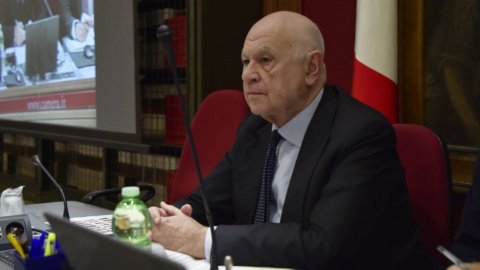
Unappealability of the public prosecutor in the event of acquittal in the first instance for less serious crimes, suppression of abuse of office, limitations on the publication of wiretaps, revision of preventive detention. These are the four cornerstones of justice reform by Carlo Nordio with which the Meloni government intends to give "more guarantees to those under investigation".
The bill amending the penal code and the code of criminal procedure, made up of eight articles, has received the green light from the Council of Ministers and will now have to pass to Parliament and be approved article by article by the Chamber and the Senate. Let's see, in detail, what it provides.
Justice reform: limited appeals in case of acquittal
In case of first degree acquittal, prosecutors will only be able to appeal certain allegations related to serious crimes, such as those against people who cause social alarm or Code Red crimes. However, it cannot be done for crimes of limited gravity. The Ministry of Justice specifies that the stop to the appeal is not "generalized" or "unilateral", but there are many in the ranks of the opposition and in the ANM who see in this rule on the unappealability of the prosecutor, the shadow of that theresays Pecorella launched by the Berlusconi government, sent back to the Chambers by the then President of the Republic, Carlo Azeglio Ciampi and declared in part illegitimate by the Constitutional Court.
Farewell to abuse of office for public administrators
Minister Nordio's justice reform establishes the suppression of the crime of abuse of office, hated by mayors and, in general, by public administrators. The reason for this decision, according to the Government, is easy to say: there are many accusations, convictions are very few. In 2021, as Corriere della Sera points out, only 18 suspects out of 4.745 were convicted. In the context of crimes against the Public Administration, all the other offenses concerning forgery, omissions of official duties, corruption, embezzlement and extortion, and specific aggravating circumstances remain in force. He comes instead revised influence trafficking offenses which will be limited to the most serious cases. The hypothesis of "bragging" is also cancelled, while the minimum penalty it goes up from one year and 6 months to 4 years and 6 months.
The crackdown on interceptions
The bill provides for a series of drestrictions on interceptions which cannot be published even after the deeds have been filed, but only if and when they are cited by the judge in the justification of a provision or used in the trial. Not only that: during the investigations, the prosecutor will have to prevent data relating to "subjects other than the parties" from becoming public and in the context of requests for a precautionary measure or precautionary order, it will not be possible to publish passages containing personal data of third parties, extraneous to the trial, with the exception of an indispensable and complete exposition of the facts. on the matter theOrder of journalists he expressed concern, emphasizing that the right to information must be "guaranteed, particularly on facts of public interest".
Pre-trial detention
The request for pre-trial detention will no longer be evaluated by a monocratic judge, but by a panel of three judges. However, the collegiate body will not be required in the case of house arrest. The three judges will not be able to participate in the subsequent phases of the process to avoid incompatibility profiles. In cases of personal precautionary measures (preventive prison and house arrest in the first place) it comes anticipation of the dispute in all cases in which it is superfluous for the investigative forces that the intervention be "surprise". Then increase i cases of nullity of the precautionary measure, providing for it when, for example, the elements exposed by the suspect during the interrogation were not expressly taken into consideration. The measure will enter effective in two years with the aim of preparing the recruitment of 250 new magistrates through a competition.
(Last update: 10.50 on Friday 16 June).