Thanks to Draghi, human capital has re-entered the discussion on how Europe can bridge the technological delay with USA, China, Japan. At the end of the summer, two studies were published that put numbers alongside the mind-blowing possibilities of generative artificial intelligence (gen AI). The McKinsey Global Institute study estimates the increase in the annual global product generated byGenerative artificial intelligence (IA gen) at 4 trillion dollars per year (for comparison, the Italian annual product is around 2 trillion) These 4 trillion are added to the 11 trillion annual product by more traditional forms of AI/digital.
That's better! Because the impact ofpopulation ageing it is calculated at -8% of global GDP by 2060. And Putin's blackmail on energy has raised inflation and interest rates with the consequent lowering of global growth estimates by both the IMF and the OECD . Furthermore, energy security and the urgency of the transition to renewable sources have costs estimated at 3 trillion dollars per year until 2050. Even to meet these costs, potential product must grow, fiscal measures are not enough for the short term.
The increase in product comes fromincrease in productivity due to the adoption of AI gen by companies, not by work or by physical capital, as recent and past experience teaches us: see below a graph of the components of potential growth in the Euro Area and in the USA which shows how the advantage of growth in the States is due to productivity (total of factors).
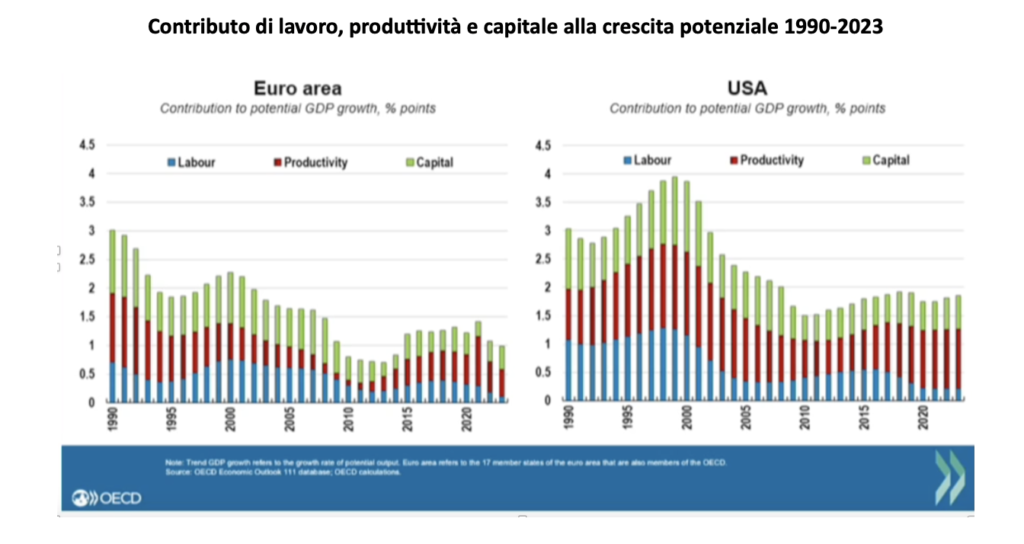
How much is generative AI worth for growth?
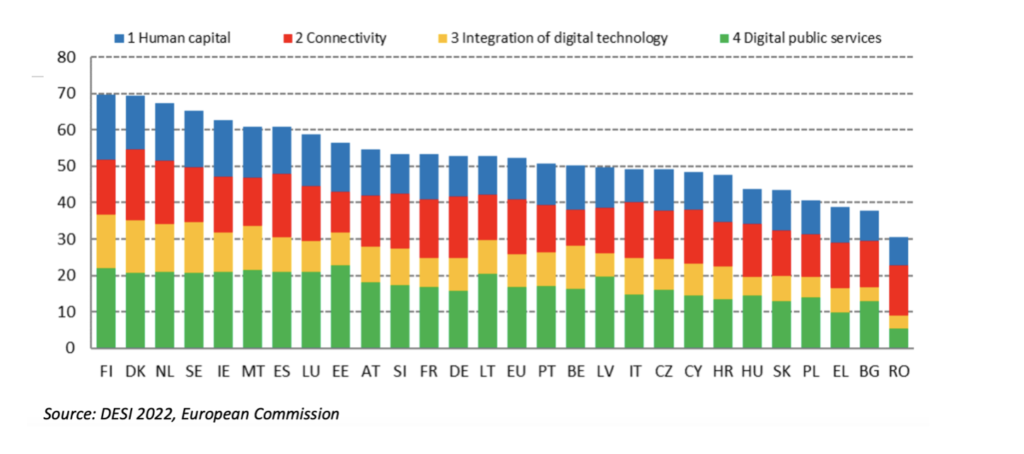
Productivity in turn is due to innovation: the digitalisation of the 90s and its most recent form, AI gen which increases productivity and can therefore finance the climate transition and energy autonomy based on renewable sources, even more urgent since the availability of energy from fossil sources is called into question by the continuous worsening of geopolitical conditions around Europe. But it will not happen immediately: the positive impact of gen AI on growth occurs through its application to production processes which in turn depends on the digital skills of entrepreneurs and workers and the efficiency of institutions to ensure the diffusion of technology throughout the world. 'economy. It is no coincidence that the digital economy is also called the knowledge economy because it is based on human capital. Requires basic digital knowledge of the population, a large number of ITC experts, advanced research in the sector, access for families and businesses to the fastest connection, integration of digital technologies in businesses and digitalisation of the Public Administration, as also required by Europe which in its effort to overcome the disadvantage in compared to the United States - but also China, Japan - monitors the digital economy and society index, reported below with its components:
The impact of generative artificial intelligence on Italy
The second study on AI gen concerns Italy, was presented in September by Ambrosetti-Microsoft Italia and quantifies the impact of AI gen in our country with the highest annual added value equivalent to 18% of GDP, but without specifying a date. In fact, the graph above shows how Italy is well below the EU average for both the digitalisation of human capital and that of businesses, which are enablers of the adoption of gen AI. Yet, since the demographic forecasts are for a loss of 3,7 million workers by 2040 (16 years) one could say "just in time AI!" which is estimated to replace the working hours of 3,2 million people. Companies that have adopted Gen AI have used it for: information retrieval (55%), virtual assistance (48%) and process efficiency (47%). Gen AI can do 70% of an employee's work, freeing their creativity while in the past digital automated routine jobs, harming less trained workers, often women.
Both AI and digital technology from 30 years ago have the ability to permanently increase productivity and consequently living standards by creating new products and well-paid jobs. But let's consider one aspect of AI adoption that is on everyone's minds: Among the most advanced AI companies, cost reduction it is the minor objective with respect to business expansion, while it is one of the two main objectives in all other businesses. Due to its digital lag, cost reduction will be the prevailing goal in our country and will not necessarily be coordinated with retirements in each sector or region. It is therefore necessary to prepare to guarantee the level of well-being to the "losers" of AI.
To reap the estimated benefits on GDP (18% more), the study estimates it is necessary accelerate digitalization of more than 113 thousand small and medium-sized enterprises. To overcome the delay in the digitalisation of human capital, based on interviews with companies, it is necessary to train almost 4 million workers and around 140.000 graduates in ICT sciences with basic digital skills.
Despite the acceleration of digitalization in families and businesses due to the pandemic, our country has half the population under basic digital level (over 80% in the most advanced countries of Northern Europe), the share of digital specialists it is below the European average and the prospects for the future are unpromising given the small number of university students in information and communication technologies. Europe therefore considers it Italy's responsibility to achieve the European digital objectives, given the size of its economy and the allocation of funds from the Relaunch and resilience program (PRR) which prioritizes digital and climate transition.
The EU has asked States to invest at least 25% of the recovery and resilience mechanism in digital. Those who have chosen to invest more than 30% of their device allocation in digital are Austria, Germany, Luxembourg, Ireland and Lithuania, which are already above the EU average for digital. Italy 21%.
Italian industrial policy and the PNRR
We therefore arrive at the most difficult part for Italy: the political choices for the national recovery and resilience plana (PNRR), i.e. the country's industrial policy. Industrial policy, or the role of the state in the real economy - non-monetary and non-fiscal - had dramatic consequences for Italy in the 80s. It led to the “state fiscal crisis” and the Tangentopoli scandal for the overlap of party, current or personal enrichment objectives with economic ones in every public company/bank. Growth reduced in the 80s and stagnated from the mid-90s to 2019 - that is, excluding Covid shocks and counter-shocks.
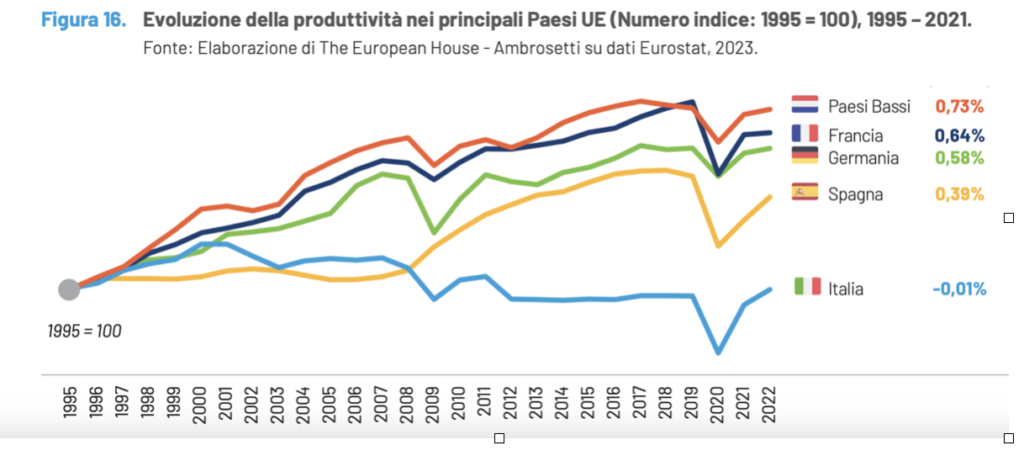
What train did we miss in the 90s? The answer is easy: the diffusion of the new digital technology. Productivity was negative in the first decade of the century due both to the very few large companies, which indicate a lack of innovation, and due to an enormous quantity of low-productivity companies which implies poor selection by the market. Both consequences of the role of the State in the previous twenty years. The tragic legacy of state intervention in the economy is still felt today in the choice of projects and causes those with lower costs or in areas of research and training to be discarded regardless of merit. Even worse in the case of reforms where there is a risk of displeasing more or less important lobbies (lawyers, bureaucrats).
The lack of adequate training of human capital is the biggest obstacle to the use of AI gen as previously to digitalization. Equally important is the institutional context, i.e. the completion of the reforms considered "enabling" of the PNRR: from justice, to competition and public administration. If the objectives of justice reform - with the reduction of trial times by at least 40% - and digitalisation of the PA are not achieved, Italy will not profit from this new technological wave, exactly as in the mid-90s. Foreign investments and the most attractive jobs will stop in the Alps and the brain drain, i.e. young people, will continue.
Conclusions
Il role of the state it was fundamental and irreplaceable everywhere to deal with the pandemic and the energy crisis created by Putin's war. But the resulting increase in debt will make it difficult to repeat the exploit before having reconstituted a buffer, or reduced public debt. Even the state that issues the global currency, the United States, worries about it: lBiden's IRA, today the most envied model of industrial policy, in light of the incentives granted to businesses, families and states for renewable energy, has imposed a minimum tax of 15% on the largest American companies as well as other measures to reduce the prices of expensive medicines on the market for some time.
The two transitions, climate and digital, require heavy expenses for many years, financed above all by private individuals who intend to take advantage of the possibilities of AI gen and direct or indirect investments in renewable energy. The State will have to provide digital infrastructures, institutional and physical. Europe has already launched its digitalisation programs with the Chips Act, the PNRR and other programmes. Italy must focus on the elements enabling digitalisation to increase productivity and therefore potential growth, thus increasing the sustainability of its public debt and respecting the commitment of the PNRR.