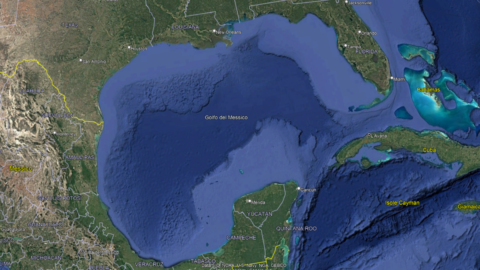
Il Gulf of Mexico is a unique ecosystem and it represents one of the most fascinating and mysterious places on the planet, from a natural, anthropological, historical and narrative point of view. Not to mention strategy and ecology.
The Gulf Impact
The Gulf also has a enormous relevance for distant regions such as theEuropeFrom its depths a flow of hot water originates which positively influences climatic conditions of north-western Europe. Exactly in the Gulf area, 66 million years ago, a devastating Armageddon occurred: on the ocean floor lies the Chicxulub crater, a 180 km depression caused by the asteroid that led to theextinction of the dinosaursThe astral impact triggered a global winter, a cataclysm that inspired works of fiction such as the film “The Day After Tomorrow” (2008), where an imaginary icy current coming from the Gulf triggers an ice age.
The Gulf of Mexico has been back in the news a lot these days, but not in terms of the planet's natural history, climate change, archaeology, or entertainment. It's back to speak for reasons, apparently futile, but in reality symbolic of a geopolitics which has regained the center of the world public debate through actions of power and culture of war. One of the emblems of hegemony and power is precisely the toponymy which is a powerful tool for telling stories of conquest, identity and cultural change. It is an eloquent narrator of memory and prestige.
Maritime denominations
The world intergovernmental organization responsible for hydrography has not yet established an international agreement to define specific naming protocols of global maritime areas. Every government national can adopt different toponyms. To obtain international recognition, a new name, however, requires acceptance by the competent bodies and other countries.
The US executive order that renames the Gulf of Mexico to the “Gulf of America” has legal value exclusively within the United States, appearing as a unilateral act. The change of name would make sense and have legitimacy if the United States could have a majority portion of the Gulf calculated in terms of territorial waters and exclusive economic zone (Zee).
In reality, the United States controls 33% of the total surface area of the Gulf, while Mexico It has territorial waters and an exclusive economic zone that extends over almost half of the entire area (47%).
The origin of the name
Spanish explorers of the 16th century coined the term “Gulf of Mexico” to identify the large inlet that laps the coasts of present-day Mexico, the United States and Cuba, defining an important geographical-maritime space.
Le first european maps bearing “Golfo de México” date back to the mid-sixteenth century. The name México derives from the Aztec capital Mexico-Tenochtitlán, conquered by the Spanish in 1521 and center of the Viceroyalty of New Spain.
According to a map of 1607, shown by the Mexican president claudia sheinbaum, the current territory of the United States was referred to as “América Méxicana”.
The President, a lady with a degree in physics and very determined, suggested, with a hint of irony, the suggestive hypothesis of giving rather a new name to the nation born on July 4, 1776: “Mexican America”.
Precedents and disputed toponyms
In 2015, Obama used executive power for rename a mountain in alaska, replacing “McKinley” with “Denali,” an Athabascan term that symbolizes indigenous history and recognition of native cultures.
An intervention with an inclusive and historically restorative meaning, which new administration announced that he will revoke restoring “Mount McKinley”. McKinley was the President who promoted the development of the region.
The naming of the Gulf of Mexico it's not the only dispute. Arab countries such as Saudi Arabia and the Emirates prefer “Arabian Gulf” to “Persian Gulf,” a toponym they believe better reflects the geography of the region. The basin between Brunei, China, Malaysia, the Philippines, Taiwan, and Vietnam is referred to by various names: China calls it the South China Sea, Vietnam the East Sea, and the Philippines the West Philippine Sea.
In both cases, the nominalist dispute reflects complex implications and geopolitical conflicts, being decisive strategic areas in contemporary international balances.
They are 5 centuries that the Gulf of Mexico bears this name. Historical revisionism is certainly acceptable, but it must have a historical or interpretative sense. It cannot be an act of mere will to power.