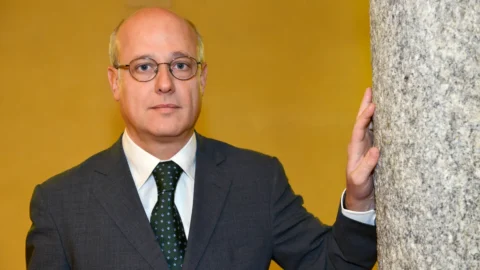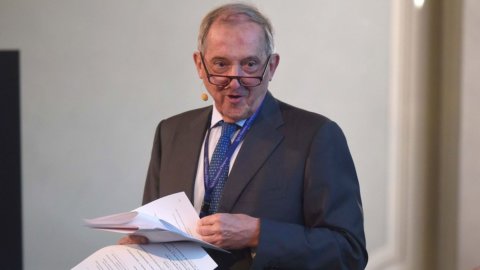
Andrea Gilardoni, professor at Bocconi and founder and promoter of the Observatory on the Costs of Not doing public works, has been calling for years for a turning point for infrastructure and public works with the power of numbers, based on the scientific application of cost-benefit analysis . Which may not be the gospel but is still a crucial point of reference. Above all because it has been useful to clarify an essential point: doing public works costs (and sometimes too much), but not doing them costs even more. If the Government of today and tomorrow renounce to build the infrastructures already foreseen by the laws and by national and European standards, the cost for Italy would be abnormal: 530 billion euros between now and 2035. Of course, the cost-benefit analysis does not explain everything but, as Gilardoni says in the interview with FIRSTonline, of which he has also been a shareholder since birth, cannot become a convenient screen for the political forces that have to put their face on the infrastructure and fully assume their responsibilities. And it will be interesting, after the controversy of recent days on Tav and Tap, to see what the political forces will say at the conference that Gilardoni's Observatory has organized on these issues at the political resumption in Rome, on 12 September, right in front of the Chamber of Deputies .
Professor Gilardoni, last spring your Observatory on the Costs of Not doing quantified the cost that Italy would have to bear between now and 530 if the public works already planned and already provided for by current laws were not carried out at 2035 billion euros: Can you explain how such an abnormal sum was calculated?
“We have been working on these issues for almost three decades. The idea is simple but certainly strong: if an infrastructure project net of costs is destined to create well-being and wealth, not doing so generates an opportunity cost for the community, a sort of hidden tax. The Cost of Not Doing aims to estimate how much wealth would be lost if nothing was done in the next 16 years. Fortunately, we build some infrastructure… Over the past 15 years we have developed a method based on the Cost-Benefit Analysis (CBA) which we have applied to a series of infrastructures in the energy sector (electricity, gas, renewables, etc. ), of soft and non-soft mobility (roads, motorways, railways, etc.), in the ultra-broadband, of the water service. Cost-Benefit Analysis is fashionable today, but I think it should be given due weight. Suffice it to say that there is not a single CBA value that is 100% certain: all prospective data, subject to uncertainty, assumptions, subjective estimates. But we'll talk about it annual meeting of the Observatory in Sala Capranichetta in Rome on 12 September”.
What does he mean exactly? Shall we throw the Cost-Benefit Analysis overboard right now, even when the Grillo Minister of Infrastructure Toninelli invokes as an absolute reference to decisions?
“Look, for us the Cost-Benefit Analysis, since unsuspected times, has been a central and essential element. It helps a lot, but you have to do it well and independently. It helps to focus on the impacts, to hypothesize the economic and social but also environmental relevance of the work, it also serves in the decision-making process to modify the infrastructure so that it better responds to the requests. But the decision in the end is always political and here politicians must not hold back".
In recent days the Five Stars have questioned all the main public works projects, from the Tav to the Tap and from the Pedemontana to the Terzo Valico Valico: if these projects, many of which are in an advanced state of construction, were to be interrupted, what would be the economic cost and financial for our country?
“Director, don't involve me in a rather lunatic debate where numbers have often been thrown at random, quoting old, uncontextualized Cost-Benefit Analyzes, often made by those who also have other interests!! Each situation has its own peculiarities and cannot be generalized. The works must be framed in a context of country-strategy which is the real point to consider. With regard to the economic and financial costs, interrupting work that has begun is usually very expensive, as investments made and not used, lost opportunities for economic and social (but often also environmental) development add up, multiple cancellations of funding and also fines and compensation for damages. In short, it is quick to reach the tens of billions of costs. But I don't think the Five Stars are crazy enough to really want to abandon the works under discussion; perhaps they want to look at them in depth and one cannot blame them completely on this…”.
[smiling_video id="61303″]
[/smiling_video]
The objections raised by the opponents of the major public works concern the costs of making and the fact that, especially in the railways, the costs in Italy are on average three times higher than in other European countries: how can this anomaly be explained? Blame the orography or the widespread corruption?
“Orography, historical artifacts and corruption – we also saw it recently in Rome with Metro C – play a central role in increasing costs (and times). But also the compensatory charges to the administrations and to the populations "damaged" by the infrastructure also have a relief of 10-15% of the cost of the work. In addition, a certain tendency to megalomania and to choose the most expensive solutions (perhaps also because they are safer); which obviously does not displease the construction companies. In this sense we must continue the search for sobriety, which is possible today also thanks to cheaper technologies; in some cases the cost of the infrastructure has been reduced by 50% or even more. For example, the State Railways have done a job in this sense that will lead to savings of billions, but this is just one example among many. As regards corruption, it can certainly explain certain strong increases in costs: it is the mechanism of variations during construction which determines the possibility of charging additional charges. Here the solution is to spend more in the design phase of the work and then outsource it without the possibility of variants, ie turnkey. But woe to stop everything by criminalizing the sector and introducing snares and snares that impede development. Today we know how it is possible to reduce costs, also aware that otherwise the work will not be done”.
In just 8 years the high-speed line is already saturated and so it happened, in a few years, also for the Autostrada del Sole…
“Here, these are two cases in which the impact of the infrastructures, overall highly positive, had not been foreseen by everyone, and many were the detractors of the too costly, useless initiatives. The political will prevailed. But I have before my eyes the recent case of Brebemi which seemed to be a total failure (or perhaps someone wanted to have it believed) and which today is already one of the first Italian motorways with extraordinarily important effects on local, regional and even national mobility. But also on employment (think of the important global companies that locate their activities thanks to the work) and on the environment. In short, it is difficult to predict dynamics that develop over decades (such are the uses of these works) strongly conditioned by unpredictable events. This is why the political-strategic vision for major works must be dominant, certainly accompanied by credible Cost-Benefit Analysis".
Beyond the costs, what effects would the stop of the TAV and that of the Tap have on Italy and on the modernization of the country?
“TAV and TAP are two completely different things. Giving up the TAV would mean less integration into the European rail logistics system with the risk of partial marginalization of Italy; with regard to TAP, the renunciation would be equivalent to one less source of gas supply, the relevance of which, however, could be debated”.
What repercussions does the construction of the planned infrastructure have on economic growth and employment development?
“Not necessarily huge repercussions, even if it would be serious to block them. But the infrastructure theme is not limited to large projects; on the contrary, there are hundreds of minor or small projects, more easily achievable, with overall very significant impacts also on the local employment level. Then there is the issue of modernizing dated but still fundamental infrastructures (gas networks, water networks, etc.). And then, again, the new technologies that are destined to have extraordinary impacts in the short term: the internet of things, self-driving cars, highways dedicated to these vehicles, smart cities, smart grids, and I could go on. This debate on major works therefore seems to me to be a bit outdated and I would prefer it to focus on the true future of infrastructures. Which we will do in the seminar on 12 September”.
As we also saw on the occasion of the rejection of the Rome Olympics, there is a part of the country that does not want public works and a political force (the Five Stars) that interprets and takes charge of this orientation of fear: what can be done to broaden the sharing of new infrastructures and to replace prejudices with clear, transparent and rational decisions?
“By now we know well how an infrastructure project should be managed. What are the implementation conditions, how can people and public administrations be involved, what are the critical phases, how can they be financed. And we also know well that it is the quality of the political-administrative system that underlies the achievements. The interests involved are always many and delicate to manage; but alongside opposition stakeholders, there are many who are in favor and who often form a silent majority”.