Italy is the country of "wars by mistake": the latest certainly concerns the all-out controversy on the issue of general strike (or just colonel?) proclaimed for the November 17 da CGIL e Uil. A few words on the reasons for abstention from work against the 2024 budget law. In my opinion this is such a meager measure that it would not deserve the honor of a general strike, but a (general) minute of silence at 12pm on the fateful day would be enough (but how do you go on strike on Friday the 17th?). But now the general strike has become a matter of routine, almost a necessary fulfillment during the budget session.
General strike, the abuse of unions is an assist to the Government
The process of the law must respect deadlines for presentation, comparisons at European level, approval by 31 December in order not to enter into provisional operation. During this process, a general strike usually takes place which must be carried out before the truce period for the Christmas and New Year holidays begins. Governments expect it, I would almost say they demand it, because a general abstention from work becomes an additional credential to be subjected to rating agencies. Of course you shouldn't exaggerate. Otherwise the abuse of the general strike it becomes like the repeated beatings of poor Delia for trivial reasons. In Paola Cortellesi's film “There's Still Tomorrow” – her first directorial work – there is a scene that is suited to next Friday's strike. Ivano's invalid father, Delia's (the protagonist) violent husband, scolds his son for constantly beating his wife. Instead, he suggests that he beat her, even harshly, every now and then like he did with her mother. Otherwise - this is the moral - Delia gets used to the beatings and doesn't notice it anymore. But let's retrace the stages that led to controversy and the precept and the challenge between Landini and Salvini, starting from the observations of the Guarantor Authority.
Transport strike: always and (almost) on Fridays
Is Friday's strike a general or inter-sectoral strike? Each of these types of abstention from work in essential public services must comply with some specific rules, which for certain sectors – such as transport – are more rigorous. Then in local transport one cannot fail to notice the almost weekly frequency of "Black Fridays". Once upon a time we didn't eat meat on Fridays; today we go on foot. For the Guarantor, Friday's strike is not expected to be a general one, so each category is subject to what the law, practice and jurisprudence on the matter provide in its case. In fact, it would be enough to read the program of the protests that begin on November 17th and end on December 1st.
The program of the five days of strikes by CGIL and IIL
On Friday 17 November, workers from the Central Regions will abstain for 8 hours. On the same day, throughout the national territory, the categories of transport (prescribed by Salvini), public employment and knowledge will be absent from work. The November 20 it will be up to Sicilia; the turn of the Sardinia he'll come on Monday November 27. Friday November 24, the workers will be called to strike Northern regions. Friday 1 December the workers of the Southern Regions will be crossing their arms. These quadrilles between territories and categories are questionable forms of struggle, adopted, as mediation between CGIL and Uil, which will create a week of chaos. Paola Bellocchi, labor law expert and new president of the Guarantor Authority, urgently convened in the Labor Commission of the Chamber, listed the reasons that led to the invitation "to reformulate the strike proclamation in accordance with the law and the regulations of the sectors".
The Strike Guarantor confirms: “It is not general”
“As it has always been interpreted and applied – explained the prof. Bellocchi – the general strike concerns the generality of the public and private work categories, the proclamation must be open. In this case the proclamation was closed because it contained a list of excluded sectors in which the fight against the government's economic maneuver was carried out by regional trade federations". “In each region – continued the president of the Guarantee Commission on strikes in essential public services – the fight against the government's economic maneuver will be made with two strike sections, one on the 17th which includes all public work and some private categories. The remaining categories that had been excluded from the proclamation of the 17th then organized themselves independently, we have 20 proclamations of regional strikes in a series of dates. From an interpretative point of view, it seemed to us that the conditions for a general strike were not met in such a structured proclamation."
“The general strike consists of category strikes; everyone must apply the own rules of the sector in terms of notice, maximum duration of the first action, rarefaction and prohibition of concomitance. Law 146 does not mention the general strike, so – he continued – to allow and facilitate its exercise, the Guarantee Commission adopted an interpretative resolution in 2003”. It had never happened before that "articulated" general strikes were held, defined by Bellocchi as "card strikes".
Salvini's own goal
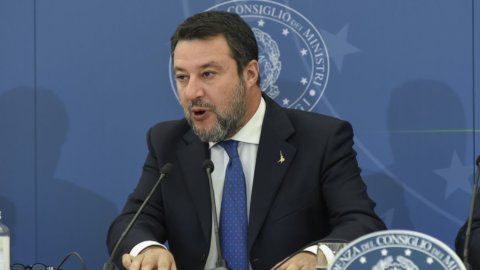
Maurizio Landini reacted on its own: the Guarantor Authority was influenced by the government. Thus the technical-legal controversy has landed in politics and precisely on the table of Matteo Salvini, who couldn't wait to play the part of the "bad sheriff" and use the weapon of injunction with the same arrogance with which he blocked NGO ships loaded with migrants from accessing the ports. Due to the way he managed relations with CGIL and UIL, the trade unions promoting workers' abstention, he managed to transform a strike without rhyme or reason in an action in defense of a fundamental right of a democracy and to make trade union leaders who squander the role and meaning of the general strike, freedom fighters who refuse to submit to the diktats of an authoritarian government.
The goal of Landini and Salvini
As if that wasn't enough, the Captain's line of conduct has provided the Democratic Party on a silver platter with a topic of controversy against the right-wing coalition which is equally part of the propaganda which he does best Elly Schlein: Meloni and its government continue to nurture the authoritarian vocation of their origins. And what is the first operation that a right/right majority does if not to go into conflict with the union, which is suddenly re-evaluated, on the left, as a cornerstone of democracy. One would almost suspect that there is a tacit understanding in place between Landini and Salvini for a common objective: to create chaos in order to present himself to the country, the former, as the leader of a true left; the second of a right with the attributes. If this were not the case, Salvini would have let the Guarantor act, without interfering with questionable jokes and considerations.
Unicuique suum: “to each his own”
For their part, the unions would have followed the institutional path: adapting to the Guarantor's directives as many other times or presenting appeal to the Tar. But they needed to give in to violence, with the noble intention of safeguarding the workers. As Landini explained in the press conference: "Since we are responsible, we have to deal with the innovation that has occurred, which poses a difficulty: if we only had the findings of the Guarantee Commission, the sanctions would have concerned the organizations calling for the strike, i.e. the CGIL and Uil. With the injunction an additional fact is introduced: workers who decide to maintain the strike are put at risk, placing them in front of economic and criminal sanctions. So we take note of the choice, the strike in the transport sector on Friday will be from 9am to 13pm." Unique sum.