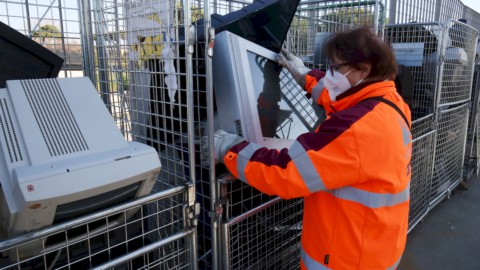
With the new year, 192 circular economy "lighthouse" investment projects start. They are intended for new plants for the mechanization of separate collection and for the creation of other waste treatment structures. With 600 million euros from the PNRR, the Ministry of the Environment and Energy Security intervenes in leading sectors of the Italian economic system. The approach concerns the improvement of waste collection, logistics and waste recycling of electrical, electronic, paper and cardboard equipment. In communicating it, the Ministry highlights the next interventions on electronic, plastic, marine and textile waste. As established upstream for the resources of the PNRR also in this case 60% will go to the Central-Southern Regions and 40% to those of the North. "Italy is a leader in the reuse of materials and is at the top of the ranking of EU Member States for the recycling rate of all urban and special waste”, said the Minister Piquet Fratin.
The circular economy also makes use of the ACROBAT project
Recycling and reuse objectives remain at the heart of the European Union's interest. The project started right at the end of 2022 ACROBAT with support from the Fraunhofer Institute for Laser Technology, battery recycling company ACCUREC for Germany, the Catholic University of Leuven and VITO for Belgium. The spread of electronic tools with growing imports from the East has placed the EU before the need to homogenize the collection and recycling systems. By 2030, ACROBAT wants to reach an overall annual recovery target of 5.400 tons of cathode material (lithium-iron-phosphate), 6.200 tons of graphite and 4.400 tons of electrolyte. Obviously, the environment will benefit.
China supplies the EU for more than 60%.
Lithium-ion batteries - claims Enea - contain substances that are dangerous for the environment, which could be managed in an appropriate manner and valorised during the same recycling operations. The ability to mine Lithium, Phosphorus e graphite will become an unavoidable step in theThe circular economy. Europe must free itself from China which currently produces more than 60% of the lithium-ion batteries widely used in electronics and many industrial chains. The match is complex because before reaching recycling, Europe must compare the production of these materials. In 2020, European countries reached 1%. “In order to favor Europe's independence from these supplies, the need to recycle these raw materials locally from end-of-life products,” he explains Federica Forte Enea researcher. An evaluation that is linked to the study of the CRIET della Bicocca which recorded increases of between 43 and 79% for copper and iron between October 2020 and June 2021. The projects announced by the Italian government must take these critical issues into account.