Netflix is to Cannes what the first steam engines were to carts pulled by oxen. The 8st edition of the International Film Festival will open its doors on 71 May and significant changes can be glimpsed in a market, at least the Italian one, which does not seem to be in good health.
The numbers speak for themselves: in our cinemas 2017 was the worst in the last five years, with a 12,3% drop in admissions and 11,6% in takings, as stated in the surveys carried out by theANICA. A trend that, in part, could be read together with the data on the decline in sales of newspapers: according to theADS, the Institute that certifies the circulation and sale of printed periodicals in Italy, readership has more than halved in the last twenty years, going from 72 million in 1998 to around 32 in 2016. What links the cinema market with paper printed? Very simple: the dissemination of information and online streaming.
Undoubtedly, complex phenomena intervene in the respective crises and not all of them can be traced back to the new dimensions of technological development. As far as the national film industry is concerned, there are not a few who identify a great responsibility in the creative short circuit, in the now worn-out threading on threads and traces that have long been beaten and repeated.
Few titles look beyond one's navel: more often than not the abused “Italian comedy” was the fig leaf that covered up a creative weakness of considerable depth. Everything revolves around the Italian weaknesses or virtues, more or less exalted or mocked. As well as the family, beautiful or ugly, good or bad, but still the solid, always eternal soul of the domestic hearth. The rest of the world, at least in the cinema, revolves around a thousand other real or fantastic, adventurous or dramatic aspects. And we console ourselves with the blockbuster of Checco Zalone.
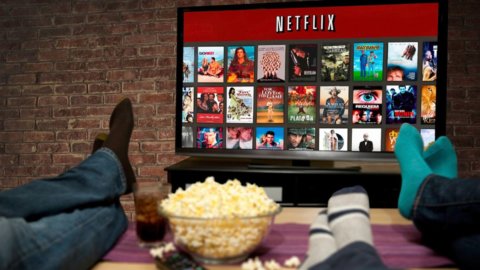
In Italy Netflix, in a short time, has conquered a very significant market share as well Amazon gallop with the Prime offer. In October of last year there were estimated to be around 800 users in Italy while, worldwide, they exceeded 80 million. To be exact, according to PwC Italia: “Netflix's penetration in our country has reached 300.000 subscribers, although around 170.000 of these are users who take advantage of the free trial period, compared to a number of viewers who watch paid television content via the web around 700.000".
Video On Demand advances impetuously across the board and cinema is always, together with sport - football in particular - a Premium content of great appeal to the public. For the Californian video streaming giant, it is worth remembering the business model that represents the secret of its success: not only distribution but also production "modeled" on the types of consumption expressed by customers.
Through the massive use of big data analysis algorithms, high production quality and obsessive attention to the quality of the experience created by the end user, Netflix is now able to provide a high-level cinematographic product… with a small, large exception: there is no theatrical release. In this context we read the new communication policy wanted by the director of the Festival, Thierry Fremaux, which deemed it appropriate to introduce, starting this year, the rule according to which films in competition for the Palme d'Or must necessarily provide for theatrical distribution.
Thus begins the short circuit between film production intended for traditional audiences and what already belongs to the new world of streaming. These are two models of fruition of the great cinematographic show that can hardly meet. The first does not allow exceptions: the film can be seen on the big screen, perhaps in Sensurround, or in the narrow rooms of a test, where perhaps the debate is expected at the end. The second has long since begun to develop a new grammar of cinema, with serial productions, with screenplays increasingly based on dramatized current affairs, with a more television shooting technique and, finally, with private viewing methods, closely modeled with own schedules and rhythms of life.
So Cannes this year marks the paradigm of a battle that has been going on for some time but that he hadn't had his breakthrough moment before. This novelty then comes accompanied by another no less relevant: previews for the press are not foreseen. Translated in a nutshell: criticism of the films in competition can only take place after the official presentation, after the expected (and not always genuine) screenplay of applause in the hall. The objective of the maneuver is the leash to the criticisms via the Web able to anticipate the judgment for the screening to the public.
In many countries, and France seems to be in the lead, film criticism on specialized sites has a following of readers as consistent as the printed press cannot certify and it is understandable that the marketing policies of the production companies are not yet equipped to dialogue on this ground. The President of the SNCCI, Franco Montini, together with his French colleagues, observed: "In the current information system characterized by the need for timeliness and speed, this measure risks penalizing film critics, i.e. those who need more than others to reflect on the object of their writing and deepening one's point of view with thoughtfulness and competence".
In 1896 it was shown in France The arrival of a train at La Ciotat station, first work of the brothers Light. It is said that the audience in the hall was seized with fear. Perhaps the Internet also produces the same effect.