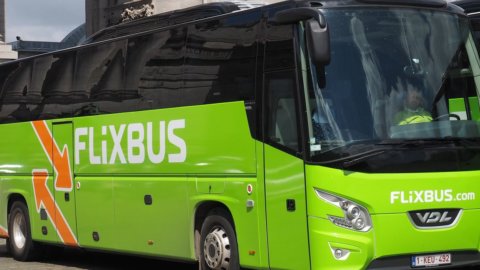
Someone calls her the Uber of buses, even if it's not really sharing economy the one proposed by the Flixbus app, as much as a service low cost of passenger transport between the most important Italian cities (it obtained 70 authorizations from the Ministry of Transport less than a year ago), at more competitive prices and with a standard of comfort comparable to that of a high-speed train, complete with free wifi on board. A Milan-Rome for example, the classic route which now takes less than 3 hours by train but with costs of tens of euros (about 90 one way, if bought at full price), can be offered for a few euros, even with only 1 euros depending on the days and offers.
Furthermore, the journey it's not at all that much more uncomfortable: certainly it is much longer than that of a high-speed train, but between the cities not yet connected by the Arrows the time difference is minimal. Just take the example of a Rome-Genoa journey: the Frecciabianca or the Intercity take no less than 5 and a half hours, just under the 6,5/7 hours required by bus.
The business of the startup born in Germany, which in the meantime has also engulfed the rival Megabus of the English giant StageCoach, could therefore decree the end above all of the railway networks not covered by very high speed, therefore the Intercity. But this trend does not convince everyone: in fact, a very harsh outcry has already started from Anav, the association of passenger transport companies belonging to Confindustria. President Giuseppe Vinella claims that Flixbus is dumping, or market below cost, offloading all the business risks on partner companies (in fact the company does not own the vehicles nor does it directly hire the drivers and staff).
The latter are kept alive by this application, but at the same time they have no negotiating power in determining prices: the choices are made in the headquarters in Munich. There is also concern on the part of the railway companies, namely FS and Italo: the former has a subsidiary called Busitalia, through which it could launch its own low-cost service to compete with Flixbus, while Ntv is experimenting with intermodality train-bus with a single integrated ticket. The experiment starts with the Reggio Emilia station (the one designed by the archistar Santiago Calatrava and covered by the high-speed train on the Rome-Milan axis): from there you can then reach Cremona, Mantua, Modena, Parma and Carpi by bus.