I 20 months of the Italian Social Republic of Salò they were a sort of continuation of the Spanish Civil War outside the borders of the Iberian Peninsula. The same irreducible opposition between the parties, the same yearning for the annihilation of the adversary, unfortunately the atrocities are similar. It is not that Italy has reached the peaks of cruelty of the Spanish experience. Without necessarily having to put the two parties on the same level, even in Italy there have been vengeful murders, summary executions, roundups of civilians, looting and even torture. Before Salò, the Italians had not armed themselves against each other for almost half a millennium. But then Italy didn't even exist and the Italians were still to be done.
The young future Italian republic was not at all willing to wipe out the activities of the republicans and the collaborators of the CSR. However, it happened that one of the most irreducible opponents of fascism, Palmiro Togliatti, Minister of Justice at the time, he decided to put a stone on it. And maybe he was right. This stone has, however, remained even with the passing of the years. Eventually it became a whitewashed tomb. It is a nation's right to be forgotten. But history has no hiding places.
The French, on the contrary, did not fail to take a serious toll on the Vichy Republic, an experience far more rooted, profound and lasting than that of Salò. But France is a nation emotionally different from Italy and perhaps even more cruel and less forgiving. While the guillotine worked at full capacity in the name of the Enlightenment, in the Italian territories of the Habsburg-Lorraine the death penalty no longer existed for several years. Pietro Leopoldo had abolished it in Tuscany in 1786 and his brother Giuseppe II the following year in Lombardy-Venetia. So goes the story.
Studies on Salò
It is not that the studies on the period of the Republic of Salò are lacking, generally inscribed in the broader perimeter of the history of the Italian resistance. There are also monographs and a lot of memoirs, but few have, in truth, entered into the sources, which are the salt of historical research. It was Gabriele Coltro, journalist of the Gazzettino di Padova and investigative historian, who really did it, as there aren't many now.
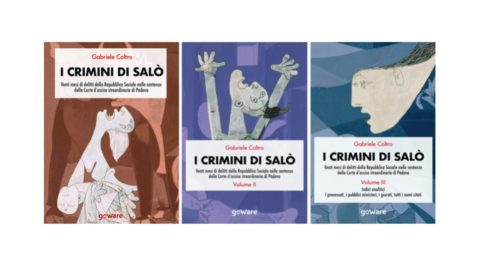
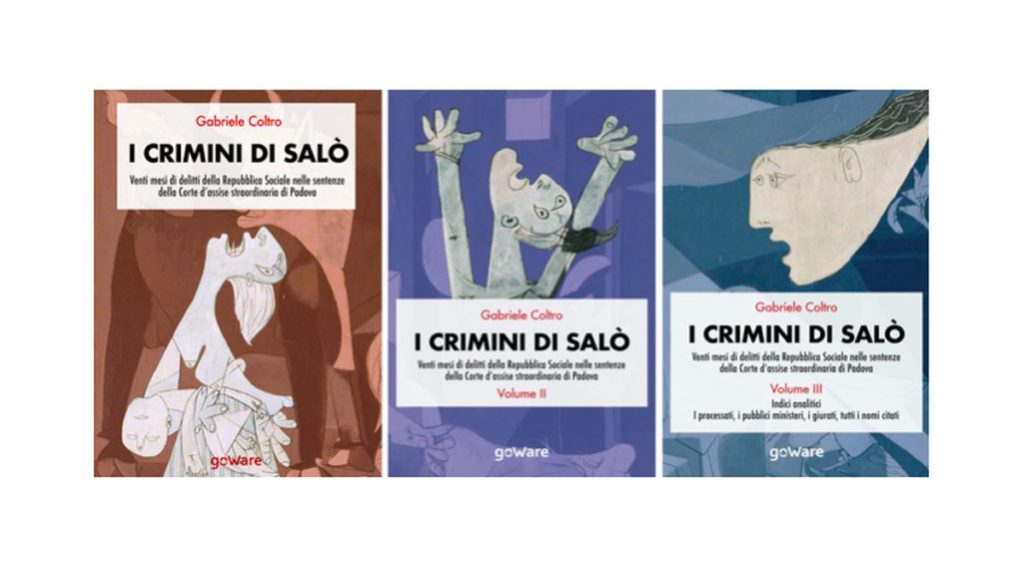
Coltro has produced a study on the crimes of Salò of over 1000 pages, with more than 10 names: The crimes of Salò. Twenty months of crimes of the Social Republic in the sentences of the extraordinary Court of Assizes of Padua, 3 vols., goWare. An entire volume, of the three inseparable volumes, is dedicated only to analytical indexes and names.
Coltro has read, copied and commented on the documents, often at the limit of readability, of the 427 trials for collaborationism brought by the Extraordinary Court of Assizes of Padua between 16 June 1945 and 17 October 1947. In the following interview the author explains well the history of the "archive of shame" and how his decision to make a book came about.
Precisely on the eve of the liberation, the provisional government of the future Italian republic had decided to transform the responsibility of the businesses of the adherents of the Italian Social Republic from actions of a political nature to manifestations of a criminal nature, criminalizing, with two specific legislative acts, the Salò regime and collaboration with the Nazis.
Why did Coltro dedicate two years of his life to studying a forgotten episode and in the end, at least in current historiography, so marginal as that of "phantom" trials and sentences never carried out for the crimes of Salò?
The Paduan scholar explains it well in his introduction to the book, writing:
“Why a book on the sentences that punished the republican fascists? Because memory is important. A society without memory has no awareness of itself. In those sentences there are all the horrors of the twenty months of civil war and the struggle for liberation. Every line of those handwritten sentences, sometimes in a calligraphy at the limit of the legible, exudes suffering. Remembering it is essential in order not to make the same mistakes again, because there is nothing more sacred than life”.
We asked Gabriele Contro a few questions. We gladly share his answers with our readers.
. . .
Interview with the author
What prompted you to start this research?
“An event that really impressed me. In the summer of 1994, in the basements of Palazzo Cesi, in Rome, the seat of the military judicial offices of appeal, a wardrobe was found containing over two thousand files relating to war crimes which had remained unpunished thanks to a highly questionable and illegitimate provision of "provisional archiving". adopted for mere political expediency in the early XNUMXs, in the middle of the Cold War, when Germany was given an anti-Soviet defensive role within NATO. The discovery of that wardrobe, which the press immediately dubbed the "wardrobe of shame", caused a great sensation. The files, many of which contained elements sufficient to identify those responsible for innumerable acts of violence committed against the civilian population, from looting to massacres, were re-catalogued and sent to the competent military prosecutors in the area. About eighty of them arrived in Padua. The deputy prosecutor Sergio Dini sent a complaint to the Superior Council of the military judiciary asking for full light to be shed on the behavior of the military judicial leaders. A special commission was set up which censured the work of three high ministerial appointed magistrates who held the military General Prosecutor's Office from the immediate post-war period until the beginning of the XNUMXs. It was then that I had the idea of starting a wider research on the crimes committed by the fascists in the province of Padua during the twenty months of the CSR. I had already come across a few sentences of the Extraordinary Court of Assizes while researching the Dongo gold trial which was held in Padua in the XNUMXs. But I had shelved the study project because the work of a journalist at the Gazzettino he left me no free time to devote to such a vast research”.
Why a study on republican fascism in Padua?
“Because Padua played a central role in the Venetian Resistance. The twenty months of the fight against Nazi-fascism saw 4.741 fighting partisans and 2.706 patriots engaged in the Padua area. 573 were killed and 274 were wounded. Six Catholic-inspired brigades operated, the communist-inspired Garibaldi brigade, made up of about ten battalions, and a shareholder brigade. It can be said that the beating heart of the Venetian Resistance was the University of Padua, the only Italian university awarded the gold medal for military valor. Men like the rector Concetto Marchesi, the pro-rector Egidio Meneghetti, Ezio Franceschini, Silvio Trentin - Bruno's father who will become general secretary of the CGIL - wrote a heroic page in the history of Italy's liberation from the fascist dictatorship and German oppression. The regional Cln was set up at Marchesi's house. Colleges became the focus of conspiratorial activity. The Institute of Pharmacology, directed by Meneghetti, was the main center of the Venetian anti-fascist conspiracy, connected with the provincial CLNs, with the military commands, with the partisan formations, with the allied authorities of liberated Italy and Switzerland. At the Institute of Chemistry, incendiary and explosive devices were prepared under the guidance of engineer Otello Pighin "Renato", assistant professor of Machines. It was Pighin himself, a militant shareholder, who set up the network of airfields where the Allies parachuted arms supplies. Professors and very young high school and university students, freelancers and traders, artisans and workers, peasants and housewives gave their lives for freedom. To all of them we owe the duty of memory. Because a society without memory cannot be aware of itself".
Surely today more than ever it is important to keep track of the past and these volumes certainly offer an opportunity for further study. How much time did you spend researching?
“More than two years. After the publication of The treasure of the Duce I took over the project on Nazi-fascist crimes. And I began the systematic collection of all the sentences issued by the Extraordinary Court of Assizes from June 1945 until the end of 1947 when the Court ceased all jurisdiction and was dissolved. In the archives of the Tribunal, I found 476 sentences relating to 927 defendants. The trials were conducted by a staff of eleven prosecutors, three of whom were professionally trained. Six judges and 197 jurors alternated in the Assize Court. 26 death sentences were issued, of which only 4 were executed by shooting in the back in the shooting range in via Goito, while 3 were commuted to life imprisonment by the Allied Commission and another 17 were annulled by the Cassation for lack of motivation, one was annulled for the defendant's death and another was wiped out by the amnesty. The court also imposed 18 life sentences. Finally 125 convictions were annulled by the Supreme Court with referral to judicial colleges of other provinces".
Why such a large number of overturned sentences?
“The explanation lies in the fact that the purge in the judiciary was slow and with very poor results. So that the leadership of the top bodies remained mostly the senior staff, the one who had been most marked by the close relationship with fascism, who, claiming the technical nature of the functions performed, survived the de-fascistisation initiated in the state organs. Thus the judgments of legitimacy partially nullified the great effort made by the Courts of Assizes in punishing a multitude of misdeeds committed by the fascists of Salò. It should be added that in the analysis of the concept of collaboration, the Paduan judges provided excellent interpretations that set the standard”.
What difficulties did you encounter in carrying out this study?
“The most complex part was precisely the reading of the sentences, all handwritten on protocol sheets, sometimes at the limit of legibility, with archaic technical language. It was necessary to reconstruct the facts briefly described in the charges and in the reasoning part. And to do this, I first of all made use of the reports of the various partisan formations, purifying them of the passages of pure self-referential exaltation. I was able to appreciate the balance of our judges and jurors: it must not have been easy for them to achieve serenity of judgment especially in the first trials which saw enormous public participation, driven by a great anxiety for revenge, eager for justice to be severely done. It is easy to understand what atmosphere hovered at the hearings that confronted the witnesses with those accused of being their torturers, especially when torture, torture and killings were reconstructed. To understand the climate of those first months following the Liberation, it is enough to think that the first trial against the city's black brigades was interrupted by a lynching: the crowd snatched the defendants from their cages, dragged them to Piazza Insurrection and killed one of them. Only the intervention in force of the Allied military police saved the others from the popular furor. If it is true that the first proceedings were characterized by greater disciplinary rigor, it is also true that the work of the Court always stood out for the defense of legality and prevented the popular furor, particularly heated in that period, from degenerating into very serious episodes of summary justice ”.
Which Nazi-fascist departments operated in Padua?
“The Germans occupied Padua in the late afternoon of 10 September 1943. A unit of scouts on armored self-propelled vehicles under the command of a major immediately obtained from General Italo Gariboldi the surrender of the entire general staff and the disarmament of about 2.500 soldiers who remained closed in the barracks in awaiting orders, all of which ended up in a concentration camp. The military and administrative structure that settled in the city was impressive. There was even a section of the National Socialist Party. But the most fearsome police unit was the SD, the security police, the most feared unit of the SS. It was commanded by Major Friedrich Bosshammer. He had organized the "final solution" in Bulgaria (51 Jews deported), in Romania (75 Jews deported) and in Slovakia (17.500 Jews deported and 832 killed on the spot). Then there was the black brigade "Begon", commanded by the infamous Allegro brothers who wrote one of the darkest pages of fascism. He had detachments throughout the province. The most ferocious were in the Bassa Padovana, in the Conselvano and in the Camposampierese. Finally there was the "Banda Carità". It was a prison of torturers in the service of the Germans. Mario Carità commanded it. Son of unknown parents, at the registry office he was registered as Pietro Carità del fu Gesù. Raised in Lodi, transplanted to Florence, he had a low forehead, a pig's snout, on his very black hair stood out a candid lock right in the middle of his forehead, revealing anomalies of the nervous system. The Allied offensive in May 1944 at Cassino forced the unit to move to the North. The "band" landed in Padua at the end of October, called by the prefect Federigo Menna, settling in Palazzo Giusti. It was five hellish months. The fantasy of the torturers knew no bounds. The highlight was the notorious "machine", a German field telephone which, when operated manually, produced electricity up to 125 volts and which became the main instrument for obtaining confessions from those arrested. Almost all of the inmates went through electric current torture. Including the women, who for further cruelty and derision were forced to strip naked and suffer repulsive displays of lust. Incredible, with regard to the torture with the current, the attitude of the Cassation which denied they could be considered 'particularly heinous tortures'”.
A book on oppression and resistance that makes you understand at what price the Italians have won freedom.
“That's the goal I set for myself with this job. There are many books on the Resistance. But often, when we talk about the Resistance, we forget the great role played by women and the clergy. The liberation struggle in Italy saw 35 partisans, 20 patriots, 4.633 arrested, 2.750 deported, 2.900 killed in combat or shot. In Padua the women were truly heroic. Starting with those who knew the concentration camp: students and workers like Maria Zonta, Milena Zambon, Delfina and Maria Borgato, Lidia, Liliana and Teresa Martini, to name just a few. Others suffered tremendous torture by the "Carità gang", such as Ida D'Este, Anna Bilato and Taìna Dogo. The priests also made a great contribution. The Benedictines of Santa Giustina, the friars of the Santo, the priests of the Barbarigo and the Antonianum, many parish priests who hid allied prisoners who fled from the barracks of Chiesanuova after the armistice, persecuted politicians, Jews. And speaking of Jews, Padua also had a collection camp, at Villa Contarini Venier in Vò Vecchio. 71 were restricted and supervision was entrusted to the Police Headquarters. On July 17, 1944, the Germans loaded them onto trucks. They all ended up in the Auschwitz extermination camp. Only three women survived."
Gabriel Coltro, journalist from Padua, is the author of The crimes of Salò, published by goWare, released last Christmas. A book in three volumes dedicated to the sentences of the extraordinary Court of Assizes of Padua on the crimes committed by the fascists in the twenty months of the CSR. A long and laborious work of document collection on a fundamental page of history in the birth of republican Italy.
Coltro was sent to Iraqi Kurdistan during the First Gulf War, to the Balkans during the Serbian-Bosnian conflict, to Albania with "Operation Pelican" and to Brazil for the UN program against the cocaine fields in Sertao Central. In Gaza he interviewed Yasser Arafat exclusively on Al Fatah's thirtieth anniversary. He directed the Rovigo editorial staff of Il Gazzettino. With goWare he published The Treasure of the Duce.