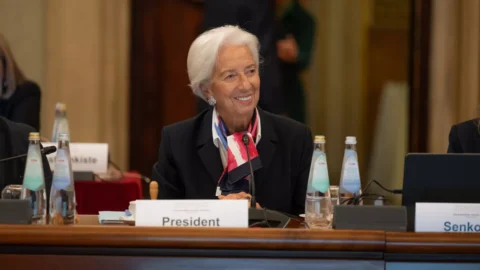
Christine Lagarde could to leave the presidency early of European Central Bank, with a possible announcement as early as the October monetary policy meeting. This eventuality comes as Eurozone governments are engaged in complex negotiations to reshape the Eurotower's leadership: according to the Financial Times, the goal is to find an agreement on the main positions by the end of December.
Lagarde's succession is in fact just one of the pieces of the puzzle. In 2027 they will expire also mandate of the Chief Economist Philip Lane, Irish and member of the Executive Committee, and the German economist Isabel Schnabel, member of the Board.
Lagarde and the possibility of an early exit
The possibility of an early departure comes despite Lagarde dismissing rumors about her future last Thursday with a "nothing to report." The issue, however, has been circulating for months: already in February the Financial Times had reported the possibility of an exit before the natural expiration of the mandate, scheduled for October 2027.
After the war with Iran began, Lagarde explained to Bloomberg TV that leaving the ECB early was not an option in a period of severe turbulence. In June, however, she told Les Echos that the scenario could have changed if conditions had improved. In the meantime, for over a year, he has been in contact with the World Economic Forum for a possible appointment to the organization's presidency. The board's vote could come in October or November, while the ECB meeting in October could be the moment for a possible announcement, with an exit in early 2027 and in any case before the next French presidential election.
ECB: The Puzzle of New Appointments
What makes the succession delicate is above all the fact that the appointments are closely linked. "The goal is to reach a comprehensive agreement by the end of the year," he declared to Financial Times an EU diplomat. Another source speaks of ongoing "strategic consultations" on "important economic positions."
For the ECB presidency, the names in the front row are above all two: the Spanish Pablo Hernandez de Kos, head of the Bank for International Settlements, and the former president of the Dutch central bank Class KnotsThe choice will also have to take into account the balance between Northern and Southern Europe and between hawks and doves in monetary policy. The candidacy of the Bundesbank president appears more complicated. Joachim NagelHis appointment would, in fact, bring two Germans to the helm of the ECB and the Commission, an unprecedented combination that would be difficult for other countries to accept. Furthermore, according to several sources, Berlin's support for Nagel is rather lukewarm.
Alongside the presidency, another decisive challenge is being played: that for the next chief economist of the ECB, considered the second most important position in the institution. Berlin is reportedly evaluating Markus Brunnermeier, Princeton economist, Monika Piazzesi, professor at Stanford, and Tobias Adrian, a former senior economist at the International Monetary Fund. The German idea would be to pair a foreign president with a strong German chief economist, creating a national counterweight. Paris However, he is aiming for the same position as the vice-president of the Banque de France Agnès Bénassy-Quéré and the former chief economist of the OECD laurence booneThe arrangements are delicate: for Berlin it would be "difficult to imagine" a French chief economist with a Spanish president, while Paris would probably oppose a Dutch president supported by a German chief economist.
A game that goes beyond the ECB
The reorganization comes at a delicate stage: bond volatility, geopolitical tensions and over six months of war in Middle East Government financing costs and concerns about public finances are rising. The ECB has already raised rates twice in 2026 and must manage inflationary pressures which could persist until 2027; the Federal Reserve is also called upon to evaluate its response. Politically, further factors weigh the French presidential elections of April, with Marine Le Pen indicated as the favourite to succeed Emmanuel Macron.
The new team will have to bring together "strong figures with diverse profiles" capable of "acting effectively in the coming years," the official concluded to FT. The succession to Lagarde thus becomes a much broader negotiation, where each appointment can influence the others. At stake is not only the post-Lagarde era, but the team destined to lead the Eurozone's economic and monetary policy in the years to come.