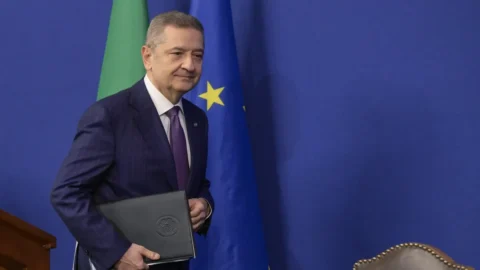
Italy must look at how to emerge from this crisis with "determination." In his Concluding Remarks, the Governor of the Bank of Italy Fabio Panetta He used this word to explain how our country should free itself from the shackles of low growth and stagnant wages, instead of the more rhetorical but also more usual “confidence.”
From opposition to cooperation
In fact, "determination" is the most appropriate word to conclude a relationship marked by calmness, free from polemical ideas on both the international situation and domestic politics, but at the same time rich in information and stringent indications on what should be done to overcome the phase of uncertainty and avoid being spiraled into catastrophic consequences through reckless actions motivated by fear and ideology. And if we look closely, the Governor's recipe It is not "blood and tears", it does not require global austerity and sacrifices such as to put the current level of well-being into crisis, if the muscular opposition between countries that try to defend themselves alone, closing themselves off from all the others, is replaced a cooperation where everyone does their part in order to reduce imbalances.
Today global economic and political crises are pushing all countries to prioritize not only military security, but also economic, interrupting global supply chains, trying to have all the energy and essential raw materials at home, as well as the companies producing intermediate and final goods, breaking the international interdependencies created to seek greater efficiency and therefore more competitive prices. But the fragmentation of the world market does not eliminate imbalances: "it hides them, makes them deeper and more expensive to remove”, and ultimately compromises the well-being achieved by citizens.
The recipe for returning to a healthier international balance is not difficult. Each country should attack its own weaknesses It's well known: the US has an excessively high budget deficit, China has an overly export-oriented policy, low domestic demand, and an inflexible yen, while Europe should accelerate investment in all sectors. Of course, doing so isn't as simple as simply listing them: it requires politicians capable of becoming statesmen and modifying policies pursued for years in pursuit of electoral consensus, perhaps even short-term.
Artificial Intelligence to Boost Italy's Growth
The reasoning was similar Panetta for Italy. We must focus our attention not on temporary measures, but on our strengths These are the technical and scientific capabilities of universities and businesses, businesses that need to grow more but remain a point of excellence; we need to bring back many young graduates who go abroad because our economic system lacks innovation and provides them neither adequate salaries nor attractive career prospects. We need a policy that can last over time to build a more suitable environment for growth starting from the necessary and rapid diffusion of Artificial intelligence in all companies and also in the public administration.
And it is precisely Panetta dedicates a large chapter to Ia of his considerations in the belief that it will be precisely from innovation and technology that will come the push to bring Italy out of the stagnation it finds itself in. The Governor warns that a lot of public resources are not needed, but rather a long-term commitment of a political class capable of looking a little further than its own nose to dedicate itself to reforms that do not penalize citizens but require them to be willing to learn new things, to change residence, in short, to get back into the game by abandoning the comfortable corner where they have taken refuge, believing themselves sheltered from any storm.
Europe must do more and faster
Europe has made progress but is weak. On European politics, Panetta's vision is similar to that of President of Confindustria Emanuele OrsiniWe need to do more and do it faster. We need to complete the single market in finance, energy, and telecommunications. Not only that, but to do this, the EU needs to issue covered bonds by expanding its budget, which would allow savings to flow in from around the world. In short, we need more Europe with a clearer and faster institutional framework.
On the topic of interest rates, which is the proper domain of central banks, Panetta was cautious. The ECB will make decisions in mid-June. From his analysis, it seems that the elements in favor of stability have a slight advantage over those who would instead push for a slight increase, adjusting official rates to those of the long-term bond market which already discounts an increase in inflation. On the other hand, forecasts are so uncertain as they are linked to the end of the blockade of the Strait of Hormuz that we really don't know what to do. And yet the ECB, to signal to the market that a spiral between prices and wages will not be allowed, has several other tools in addition to interest rates. We'll see, but in any case the will seems to be that of avoid prematurely strangling the entire economy fearing an inflationary explosion that is not yet visible.
Governor Fabio Panetta's Annual Report is particularly informative this year. Amid the babble of languages and the great uncertainty affecting not only ordinary citizens but also the entire political and managerial class of the West, it was necessary to avoid engaging in a vortex of controversy, but instead offer a calm, timely analysis of the ills afflicting the economic system following the globalization crisis, and possible remedies. These remedies, if implemented, would provide satisfaction to all the countries currently glaring at each other, so much so that according to IMF analyses, these coordinated actions would lead to an additional growth in global GDP of one percentage point. In short, it would go from just over 3% to over 4%. This is no small feat. We'll have to see whether reason prevails or whether the actions of the world's major powers are guided by a dangerous predatory nationalism.