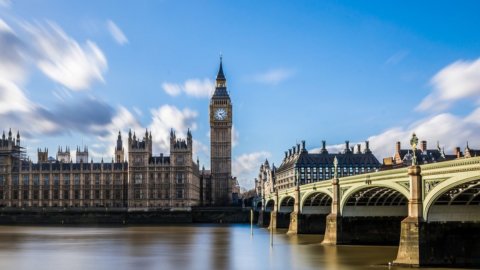
The reign of the Tories now seems to be in its days. After fourteen uninterrupted years at the helm of UK, conservative British are about to leave the scepter of power in the hands of the Labor who, after an internal revolution that lasted years and a change of leadership that has profoundly changed the structure of the party, now appear ready to return to Downing Street through the main door, electing their first prime minister since Gordon Brown.
What until a few days ago were considered very concrete clues, but still clues, in recent weeks have been transformed into (almost granitic) certainties in the eyes of all political observers who now unanimously predict a clear defeat for the Conservatives in the general election which should be held by the end of 2024. Polls, economic trends, policies at the limits (and beyond) of constitutionality, electoral challenges, everything now suggests what many consider "the end of an era". An era destined to remain in the history of the country. The reason can be summed up in one word: Brexit.
UK by-election: Labor wins landslide in conservative strongholds
Yet another proof of the probable future conservative debacle arrived three days ago together with the results of the two by-elections which were held on Friday 16 February in the constituencies of Wellingborough and Kingswood, England, two Tory strongholds until recently considered almost impregnable.
And yet the two Labor candidates, Gen Kitchen and Damien Egan, have won both seats by a landslide, entering Westminster Parliament with his head held high. In Wellingborough in particular, the Labor Party obtained 45,9% of the vote compared to 24,6% for the Conservatives. In the previous 2019 elections the Tories had won almost 40 points more. It didn't go any better in Kingswood, where Prime Minister Rishi Sunak's party got 8,675 votes compared to over 11 for the progressive party.
The result “shows that people want change and they are ready to trust a renewed Labor Party to achieve it,” commented the opposition leader Keir Starmer. On the contrary, he downplays the Conservative Party, which talks about "local issues that do not reflect the opinion of voters at a national level". A comment that could also be there if it weren't for the fact that, from 2019 to today, i Tories have been defeated in 10 different by-elections, which in some cases were won by Labour, in others they determined the success of the Liberal Democrats.
The UK is in a technical recession
Twenty-four hours before the by-elections, another tile had fallen on the head of Rishi Sunak's government: while inflation remained stable at 4% according to the data published by the National Statistics Office (ONS) Last Thursday, the United Kingdom officially entered technical recession. After the negative sign in the third quarter of 2023, in the fourth quarter, the country's GDP fell by 0,3% compared to the previous three months and by 0,2% compared to the same quarter of 2022. Overall, last year , the British economy grew by just 0,1% compared to 2022, a disappointing result for all and below the other major European economies (excluding Germany).
"The UK economy is essentially hitting bottom”, commented Stephen Payne, Portfolio Manager at Janus Henderson. Jack Amy, Portfolio Analyst at Moneyfarm, pointed out how "The news, at the beginning of a year of political elections, certainly does not play in the government's favour, even if it is not entirely unexpected, given the current inflation scenario and high interest rates and considered the slowdown in growth that the United Kingdom has been recording for years."
READ MORE: United Kingdom, the black year: profit alarm and escape from the markets in 2023
Polls plummet for the Conservatives ahead of the UK general elections
Sunak's mandate will expire at the end of the year, while Parliament will cease its functions on 17 December 2024. At that point there will be 25 days to call new elections which in any case cannot be held beyond January 2025. The current first However, the minister has repeatedly reassured that he does not intend to go to the polls "at the last minute" and that the elections will therefore be held by the end of the current year.
The problem is that the Conservatives risk showing up at the fateful meeting with broken bones, after years of internal conflicts and political crises - which brought 5 different prime ministers to Downing Street in 7 years - and a full-blown technical recession, the Tories are in serious difficulty. The polls, for months now, have been merciless: according to the findings carried out by the various opinion polling offices, in fact, the detachment towards the Labor party exceeds 20 points for the first time in years. Simply put, without a clear turnaround (or a miracle according to some observers), returning to power for the conservatives will be practically impossible.
Furthermore, in this context, we must not forget that the danger does not only come from the left. Because while the Labor Party, in its new guise as a centre-left party, takes the moderate votes, on the right there is also the Reform party, the new name of the Brexit Party founded by Nigel Farage, which in last week's by-elections achieved the best result in its history in both constituencies, obtaining 13% of the votes in Wellingborough and 10,4% in Kingswood. Without forgetting then the Liberal Democrats who have no intention of "giving up".
The rebirth of British Labour
The current political context did not arise overnight. On the one hand (the conservative one) we find a party in power for over a decade, worn out internally by internal struggles and a Brexit that has swept away any type of balance. On the other hand (the Labor Party) there is a political force that after years of subordination has managed to reform itself profoundly, slowly regaining that large portion of the electorate that had abandoned it due to political proposals considered too radical, too disconnected from reality, too much.
The merit, say British political scientists, goes above all to Keir Starmer that, from the victory against the former Labor leader Jeremy Corbyn in the now distant 2020, he was able to slowly but steadily, and not without difficulty, give the party the turning point it needed to restart, exploiting every weakness of the Tories and acquiring over time that authority and political charisma which was considered deficient. After the Corbynista season was archived and having brought the Labor party back to more centrist positions, Starmer therefore seems ready to take over Downing Street too.
And Sunak? After just over a year of premiership, the British Prime Minister is trying to convince the electorate that the internal divisions are now overcome and that the country's difficulties are only temporary, caused by the international political context (first Brexit, then Covid, then the wars in Ukraine and the Middle East). We will overcome everything, he repeated several times, with a very unconvincing attitude to tell the truth. A key event will arrive on March 6th with the presentation of the “spring budget”, the so-called spring budget. Given the economic situation, the promises made a few months ago about strong tax cuts now seem to be archived, with the arrival of small interventions on excise duties almost destined to become irrelevant. In short, the blanket is short and the time to recover is less and less. Could the most predictable elections in the history of the Kingdom be coming?