The agreement between the United States and Iran It's time for the end of hostilities in the Middle East officially in force after company of the American president Donald Trump and the Iranian president Masoud Pezeshkian, which occurred in the form digital and confirmed by both capitals.
The document provides for immediate measures such as the resumption of freedom of navigation in the Strait of Hormuz and an initial easing of economic restrictions. The agreement, although already in effect, still leaves several sensitive issues open, including the program nuclear Iranian, which will be addressed in the next stages of the negotiations.
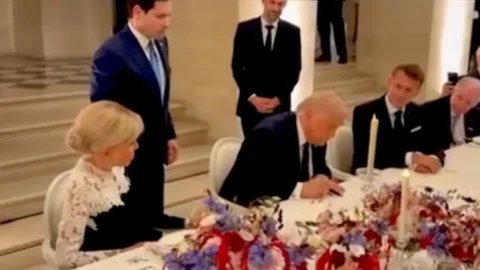
Trump signs the Versailles agreement: "Iran will not have a nuclear weapon."
Late in the evening, by surprise, during the dinner with the French President Emmanuel Macron in Versailles, il president Rainforest puts his own stamp on it digital signature on the memorandum, making the agreement operational. On the Iranian side, President Pezeshkian signed it at the same time, completing the entry into force of the agreement between Washington and Tehran.
During the G7 summit, the US president called the agreement "a very good agreement for many reasons," emphasizing that the top priority was to prevent Iran from acquiring a nuclear weapon. "There's a 99,9% chance Iran will never have a nuclear bomb," he declared, adding that "Iran cannot be allowed to have a nuclear weapon."nuclear weapon and he will never have it." Trump also claimed his own political line with respect to previous agreements, saying he had made "better than Obama” and calling his strategy “a wall against nuclear weapons.”
In his speech, the American president claimed responsibility for the decision to end the conflict and reiterated that, without an agreement, the situation could destabilize the entire region. "If I hadn't put an end to all this, Iran would have blown up the entire Middle East and Israel" he said, emphasizing that the new memorandum represents, in his view, a strategic turning point. Trump also implied that the stability of the agreement would depend on the behavior of the parties, warning that if commitments were not met, "the situation could flare up again."
US-Iran deal in force: reactions
International reactions were immediate. NATO Secretary General Mark Rutte He welcomed the agreement, declaring that "President Trump has reached a good agreement, which is important because it aims to weaken Tehran's nuclear capability," adding that Iran's missile capabilities also represent "a threat not only to the Middle East, but also to Europe and other parts of the world," and also emphasizing the issue of freedom of navigation.
A sign of openness also came from Pope, who at the end of the general audience expressed "satisfaction with the agreement reached between the Islamic Republic of Iran and the United States of America. I express gratitude to the countries that have worked to facilitate the meeting between the parties and make this understanding possible," and added: "I hope that this agreement can contribute to strengthening mutual trust, security, and stability in the Middle East by promoting paths of dialogue and cooperation between peoples."
From the Iranian front, the Speaker of the Parliament Mohammad Bagher Ghalibaf He said that Tehran negotiated “from a position of strength,” explaining that Iran’s “victory on the battlefield” was the basis of the talks and that “the difference from previous negotiations is precisely this strength recognized by both enemies and friends.”
Will the meeting in Switzerland take place?
However, there remains an element of uncertainty related to the final phase of the agreement. The official ratification ceremony, initially expected in Switzerland, could be subject to changes or postponements, although the possibility of a meeting between the delegations at a resort on Lake Lucerne remains on the table. The Swiss government has confirmed, however, that the organization of the meeting remains currently confirmed and it has not been deletedThe parties involved are working to finalize the procedural details, while the international community is cautiously observing the evolution of an agreement that, while already operational, still requires long-term confirmation.