I past US presidents they had a very different idea of the markets than the current one has in mind Donald Trump: they believed that their task was to ensure the fundamentals and let the markets self-regulateTheir interventions were generally co-written with the emergencies: tapping strategic oil reserves during geopolitical upheavals, organizing a bailout in the event of a financial crisis, or working with allies to stabilize currency markets. Instead, Trump and his aides are obsessed with markets and willing to influence them, as reconstructed by the Wall Street Journal.
A typical day in the oil market: Trump's slalom of statements
Last Monday they met on the oil market le usual dynamicsThe day began with the news that Iran had called off mediated talks with the United States, sending oil prices soaring by $3 a barrel. That afternoon, President Trump posted on social media that Israel was withdrawing from Lebanon and that Hezbollah had agreed to cease fighting. Oil prices dropped by $1. Less than 15 minutes later, Trump wrote that talks with Iran were proceeding at a "rapid pace." Oil prices fell by a further 50 cents. By the end of the week, Hezbollah and Israel were still exchanging fire, and talks with Iran had failed to reach an agreement. Nonetheless, the episode reinforced a pattern that had recurred throughout the war: through verbal interventionsTrump has repeatedly blunted oil surges, not by restoring crude flows but by inflicting losses on those who were betting on the opposite.
And then the manipulations on stocks, interest rates, currencies and mortgages
But it's not just about oil. Trump and his aides have manipulated stocks, interest rates, currencies, and mortgages, reports the wsjThey don't explicitly say they want to act on the market, but that's what investors believe.
The Department of the Treasury, upon direction of the Secretary Scott Bessent, a former hedge fund manager, bought pesos to support the Argentine president Javier Milei ahead of last year's crucial election. In January, he signaled the possibility of buying yen, then under strong downward pressure. Both currencies subsequently appreciated.
Last January, Trump ordered a Fannie Mae and Freddie Mac to purchase $200 billion in mortgage-backed securities in an attempt to lower mortgage interest rates. Yields on these securities immediately fell by a tenth of a percentage point.
It's dangerous to bet against Trump
- and to investors They may disagree with Trump on the direction of the markets, but they cannot ignore him. The US president can stop or start wars, pump billions of dollars of public money into the markets, and overthrow foreign heads of state. The mere possibility makes dangerous to bet against him. “The market must assume that he has information that the public is not aware of“Jim Ritterbusch, who runs an oil trading and consulting firm, told the newspaper.
From a technical standpoint, analysts highlight unusual details. Investors typically react to an oil supply disruption by assuming a “long” position, which allows you to profit from an increase in price (while a “short” position allows you to profit from a decrease in price) using futures and options. This can push the price above what fundamental supply and demand predict, resulting in an increased risk premium. According to Ritterbusch, after Russia's invasion of Ukraine in early 2022, the ratio of net long to net short positions rose to an all-time high of seven. The war with Iran removed significantly more oil from the market. Yet the ratio of long to short positions only rose to four, before falling to 2,7, Ritterbusch said. Investors have been wary of taking long positions for fear of a price spike. that a comment from Trump could cause the price to collapse.
“Everyone is optimistic, but no one is long,” said Ilia Bouchouev, former head of derivatives trading for Koch Global Partners and a senior fellow at the Oxford Institute for Energy Studies. “I'm not a politician, I'm a trader, but I give credit where credit is due: somehow theadministration has managed to destroy the bulls' sentiment."Some hedge funds were forced to sell when the price was down 5%," Bouchouev said. "They won't buy oil if a single tweet can cause the market to fall 10%. Why risk my job and my investors' money?"
The result is one risk discount, rather than a risk premium, in oil futures contracts. Futures prices do not move in tandem with the price at which physical oil is traded. However, the futures market is much larger. According to Bouchouev estimates, the trading volume of oil futures and options on the Intercontinental Exchange is approximately 40 times greater than daily oil consumption. And it is much more sensitive to market sentiment.
Trump's repeated promises of a quick end to the war may explain why in April the futures prices they were up to 30 dollars lower than those of physical oil. Since then, that gap has narrowed, suggesting they have acted key factors, such as the decrease in Chinese imports and the increase of Venezuelan exports, containing prices. However, even if Trump's interventions cannot be quantified, their effect is undeniable.
The same applies to i interest rates. Although i government bond yields in the long term have increased this year, the increase was relatively content, given the forces that have pushed them higher: Trump's attacks on the independence of the Federal Reserve, stubbornly high inflation and huge budget deficits. Trump's statements could be the cause. Last year, Trump repeatedly pressured the then Fed chairman Jerome Powell to cut interest rates (but Powell resisted), threatening to replace him with someone who would. Many of the candidates to succeed Powell, whose term as chairman ended in May, have publicly called for lower rates. Among them are two incumbent Fed governors, Chris Waller and Michelle Bowman. Statements by Trump and Powell's potential successors have led markets to anticipate rate cuts larger than the Fed itself initially expected. This likely put downward pressure on bond yields. The same goes for suspicions that, if yields became too high, the Treasury might respond by selling fewer bonds or even buying back some, or that the Fed might adjust the size of its bond holdings.
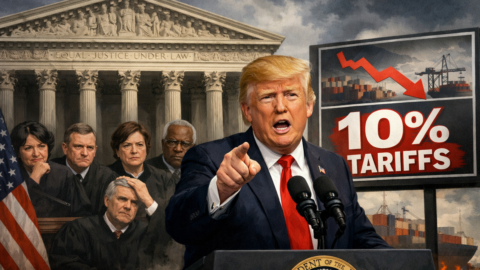
Critics often argue that Trump is being manipulated by the markets. Last April he announced customs duties high, only to scale them back after the stock market crash. “Trump always backs down” is the Wall Street mantra summed up by the acronym “Taco.” But the markets have been, on closer inspection, manipulated by Trumpsays the Wall Street JournalHis retreat was only partial: according to JPMorgan ChaseThe effective U.S. tariff at the end of July was 15%, down from 26% at the beginning of April, but up sharply from 2,3% before he took office. Investors, meanwhile, had pushed stocks to record highs, suddenly reluctant to bet that Trump would do anything to thwart them.
Have Trump's actions brought concrete economic benefits?
All of this suggests that Trump managed to bend the markets to his will more successfully than is commonly believed. The question, then, is: to what end? What are the concrete economic benefits?
On the front of oil pricesTrump can only do so much against speculators; ultimately, supply and demand will dictate. While fundamentals indicate that for the consumers there will be no improvements in the short term.
Le customs tariffs they did not lead to a economic growth faster overall, nor in the most protected sectors. And although interest rates are lower than when he took office, this victory could be ephemeral.inflation is higher than when Trump took office. budget deficit continue to increase.
After the optimistic data on theoccupation released Friday, the Nasdaq Composite Index recorded its worst day in more than a year, as investors increased bets that Kevin Warsh, Trump's newly appointed Fed chairman may actually have to raise rates. Kevin HassettTrump's top economic adviser, argues the opposite when he said on Friday that markets are "profoundly mistaken" in pricing in an interest rate hike. We'll see who's right.