With US markets closed for the Thanksgiving Day, Asian trade is moderate in Asia, while the move by the US dollar has definitely surprised South Korea with a rate cut that is likely intended to begin addressing Trump's trade ambitions. Today's headline data will be theGerman inflation and French budget dilemma, with investors worrying about the economic and political stability of the two countries, while the specter of US tariffs looms over Europe. Futures indicate that the European stock markets they should open higher.
Wall Street falls as yesterday's data leaves uncertainty about the Fed's next move on rates
Yesterday the main indices of Wall Street ended lower, led by the Nasdaq, with Dell and HP shares falling sharply after negative quarterly data, on the eve of Thanksgiving and ahead of the Fed meeting next week. The Dow Jones ended down 0,31% and the S&P-500 lost 0,38%, closing at 5.999 points. The Nasdaq 100 was also negative (-0,85%), as was the S&P 100, which showed a decline of 0,41%.
Yesterday the PCE, the Fed's preferred measure of U.S. inflation, rose 2,3% in October on an annual basis, while the GDP third quarter was confirmed at 2,8%. This indicates that the progress in slowing inflation has stopped, while the economy remains resilient, raising doubts about the path that the Federal Reserve could take on rates, starting at next week's meeting. U.S. markets will be closed on Thursday for Thanksgiving Day and will reopen Friday for half a day.
Korea surprisingly cuts rates. Central bank and government tug of war in Japan
Asian stocks were mixed and the dollar remained on the defensive after Wall Street fell, while trading was subdued due to the US Thanksgiving holiday. MSCI's broadest index of Asia-Pacific shares outside Japan fell 0,07%, while Japan's Nikkei rose 0,7% to 38.400. The dollar's appreciation was halted yen with the dollar cross reaching 151,5 tonight, a level not seen in a month.
In Japan is open dichotomy between central bank and government. While the central bank is about to raise rates to slow the economy and stop inflation growth, the government is working to boost the economy. According to the state broadcaster NHK, Japan will rely largely on additional tax revenues of 13.900 trillion yen ($92 billion) to finance the stimulus package Prime Minister Shigeru Ishiba. The budgetary shift will be partly funded by 3.800 trillion yen in higher tax revenues and unused funds from the previous year, limiting the need for additional bond issuance to about 6.600 trillion yen, according to data provided by NHK.
Hang Seng Index down 1,3% Hong Kong. Chinese biopharmaceutical company Hangzhou Jiuyuan Gene Engineering plunged 40% on its first day on the stock exchange. The CSI 300 index of stocks Shanghai and Shenzhen is at -0,5%. The Biden administration is considering further restrictions on sales to China of semiconductor equipment and memory chips used in artificial intelligence, he writes this morning Bloomberg. In some respects it would be a further crackdown, but it would still be less far-reaching measures than those considered a few months ago.
The bag of South Korea is flat. The central bank surprisingly cut its seven-day repurchase rate by a quarter of a percentage point to 3%. “Our decision can be interpreted as accelerating easing to address downside economic risks that are growing more than we expected,” BOK Governor Rhee Chang-yong said at a briefing after the decision. The BOK also cut its 2025 growth forecast to below 2% and lowered its projections for this year. The rate cut could be a preemptive move to a potential slump in investment and consumption due to Trump’s trade policies. The president-elect has vowed to impose higher tariffs on U.S. trading partners, a factor that would hit the export-dependent South Korean economy. Trump has also hinted at potentially reducing subsidies for foreign companies operating in the U.S., such as Samsung Electronics and Hyundai Motor.
Lo yen fell 0,3% to 151,615 per dollar, but remained close to the monthly high hit in the previous session. The Asian currency is headed for its strongest weekly performance since early September, on rising expectations of a rate hike by the Bank of Japan next month. The euro remained steady after rising 0,7% in the previous session, as investors scaled back bets on upcoming rate cuts after European Central Bank board member Isabel Schnabel said the cuts should be gradual and move toward neutral, non-accommodative territory.
As regards raw materials, the oil prices were steady as supply concerns eased after the ceasefire agreement between Israel and Hezbollah. Brent crude futures were virtually unchanged at $72,8 a barrel. U.S. West Texas Intermediate crude was steady at $68,7. The spot price Of their fell to $2.626 an ounce.
European stocks: eyes on German inflation and French budget
The spotlight will be on French stocks after the country's main stock index fell yesterday to its lowest since early August as budget discussions threatened to topple the new government. French government bonds also fell sharply, sending the OAT/bund spread to its highest level since the 2012 eurozone debt crisis. The far-right leader Marine Le Pen threatened to overthrow France's coalition government with a vote of no confidence over a disagreement with Prime Minister Michel Barnier over the proposed budget, which contains measures to cut spending and raise taxes.
In Germany, where the collapse of the ruling coalition earlier this month paved the way for snap elections in February, attention today is on preliminary inflation data for November. Based on harmonized data compared with other European Union countries, inflation is forecast to remain elevated at 2,6% after a 2,4% annual increase in consumer prices in October. A survey yesterday showed further signs of trouble ahead for Europe's largest economy. The German consumer sentiment looks set to collapse in the final month of the year as households, worried by news of job cuts, turn pessimistic. The German government has forecast an economic contraction of 0,2% in 2024, marking a second year of decline and cementing Germany’s position as the tail-ender among its big eurozone peers. Political and economic turmoil in two of the region’s biggest economies has investors wondering who the sick man of Europe really is.
Christine Lagarde in an interview with Financial Times, the first since Trump won his second presidential term, urged European political leaders to work with Donald Trump on duties and to buy more products made in the United States, warning that a harsh trade war risks wiping out global economic growth. The ECB president says the EU must not "react with retaliation, but to negotiate” with a president-elect threatening a blanket tariff of up to 20% on all non-Chinese US imports. Lagarde also warns that a “full-scale trade war” is “in no one’s interest” and will lead to “a global reduction in GDP.”
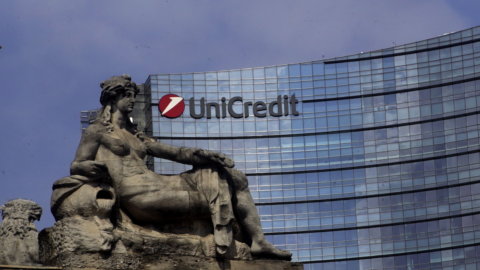
Unicredit. Rating agency Moody's has affirmed UniCredit's Senior Preferred (unsecured) debt and long-term deposit ratings at Baa1, with a stable outlook. According to the agency, if the acquisition of Banco BPM were to be finalized, UniCredit's credit rating would remain substantially stable. The statement, it is stated in a note, also reflects the rating agency's assessment that the acquisition of Banco Bpm would not prevent the potential acquisition of Commerzbank by UniCredit. Moody's reiterates that, in the event of an acquisition of Commerzbank by UniCredit, it will take into consideration the possibility that the rating stand-alone of the Piazza Gae Aulenti group, currently equal to baa3, get updated to baa2, one step above Italy's sovereign rating. This would imply a rating upgrade including for senior non-preferred and junior debt.
SnamThe board of directors has authorized a potential bond issue in dollars, for professional investors, in multiple tranches up to a maximum total amount of 3 billion dollars to be completed within the next 18 months.
Amundi holds a 1,3% stake in UniCredit on behalf of its clients, the fund management company controlled by Credit Agricole said.
Stellantis will suspend production at the Mirafiori plant's body shop for the entire month of December, mainly due to weak demand for the electric Fiat 500.
Leonardo. According to the Italian Foreign Minister, the Leonardo Global Combat Air Programme (Gcap) project between Italy, Great Britain and Japan for the construction of a new generation fighter will probably be extended to Saudi Arabia. Leonardo, Bae Systems and Mitsubishi Heavy Industries are participating in the project. Morgan Stanley raises the target from 23 to 25 euros
Campari . Remy Cointreau expects to close 2024 with a year-on-year decline in sales of between 15% and 18%, worse than analysts' forecasts.
Generali In the UK, Direct Line Insurance rejected a £3,3 billion ($4,2 billion) takeover bid from Aviva for the second time this year. The price represents a 58% premium to Direct Line’s close on Wednesday.
Recordati . This morning in the newspapers there are other elements on the change of ownership: the agreement between the CVC fund and the pharmaceutical company Angelini could be closed within a few weeks. According to the Corriere della Sera, of an operation worth over 4 billion euros. Angelini should form a consortium with the funds KKR and TPG to raise up to 2 billion euros, money needed to acquire a significant stake in Recordati from the CVC fund. Following these transactions, the new investors would hold 40% of Recordati, while CVC would retain a significant minority stake