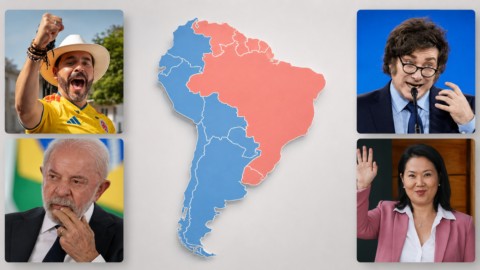
South America is experiencing one of the most rapid political transformations in recent decades. After the so-called “red wave” of the years 2000–2010, characterized by the rise of progressive governments in Brazil, Argentina, Uruguay, Bolivia, Ecuador and Venezuela, the elections in the two-year period 2025-2026 in Chile, Bolivia, Peru, Colombia and Ecuador have marked a clear shift towards the right and, in several cases, towards radical conservative or far-right forces, like the last case of triumph of the Trumpian Abelardo De La Espriella in Colombia, where until recently one of the continent's few socialist leaders, Gustavo Petro, governed.
The last bastion, apart from Yamandù Orsi's Uruguay, is Lula's Brazil, which however goes to the polls in October with the possibility of a victory for former President Jair Bolsonaro's son, Flavio. This new ultraconservative wave was inspired by Donald Trump's return to the White House, for which South American leaders are competing to see who is the most friendly, starting with Argentina's Javier Milei, but also by the success of Salvadoran President Nayib Bukele, who was the first has brought the issues of security and internal control back to the centre of the political agenda, in a context of strong social polarization.
Seven decisive elections: the continent's new orientation
In Colombia, the recent success of the outsider De La Espriella surprised everyone: in April he was given a 20-point deficit in the polls compared to Petro's dolphin, the philosopher Ivan Cepeda. Also in these days that in Perù he won by a hair's breadth Keiko Fujimori, daughter of former president Alberto, thus marking the return of a right-wing movement of Fujimori-inspired origin, accompanied by a more liberal economic orientation and a strong demand for political order.
In Bolivia, the end of the long hegemony of Evo Morales's Movement to Socialism marked one of the most significant transitions of recent years: after a political cycle dominated by the indigenous left, power passed in 2025 to a conservative coalition led by Rodrigo Paz Pereira. In Chile, still at the end of 2025, the election of Jose Antonio Cast has consolidated a model of an identitarian and security-minded right, focused on immigration, public order and the reduction of the role of the State.
Last year was also the year of the affirmation of the pro-American liberal Daniel Noboa in Ecuador, who immediately granted military bases to the US to begin a harsh repression of drug trafficking, while in 2023 the centre-right exponent had won Santiago Pena in Paraguay and Javier Milei in ArgentinaFrom 2023 to today there has been only one affirmation of the left, in 2024 with Yamandù Orsi in Uruguay.
The “right-wing belt” and the crisis of the Latin American left
The combined result of these elections has strengthened what observers call a real Latin American "right-wing belt". At the root of this shift are recurring factors: the deterioration of urban security, persistent economic fragility, inflation, and a growing disillusionment with progressive governments accused of failing to reduce inequality. In many countries, the right has succeeded in intercept social discontent by presenting itself as a force for order and stability, while the left appears to be struggling to renew its political language and respond to the electorate's new demands.
Brazil and Uruguay: The Last Progressive Bastions
Excluding Mexico which is part of North America, only the Brazil of Luiz Inácio Lula da Silva, whose success, however, dates back to 2022, and Uruguay remain the main exceptions to a now regional trend. Brazil, in particular, continues to represent the linchpin of the South American progressive camp, both in terms of economic size and geopolitical weight, but in a few months it will go to the polls with the threat of a possible return to power of the far right, represented this time by Flavio Bolsonaro, the son of the former president now under house arrest and ineligible.
The Lula government maintains an approach focused on social policies, public intervention, and a more autonomous diplomacy compared to the traditional Western axis, with a rapprochement with the BRICS and the so-called "Global South," particularly towards China. However, this position appears increasingly isolated within the continent, which is once again moving towards Trump's United States.
A continent in search of a new balance
The right's string of victories in Latin America raises questions about the region's political future. On the one hand, a widespread demand for stability and security emergesOn the other hand, the ability of the new governments to offer structural solutions to the economic and social fragilities affecting the continent remains uncertain.
The risk, highlighted by several analysts, is that of a phase of strong political polarization, destined to redefine not only the internal balance of power within individual countries, but also Latin America's role on the global stage. It's clear that after becoming China's strategic partner, the continent, rich in mineral and energy resources, could once again become the United States' "backyard," with Europe watching. Il EU-Mercosur trade agreement, already formally signed, could be called into question precisely from the new sovereignist and Trumpian leaders.