I leader in artificial intelligence put aside the rivalry and they issue a warning to the U.S. Congress. Sam altman by OpenAI, Dario Amodei by Anthropic, Half Hassabis of Google DeepMind and Mustafa Suleyman Microsoft AI are among the signatories of a public letter who asks mandatory controls on the sale of synthetic DNA and RNAThe goal is to close an increasingly delicate gap in the biosecurity chain: preventing tools designed to accelerate research, vaccines, and new therapies from being exploited to design biological weapons.
The request comes at a time when AI models are rapidly advancing even in the field of biology. The concern is not only about what artificial intelligence can already do today, but also about speed with which it could make more accessible knowledge once reserved for highly specialized researchers. The letter states that “AI systems are improving rapidly and, alongside the extraordinary benefits to science and medicine, there is a real possibility that the knowledge barriers that have historically prevented malicious actors from obtaining biological weapons is significantly eroding".
A rare convergence between rivals
The letter was promoted by theInstitute for Progress and the Foundation for American Innovation It brings together figures competing in the AI market for models, talent, capital, and infrastructure. OpenAI, Anthropic, Google DeepMind, Microsoft AI, and Meta appear on the same front, along with national security experts, scientists, and representatives of the gene synthesis industry.
Among the signatories are Sam Altman, CEO and co-founder of OpenAI; Dario Amodei, CEO and co-founder of Anthropic; Demis Hassabis, CEO of Google DeepMind and winner of the 2024 Nobel Prize in Chemistry; Mustafa Suleyman, head of Microsoft AI; and Alexandr Wang, Chief AI Officer of Meta. The presence of these names lends political weight to a specific request: introduce a mandatory national standard for screening synthetic nucleic acid orders, rather than relying solely on voluntary measures or fragmented rules.
The document defines this passage as “a rare moment of agreement between subjects who are often in conflict“A sentence that captures the scope of the initiative well. The AI industry recognizes that one of its most promising technologies could amplify risks already known for decades, and is calling on politicians to intervene before the problem becomes more difficult to manage.
The weak point in the biotechnology supply chain
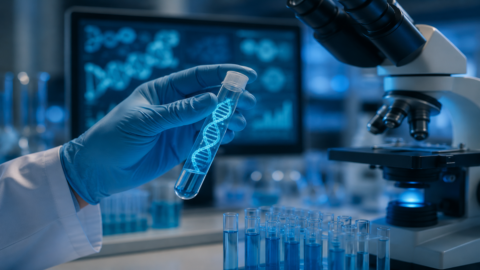
La DNA synthesis It's nothing new. The first success dates back to the 1950s, with the work of scientist Arthur Kornberg. Since then, however, the process has changed radically. Today, dozens of companies around the world use commercial synthesizers to produce and sell custom genetic sequences, used in scientific research, drug development, and diagnostics.
The problem arises from the fact that not all suppliers verify with the same rigor who buys and what is ordered. Many companies sell only to qualified researchers, biotech companies, and academic institutions, but the letter emphasizes the need to mandate checks on customers, orders, and data traceability of the sequences produced.
The vulnerability had already come to light in 2017, when Canadian researchers successfully reconstituted the extinct horsepox virus using DNA purchased through the mail for $100. The experiment fueled fears that similar methods could be used to recreate more dangerous pathogens. Since then, gene synthesis has become even cheaper, while AI has increased the ability to search, connect, and transform complex technical information.
When AI lowers barriers
The alarm concerns above all the combination of genetic synthesis and artificial intelligence modelsBiological weapons remain difficult to build, and creating a working virus from scratch would likely still require biological expertise. But the fear is that more advanced models may help malicious users to identify less rigorous suppliers, reformulate suspicious orders or bypass controls designed to intercept risky sequences.
David Relman, a microbiologist and biosecurity expert at Stanford University, explains that "AI tools allow a user to very quickly determine where to go to order sequences that won't be screened." He adds: "If prompted appropriately, they can also tell a user how to change the nature of the order, so that even those performing the screening may be much less able to detect what is being attempted."
The letter insists on one point.AI brings enormous benefits to science and medicine, but the same ability to accelerate research can become a risk multiplierThe paper also states that "AI systems now outperform PhD-level virologists on questions related to highly technical laboratory procedures in their own fields of expertise." However, it immediately acknowledges that "The evidence on what this means for current biosecurity threats is indeed mixed, but the trend is difficult to dispute." The threat, therefore, is presented not as an immediate certainty, but as a trajectory to be taken seriously.
Mandatory screening, records and responsibilities
The main proposal is that who sells synthetic DNA, RNA or the necessary tools to their production should check the orders to search for sequences considered risky, verify the legitimacy of customers, and maintain records useful for any biosecurity investigations. Not just prevention, therefore, but also traceability.
Many companies already do so voluntarily. Twist Bioscience and Ansa Biotechnologies, also signatories, are members of the International Gene Synthesis Consortium, founded in 2009 to promote screening practices in industry.ames Diggans, vice president of public policy and biosafety at Twist Bioscience, summarizes the industry position this way: “If you have a technology capable of synthesizing DNA, then you need to make sure it’s used responsibly, and part of that means making sure you understand what you’re producing and who you’re producing it for.”
In the United States they already exist federal guidelines Introduced during the Biden administration, which requires publicly funded scientists and companies to order synthetic genetic sequences only from suppliers who monitor their purchases. But the letter calls for going further. A bipartisan bill introduced in the Senate, the Biosecurity Modernization and Innovation Act of 2026, aims to make order and customer verification mandatory for gene synthesis suppliers operating in the United States. According to Josh Wentzel, a senior fellow at the Foundation for American Innovation, the united front between AI, biotechnology, and national security experts offers Congress a concrete political opportunity. The measure, he says, is "bipartisan, concrete, achievable, and uncontroversial."
Controls aren't enough if AI runs faster
Il biosecurity frontBut it doesn't stop at the gene synthesis supply chain. Order controls can fail. A study by Microsoft researchers showed that AI tools for protein design were able to generate potentially dangerous sequences that weren't detected by the companies' screening software. The models suggested new protein sequences with structures similar to already known proteins considered dangerous.
For this reason some signatories ask that also the AI labs take a direct role in controlling of the uses of their models, especially when developing tools applied to biology. "It should be very difficult, if not impossible, to ask a model to help someone do something immediately dangerous," he commented. Geoff Ralston, former president of Y Combinator and partner of the Safe AI Fund. Relman comes to the same conclusion from another perspective. If screening may not be enough, multiple layers of protection are needed. “Since screening can fail in some cases, we need to include other checkpoints. This is where AI companies will have to play their part.”
OpenAI's move on biodefense
The theme is also intertwined with the OpenAI's strategy in the biology sectorIn April 2026 the company presented GPT-Rosalind, a reasoning model designed to support biological research, drug discovery, and translational medicine. In May, it announced Rosalind Biodefense, an initiative aimed at trusted developers to build biodefense and pandemic preparedness capabilities.
OpenAI describes this approach as a way to strengthen biosecurity by equipping responsible defenders with advanced tools, along with adequate safeguards, evidence, and governance. In its "Biodefense in the Intelligence Age" plan, the company claims the goal is building a more resilient biological future, where companies can identify threats earlier, develop countermeasures more quickly, and respond to crises with greater coordination.