The American attempt to build a new political framework for the Middle East takes a heavy hit stop from Israel. Benjamin Netanyahu rejected 15-point plan for Gaza developed from the Board of Peace and promoted by US President Donald Trump, tying any withdrawal of Israeli forces from the Strip to the complete disarmament of Hamas. The slowdown comes as the regional crisis continues to widen, from Yemen to Syria to the confrontation with Iran. And the war against Tehran is also putting pressure on the United States, where alarm is growing over the rrapid consumption of missile stockpiles and defense systems.
On the diplomatic front, meanwhile, Iran and the United States remain far from real negotiations. Tehran is only confirming indirect contacts through intermediaries and is keeping the stakes high on the Strait of Hormuz. The agreement under discussion with Oman on the management of maritime routes, Foreign Minister Abbas Araghchi clarified, does not equate to the reopening of the Strait.
Netanyahu rejects Gaza plan and keeps open military option against Iran
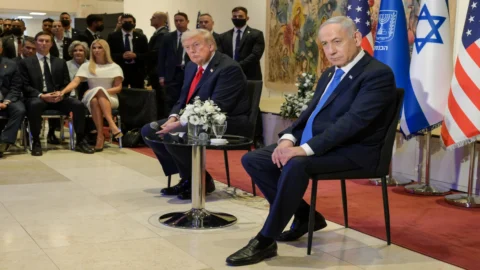
“Israel rejects the document in 15 points” and will not withdraw the IDF from the Strip "until Hamas is effectively disarmed." With these words, Netanyahu publicly rejected the new American roadmap for Gaza, belying expectations of progress on the political path announced in recent weeks by Trump. The Israeli Prime Minister accompanied his rejection with an equally clear position on future of the Palestinian territories"As long as I am prime minister, there will be no Palestinian state, neither in Gaza nor in the West Bank. Neither Fatahstan nor Hamastan," he stated during the cabinet meeting.
Israeli rigidity does not only concern Gaza. Netanyahu also reiterated that, “With or without a deal,” Israel will not allow Iran to acquire nuclear weapons. And according to the Israeli broadcaster Channel 13, the armed forces continue to prepare for the possibility of new unilateral operations against Tehran even without the direct involvement of the United States.
Meanwhile, the entire region remains unstable. In southwest Syria, new Israeli incursions have been reported in the Quneitra area, while in Lebanon, Israeli forces reportedly entered the village of Zawtar al-Gharbiyeh, where a barrier has been erected blocking an access road. Egypt is also escalating its diplomatic confrontation over the Palestinian issue. Foreign Minister Badr Abdelatty has defined any plan to evacuate Palestinians from Gaza as a "red line," arguing that the population's possible departure cannot be considered voluntary if it is driven by unsustainable living conditions.
Yemen in flames again, Houthis attack Aramco and the port of al-Makha
The deteriorating situation is increasingly directly affecting the Arabian Peninsula as well. The Houthis have claimed responsibility for a drone attack on the Saudi Aramco refinery. in Jazan, where a fire broke out but was later extinguished without any casualties. The plant, capable of processing approximately 400 barrels of crude oil per day, had already been hit in previous weeks. The Iranian-backed Yemeni movement also declared that it had launched a new operation against the port of al-Makha, over the Red Sea, using missiles and drones. According to military spokesman Yahya Saree, Saudi troops and weapons depots were targeted. Yemeni sources reported attacks on the port's commercial pier and storage areas.
The new escalation comes a few days later the defense agreement signed by Saudi Arabia with Türkiye and Pakistan, according to which an armed attack against one of the three countries will be considered an attack against all. Ankara has clarified that the agreement is not aimed at Iran, but the timing confirms how the war is rapidly reshaping the regional security balance.
The tension also comes from theIraq, where a pro-Iranian militia has promised retaliation for previous US and Saudi attacks against the Popular Mobilization Forces. Iraqi authorities have also reportedly arrested three members of a cell accused of preparing military operations outside the country and of being in contact with Iranian officials involved in drone strikes.
War empties US arsenals, Pentagon raises alarm over missiles and interceptors
The continuation of the conflict is presenting a growing bill in Washington too. According to New York Times, the war against Iran is consuming rapidly some of the munitions most sophisticated in the United States, especially air defense missiles and long-range weapons.
The Pentagon's concern is not only about the immediate availability of the systems, but also about the American ability to simultaneously support any new crises in Europe or the Indo-Pacific (Russia and China would thus be "free to act"). To fuel the military effort in the Middle East, Washington has reportedly already transferred ships, aircraft, defense systems, and munitions to the area previously deployed in other theaters.
Numerous Tomahawk missiles and other long-range systems have reportedly been moved from Asia, along with hundreds of advanced interceptors from South Korea and other bases. Even with a production ramp-up, according to reported estimates, it could take more than two years to replenish some of the stockpiles used in the war.
It is in this context that the United States is increasing caution towards a new escalationAccording to CNN, Chairman of the Joint Chiefs of Staff Dan Caine warned the Trump administration that further operations against Tehran could prove counterproductive and that air strikes alone would not be enough to guarantee a victory.
Iran and the US are still far from peace, Hormuz remains Tehran's decisive lever.
While Washington seeks a possible diplomatic exit from the conflict, Tehran is still holding back on resuming negotiationsIran and the United States are not engaged in talks at this time, Foreign Minister Abbas said. Araghchi, specifying however that "messages are being exchanged through intermediaries." The Islamic Republic links any return to the negotiating table to American conduct. According to Araghchi, negotiations cannot resume "until the US ends its violations of the memorandum of understanding" reached in June.
At the centre of the negotiations remains above all the Strait of Hormuz, a strategic passage for global energy flows. Tehran and Oman are discussing an agreement which is now in its final stages and would need to define new shipping routes. But Iran has ruled out that an agreement with Muscat would automatically lead to the reopening of the Strait. "The talks with Oman are focused on the management of Hormuz, on the introduction of new routes, and we are in the final phase. We could reach an agreement, but that doesn't mean traffic in the Strait will be open, because first the US must accept our conditions“, Araghchi explained.