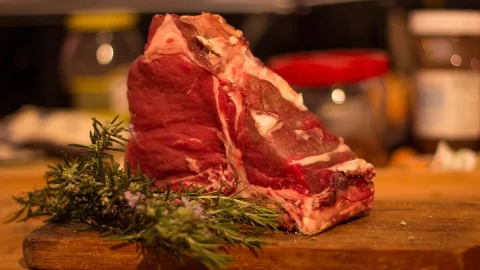
“Protect immediately Florentine steak“. This is the appeal of the Unione Cuochi della Toscana which together with the Accademia della Fiorentina are asking for the European sticker of quality that certifies respect for one of the most famous Florentine and Italian culinary traditions. A recognition against imitations, so that the dish is identified as a "Guaranteed Traditional Specialty".
"Protecting a gastronomic identity such as that of the Florentine steak means protecting a city's heritage - he said John Brajon, president of the Academy – in an increasingly globalized world the risk is a flattening, which leads to losing quality one bite at a time. We need European certification as a guarantee. The "Traditional Specialty Guaranteed" (Stg) is a brand used in Europe to enhance a traditional production method that must have existed for at least 30 years: this means that Fiorentina STG can be prepared in any country of the Union, provided that the production complies with the relative specification and is certified by an accredited control body".
The unwritten rules of Florentine steak
Its T shape, the inevitable bone and the important thickness have decreed its success and fame. It is a real institution, not only for Tuscany but for the whole country. The selection of the steak, the breed of the animal, the height of the cut and the cooking have strict parameters, unwritten rules known to enthusiasts, to be followed carefully to obtain the best possible result.
“There are many characteristics that must be followed for what is a supply chain product. From the type of meat: white-coated veal must be used, as well as Charolaise and Limousine, native breeds and breeds raised in the central Apennines - he added Roberto Lodovichi, president of the Regional Union of Tuscan Chefs -. Then the minimum height of 4 centimeters and the weight not less than one kilogram. The minimum maturation over 20 days, the type of culture, the wood used and other important aspects. Recognition is as important for chefs as it is for breeders and above all consumers who have the right to taste the real dish they order and not an incorrect reproduction”.
History
La Story della Fiorentina is as old as the city from which it takes its name and is linked to the family de 'Medici who governed Florence and Tuscany between the XNUMXth and XNUMXth centuries.
Florence, at that time, was an important crossroads where you could meet travelers from all over the world and so it is said that on the occasion of a San Lorenzo some English knights were present at the celebrations to whom meat was offered roasted on fires. They called it "beef steak". From here a translation adapted to the current language created the word steak which has come down to the present day.
How to prepare a perfect Florentine steak
An good cooking is the secret of all the taste of this iconic dish: the meat must be colored on the outside and red, soft and juicy on the inside, warm but not cooked.
The meat – previously aged for at least two weeks in cold storage – must be at room temperature at the time of cooking. The cut is about 1-1,5 kg, the height about 5-6 cm.
First of all, you need to heat the grill with plenty of charcoal embers, preferably using oak, holm oak or olive tree charcoal. There embers it must be very alive, just veiled by a light layer of ash, without flame. To absolutely avoid plates, gas, electric grills, with refractory stone. The meat must initially be close to the coals, so that an aromatic crust forms as quickly as possible, obtaining the so-called Maillard reaction, then after the first minute it must be raised to a “softer” flame.
At this point put the meat on top without seasoning, goes turned once, cooking it for about 3/5 minutes maximum per side. To turn it, never use "forks" or any other kitchen utensil that could penetrate the meat and break the crust that forms at the beginning of cooking. Instead, it must be turned, gently "pinched", with the use of a suitable tool, as the tool can cause the release of the precious "juices" that give flavor to the meat. Finally, it should be cooked "standing" on the bone side, for 5/7 minutes, no more, until the blood droplets disappear (it is actually myoglobin, a protein). The steak should be thick enough to stand on its own. Another school of thought, however, believes that meat should not be cooked standing up.
There is a third school of thought, called "reverse sealing“: consists in heating the piece of meat (in the barbecue or in a conventional oven) up to a core temperature of about 52° for at least two hours. Subsequently, the steak is placed in a previously heated grill or pan (preferably cast iron) (they must be hot) to create a brown and tasty crust, which is the consequence of the Maillard reaction. Finally, let the steak rest for 4/5 minutes and then serve, trying to cut against the grain.