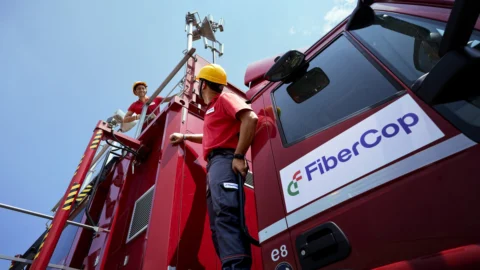
FiberCop and Nokia have signed a memorandum of understanding to collaborate in the experimentation of innovative technologies capable of transforming the fibre optic access network into a advanced monitoring platformFiberCop announced this in a press release, explaining that “fiber sensing” can support two main areas of application: network protection and environmental monitoring.
In the operational field, it allows to detect, locate and classify problems caused by events such as landslides, falling trees, roadworks, or vandalism, allowing for faster interventions, a reduction in field activities, and greater service continuity. The same infrastructure can also enable environmental monitoring services, detecting phenomena such as wind, temperature changes, seismic activity, floods, leaks or traffic.
The agreement announced today aims to explore both of these areas. The collaboration includes: joint research and testing activities on solutions that enable fiber not only to transmit data, but also to detect, thanks to artificial intelligence, events and variations along the infrastructure in real time.
"The technologies at the heart of the collaboration use the network as a distributed sensing system, capable of detecting physical and environmental changes, such as vibrations, temperature variations, or mechanical stress, through optical signal analysis. Fiber thus evolves from a connectivity infrastructure to a platform capable of generating useful information for infrastructure management, security, and resilience," the company explains in a statement.
Paggi, FiberCop: "A step forward in the evolution of fiber infrastructure."
“This collaboration represents an important step in the evolution of fiber infrastructures, which can become increasingly intelligent and capable of providing new useful information for their management,” declared Stefano Paggi, FiberCop's chief technology and operations officer. "The goal is to explore solutions that help strengthen network reliability and open up new application possibilities to support the economy."
“AI is fundamentally changing what networks need to do. Networks are no longer just transporting data—they're also helping operators understand what's happening in real time,” he said. John Harrington"By combining Nokia Bell Labs' innovation with our AI-enabled fiber sensing, we can help FiberCop transform its fiber network into an intelligent monitoring platform that offers reliable infrastructure that can sense, understand, and act in real time. Working together, we can support faster detection of network issues, enable new sensing-as-a-service applications, and create a more resilient network."
The planned activities will focus on two main areas: the advanced monitoring , predictive maintenance, to identify anomalies, performance degradations and potential outages before they occur; and the fiber sensing, to detect external events and environmental conditions, such as vibrations and movements, along the infrastructure. “These capabilities will help improve network security and support more accurate monitoring of the surrounding environment,” concludes FiberCop.
Testing will be conducted in controlled environments, including dedicated FiberCop laboratories and isolated fiber sections, with the aim of evaluating different technologies in terms of performance, accuracy, and applicable use cases.