Le European stock exchanges they move in no particular order after the new negative session of Wall Street and the heavy decline in price lists AsianThree factors are keeping the markets in suspense: the escalation of tensions between the United States and Iran and the new oil rise, the pressure on government bonds, with long-term yields returning to multi-year highs, and the new wave of selling in technology stocks, which rekindles fears of a possible bubble in the sector. Counterbalancing this is the Unitree's record-breaking debut, which in Shanghai gained as much as 629%, maintaining a rise of nearly 500% at mid-day.
After a difficult eve, European stock markets are therefore starting with caution: Frankfurt moves just below parity, Paris 0,2% salt, London of 0,04%, while at Milan the Ftse Mib it is hovering just below zero, clinging to the psychological threshold of 53 points. Madrid It is colorless, while Wall Street futures remain essentially unchanged.
US-Iran: Geopolitical risk once again pushes oil prices
The first element of tension comes from the Middle East. truce between the United States and Iran expired on Monday, August 17th and Donald Trump has ruled out new negotiations with Tehran, arriving at defining the Strait of Hormuz as a “new US territory.” Iran, on the contrary, maintains that the passage is still closed. According to the Financial TimesFurthermore, Tehran may be ready to strike American military targets in Europe, further increasing the risk of a widening of the conflict.
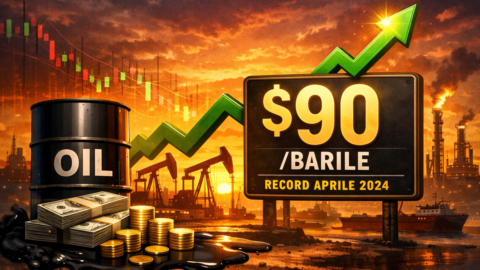
It is a picture that is immediately reflected in the raw materials. Brent rose above $91 per barrel, while WTI has reached close to 85 dollars, remaining approximately 25% above the levels before the outbreak of the conflict. Even the gas European crude oil is rising again, with the Amsterdam TTF hovering around €64 per megawatt-hour. The problem for markets isn't just energy costs: oil prices consistently above $90 risk fueling inflation again and complicating the path to rate cuts.
Meanwhile, geopolitical tension is intertwined with trade tension. Trump has announced a three-day suspension of 50% tariffs against Canada, explaining that Washington and Ottawa have reached an agreement yet to be formalized. The Keystone XL pipeline project is also back on the table.
Bonds under pressure: 30-year Treasuries hit their highest level since 2007
The increase in energy prices thus contributes to keeping attention high also on the bond market. The 30-year Treasury yield The yield on the eve of the meeting reached 5,3371%, the highest level in the last twenty years, while the 10-year yield remained at around 4,68%. Such high yields make government bonds more competitive with stocks and increase the cost of financing for companies, putting pressure especially on higher valuations. Even in Europe The pressure remains clear: the yield on the 30-year Bund is near the highs reached in 2011, the French one has risen by around 50 basis points since June and the 30-year British Gilt is approaching 5,9%.
In Italy The 10-year BTP yields around 4,07%, with the spread versus the Bund around 82 basis points. Energy and expectations are not the only factors contributing to yields. on inflation, but also fears about the sustainability of public finances, the increase in defense spending and the high American debt, now close to 40 trillion dollars.
For this i Fed meeting minutes The latest rate hikes at the end of July will be particularly closely watched. On that occasion, rates remained unchanged, but the decision was not unanimous: nine members voted to keep interest rates unchanged, while three supported a 25 basis point hike. Following weaker labor market data, lower-than-expected inflation, and slowing retail sales, the market continues to view a pause in interest rates as likely in September, but does not rule out a hike by December if price pressures were to intensify again.
The final data on the matter will also arrive before the minutes.Eurozone inflation in July, expected at 2,9%. Operators are also looking to the intervention of the ECB president Christine Lagarde at the World Economic Forum in Geneva, hoping to gain insights into the outlook for the European economy and the next phase of monetary policy.
Asia in sharp decline, technology back under scrutiny
The climate of caution is particularly evident in Asia, where the sales hit technology stocks the hardest. Kospi South Korean lost 5,8%, with Samsung Electronics down 7,72% and SK Hynix of 9,2%, while the Nikkei di Tokyo left more than 3% on the ground. More limited declines also affected Shanghai, Hong Kong, Taiwan e Sydney.
The sector's weakness has already been seen on Wall Street, where the Nasdaq fell 1,3%. Micron fell 7%, Nvidia 2,3%, and Broadcom 3,2%, rekindling debate about the sector's valuations and the sustainability of AI investments.
In this context, the debut of makes even more noise Unitree, one of China's leading manufacturers of humanoid robots. The company, founded in 2016 by Wang Xingxing in Hangzhou, raised approximately 6,1 billion yuan, equivalent to approximately $904 million, by listing on the Shanghai Star Market. The offering price was set at 150,80 yuan per share, but the stock surged 629% at its debut, holding nearly 500% at mid-session. This surge, just as the market fears a potential bubble in the tech sector, further underscores investors' enthusiasm for the new frontier of AI and robotics.
READ MORE Artificial intelligence, official figures don't tell the whole story: for US Big Tech, a loose cannon of $3.000 trillion in off-budget commitments. di Vittoria Patane
Banks in Milan under spotlight, oil stocks performing well
At Piazza Affari, attention remains focused primarily on the banking game. Ps moves just above parity, while Bpm bank e General Bank they are rising. As reported by Il Sole 24 Ore , the CEO of MPS Louis Lovaglio The board may submit two extraordinary transactions to the board in response to Intesa Sanpaolo's takeover bid: a potential takeover of Banco BPM and a second of Banca Generali. Some board members have reportedly already been alerted to a possible meeting.
On the rest of the price list, purchases prevail on Stellantis and on energy-related stocks. In particular, they are advancing Saipem (+ 1,34%) and Hera (+0,89%), followed by Tenaris (+0,87%) ed Eni (+0,73%), supported by the strengthening of oil prices. The increases in Snam (+ 0,56%) and Italgas (+0,55%). Defense stocks also performed well, with Avio (+ 1,45%) and Leonardo (+1,01%) well bought, while Fincantieri (-0,75%) moves against the trend.
On the other hand, the technology sector weighs heavily, with stmicroelectronics down 1,29% e Prysmian of 1,16%, following the weakness of semiconductors at the international level. Among the declines also Moncler (-0,78%), Inwit e nexi (-0,65%).
Euro stable, gold rises and silver falls
On the currency market theeuro rises to 1,1593 dollars, while the euro-yen exchange rate stands at 184,60 and the dollar-yen at 159,22. Among raw materials, the rally of the , which remains around 4.352 dollars an ounce, up 0,43%, while thesilver spot falls by 0,33% to 63,14 dollars an ounce.