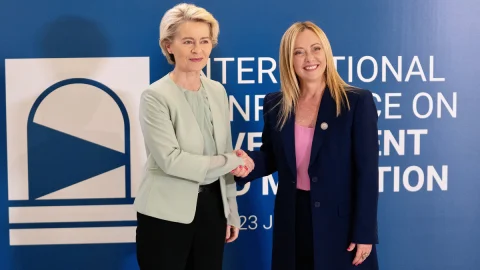
La Letter from Giorgia Meloni to Ursula von der Leyen will remain without a real formal response. Brussels, at least for now, does not require a written reply Italy's request to extend the Stability Pact exemption already in place for defense to energy. The response will be much colder and more institutional, inside the European Semester package and in the spring economic recommendations. For Palazzo Chigi, this is not exactly the political signal they were looking for. The Prime Minister had tried to transform the high energy prices into a game of principle, arguing that Europe could not grant flexibility for defense while denying it to families, businesses, and workers affected by the price increases. But the Commission chose not to engage in a direct exchange. No letter, no solemn recognition of the Italian position, no full victory to claim. Just a technical opening, limited and very conditioned.
Brussels' non-response
The Commission's move is clear. Instead of formally responding to the Prime Minister, Brussels entrusts the message to the European Semester packageIn other words, the EU is not granting Meloni the platform for political confrontation that Palazzo Chigi had attempted to open, but is bringing the issue back within the rules of public finances.
The Italian request arose from an attempt to broaden the scope of the national safeguard clause, provided for defense spending, to also include interventions against energy costs. Meloni had linked energy security to European security, arguing that families and businesses deserved the same attention given to military investments. This argument was effective in internal communication, but more fragile in European negotiations, because it combined two very different spending categories and attempted to transform an exemption created for defense into a good precedent for utilities and fuel.
Brussels, which in recent days had already made it known that his position had not changed, Now it only opens a crackBut it does so on its own terms. Not a broad exemption, not a green light for the most electorally viable symbolic measures, not a check to finance immediate discounts. The line remains that of the tax liability.
Six and a half billion, but on a short leash
Lo The fiscal space that Italy should obtain is worth approximately 0,3% of GDP, equal to 6,5 billion euros, within the margin already authorized for defense. This is therefore not a new autonomous lane for energy, but a mini-clause inserted within the 1,5% of GDP perimeter military spending is expected to be spent in four years. Time is also tight. Energy flexibility should last 18 months, until December 2027, and not four years as for defense. This reduced concession allows the government to claim it has achieved something, but at the same time significantly downplays the political significance of Meloni's request.
The most delicate point concerns the use of funds. The resources they cannot be used to cut excise duties on petrol nor to intervene directly on citizens' bills. Instead, they will have to finance targeted investments in the fields of decarbonization, energy efficiency, electrification, renewables, and more generally the green transition. And this is where the government's narrative risks stumbling. The prime minister had framed the battle as an immediate defense of families and businesses against high energy costs. But the European response, even when it allows for margins, obliges them to structural interventions and not direct relief measures.
The government's possible accounting game
The government could though look for an accounting way outOne of the hypotheses is move resources already foreseen for interventions compatible with the mini-clause, such as energy efficiency or other green measures, thus freeing up space for other chapters. In this way, Palazzo Chigi could try to indirectly use the European margin to finance more politically useful measures. It's a path that resembles a three card gameFormally, the funds would remain within the limits set by Brussels. Politically, however, the government could try to transform the flexibility for green investments into a margin for developing more publically appealing responses to energy costs.
The problem is that the The Commission has narrowed the field considerablyNot only did he avoid a direct response to Meloni's letter, but he also prevented the exemption from becoming a widespread tool for supporting fuel and utility bills. The European opening is there, but it is very far from the political framework built by the Prime Minister, who had tried to present the match as a test of the Union's coherence between military security and energy security.
The timing also plays a role. The 18-month window extends until the end of 2027, a politically sensitive period for the Italian government. Precisely for this reason, the mini-clause may prove useful to Palazzo Chigi, but not enough to erase the partial and conditional nature of the outcome.
The issue of the accounts remains open
Furthermore, the game is not over. mini-clause will have to pass through the Council and resistance could emerge, even though Brussels is confident about the final green light. In the background, however, remains the most pressing issue for Italy, the infringement procedureThe flexibility granted under the safeguard clause is in theory intended toavoid entering the procedure. But Italy is already in the surveillance process, also because it failed to bring the deficit below 3% of GDP in 2025. Using the new 0,3% margin may therefore not be enough to unlock the exit from the procedure and may even risk keeping the issue open in 2026.
An ambiguous outcome for the Meloni government, which can claim an opening after weeks of pressure on Brussels, but without achieving a full political victory: the Commission avoids a formal response to the prime minister's letter and limits flexibility to green investments, excluding the most immediate measures for families and motorists. In the end, a few billion are granted, but with tight constraints, a short timeframe, and no obvious shortcuts on public finances. More than a break with Brussels, for Meloni it seems like a supervised concession.