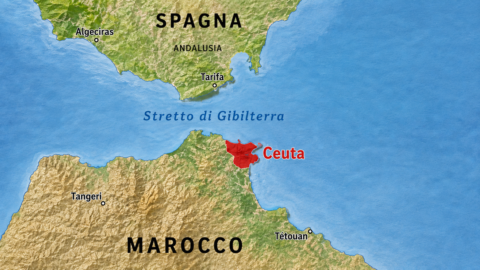
The attempt by the Italian and Danish governments to exploit the migrant crisis in theSpanish exclave of Ceuta for purely domestic political purposes.
Il extraordinary summit of the EU Justice and Home Affairs ministers requested in a letter, signed by 22 European countries with Italy and Denmark as leaders (without Spain, France, Portugal, Luxembourg and Ireland), ended yesterday with a full solidarity with the Spanish government led by Pedro Sanchez for crisis management, which has never threatened the Schengen area. No decision has yet been made on third-country hubs for the repatriation of irregular immigrants, a topic that will be discussed at the next European Council in October.
The EU Council expressed solidarity with Sanchez: "Continue to fight migrant trafficking."
From the Council "a shared vision emerged on need to continue to fight migrant trafficking relentlessly, to strengthen returns, to strengthen the EU's borders, to build strong partnerships with third countries and to improve predictability." The ministers stressed that "communication should be more coordinated and more coherent, especially to counter malicious external actors engaged in information manipulation and interference from abroad."
First of all the figures: the migrants who entered Ceuta were 72.000 in total, of these 70.000 have already returned to Morocco. 75 bodies of drowned people have been recovered from the sea so far. No migrants have reached Spain From Ceuta and EU ministers acknowledged that there have been no movements of migrants towards mainland Spain after the massive influx in Ceuta.
EU: No Schengen violations, funding coming to Madrid
EU Migration Commissioner Manfred Brunner confirmed that there had been no violation of the Schengen area and that the Spanish government will be able to count on funding to strengthen border controls. Brunner said he understands Italy's position "because people are concerned. This is also why the Schengen Borders Code includes some safeguard clauses. I believe that when these measures were discussed by Italy," Brenner added, "the situation was different, but in recent days it has evolved, and at the time it wasn't clear what was really happening. But now the situation has changed, and we know that people have been repatriated. It's good news that what happened at our external European border is under control."
According to Brunner Ceuta was one “stress test for the Union, for European resilience and for the security of external borders”The EU, Brunner then said, is ready to offer Spain "emergency financial assistance" to strengthen surveillance at the Union's external border in Ceuta. According to the commissioner in Madrid, an additional €28 million could be received beyond the funds already earmarked. Regarding the issue of immigrant regularization, decided by Spain (well before the events in Ceuta), a move that Italian Foreign Minister Antonio Tajani had called "a dangerous choice for the entire European Union," Commissioner Brunner, while noting that the matter falls within the competence of the member states, could only comment: "It certainly isn't a good sign for the rest of Europe."
Piantedosi: "Closing the borders was not a decision against Spain."
Italian Interior Minister Matteo Piantedosi He wanted to clarify "clearly that the nature of our decision to temporarily reinstate controls at internal air and sea borders is in no way a measure directed against Spain or any other partner." Rather, it is "a precautionary and organizational choice, intended to protect national security and the stability of the entire European border control system at a time of great pressure, as has occurred in so many other cases."
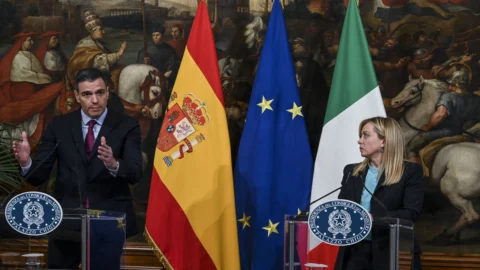
Spanish Interior Minister Fernando Grande MarlaskHe denied any criticism of Madrid and reiterated his government's opposition to reception centers in third countries. He also stated that he "considers Italy's action in suspending the Schengen area to be absolutely superfluous and disproportionate," demanding that "border controls be lifted immediately because the Schengen area has never been in danger." According to the minister, "there was no risk of secondary movements, given that Ceuta has a special regime and no one leaves Ceuta without being checked."
The French minister: "Schengen is not the problem but the solution."
The dangers, he underlined, if anything come from other areas: “We have recently recorded secondary movements in Spain Not across the Mediterranean but from the East." The promptness of the Spanish response was also underlined by Denmark. "I am very satisfied that Spain acted quickly, especially with the deployment of police and army, and that many migrants have already returned to Morocco," he acknowledged. Danish Minister for Immigration and Integration Morten Bodskov.
“However,” he added, “events demonstrate that it is absolutely essential to have control of the EU’s borders.” French Interior Minister Laurent Nuñez, explained that the Schengen area "is not the problem," but "the solution." All European ministers, he explained, "deplored the fact that, following the release of images" of the Ceuta crisis, "there were several instances of information interference by foreign states that used these images to criticize the European Union's migration management policy, seeking to divide member states."
Spain and France oppose repatriation centers
The issue of repatriation centres in third countries remains, which Spain and France, among others, continue to oppose. "Five, or rather six, member states are working together to discuss the creation of repatriation centers with third countries," said EU Commissioner Brunner, adding, however, that this "is a legitimate choice that belongs to the member states that wish to proceed in this direction."
Finally, according to a Moroccan government source, "160.000 migrants have been stopped in two years and the Kingdom of Morocco has always fully assumed its responsibilities in managing irregular migration, investing significant human, logistical and financial resources to control migratory flows and to combat criminal networks dedicated to human trafficking." But Morocco is "neither the policeman nor the carer of Europe", but a sovereign partner, and not a subcontractor."