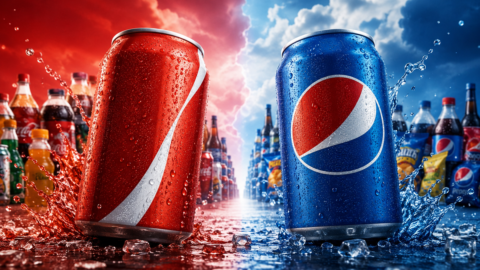
There are few rivalries in consumer and financial terms that can span an entire century while maintaining their symbolic power intact. The one between Coca-Cola and Pepsi is one of them. For over a hundred years, the two companies have fought a trade war made of memorable advertisements, comparative campaigns, price wars and continuous reinventions of the most iconic product in the modern food industry: cola, the most famous and most consumed carbonated drink in the world.
But today the battle has changed radically. It's no longer just about which can ends up in Americans' shopping carts or which commercial dominates the Super Bowl. The real battle is being played out over much deeper issues: public health, weight-loss drugs, inflation, consumer spending changes, ultra-processed snacks, and the redefinition of industrial chains. And it's in this new scenario that an increasingly clear fact emerges: while Coca-Cola appears more solid and consistent today, Pepsi is going through a strategic repositioning phase which could redefine its very identity.
Two now very different companies
For decades, Coca-Cola and Pepsi were perceived as almost mirror images of each other: two soft drink giants engaged in the same trade warIn fact, over time, their business models have diverged profoundly.
Today Coca-Cola brands control about 17% of the U.S. market of soft drinks, compared to Pepsi's 11%, according to Beverage Digest. But the most important difference is another: Pepsi is no longer just a beverage company. Over half of the group's revenue now comes from packaged foods and snacks, through brands like Lay's, Doritos, Tostitos, and Quaker Oats.
This transformation, which for years seemed to be a strong point — greater diversification, less dependence on cola —today it's also proving to be a vulnerability. Because the packaged snacks sector is one of those most exposed to changing eating habits.
Coca-Cola, on the other hand, has gradually chosen a leaner and more focused model. About a decade ago, it refranchised much of its bottling operations in the United States, streamlining its industrial structure and focusing more on global marketing and distributionPepsi, on the other hand, has retained direct control of domestic production, with higher operating costs and a less flexible structure. Now, however, something is changing: the blue-chip outsider is starting, at least in part, to imitate the model of its historic rival.
Inflation, prices, the stock market and tired consumers
The last two years have clearly rewarded Coca-Cola. Since the beginning of 2023, the company's market value has increased by approximately 23%, while Pepsi has lost 15%. Looking at what happened on Wall Street, Pepsi shares have risen 7,1% over the past six months, compared to Coca-Cola's 12,7%. and 11,6% of the sector's benchmark index.
Pepsi's slowdown is primarily due to its management of the post-pandemic inflationary phase. Like many multinational food companies, the group aggressively raised the prices of snacks and beverages to protect margins. But the price increases were even higher than those of many competitors, and this in the long run had a boomerang effectAmerican consumers, increasingly price-sensitive, have begun to shift toward alternative brands, private label products, and cheaper segments. The slowdown has hit snacks hardest, a traditional driver of PepsiCo's profitability.
To further complicate the picture, the American market's new health obsession has arrived. Ultra-processed foods have increasingly come under fire, while the spread of GLP-1-based diet drugs—medicines used for weight loss—is changing the eating habits of millions of people. According to the consulting firm AlixPartners, Americans taking these drugs reduce soft drink purchases by approximately 7%, like Coca-Cola and Pepsi, except that the latter is also suffering in the snack sector.
Coca-Cola's strategic advantage
In this context, Coca-Cola seems to have intercepted the change more quickly. The company clearly dominates the sugar-free cola market. In the United States Diet Coke consumption is about two and a half times higher than Diet Pepsi consumption.. Furthermore, Coca-Cola has moved more quickly in categories considered most consistent with the new health paradigm: functional drinks, sugar-free versions, ready-to-drink coffee and protein shakes.
The strategy of the Atlanta-led company is now very clear: to transform itself From cola producer to global diversified beverage platform, focusing on premiumization, selective innovation, and higher-margin brands. Marketing also reflects this approach. Coca-Cola continues to invest in large-scale global campaigns and high-visibility innovations, seeking to preserve the symbolic value of the historic brand while adapting it to new consumer sensibilities.
Investors' attack on Pepsi: Elliott's entry into the company's capital
The pressure on Pepsi has become so evident that it has even attracted activist investors. Last September Elliott Management has acquired a stake worth approximately 4 billion of dollars into the company, sending a very clear message to management: a profound restructuring was needed.
Among the hedge fund's demands were: cost reduction; simplification of the product range; greater focus on the core beverage business; cutting less profitable brands; and outsourcing bottling to the United States. Pepsi managed to avoid the fund's direct involvement in its board of directors, but it nevertheless initiated a series of measures that mirror many of Elliott's demands.
The company has lowered prices on several snack products, announced the elimination of about a fifth of its brands, closed some plants, and begun evaluating experimental forms of bottling outsourcing in some U.S. states. Historic but underperforming brands, such as Quaker Oats, could be sold or downsizedIn other words, Pepsi is trying to become more agile, less distracting, and more focused. More like Coca-Cola, in fact.
The bet on the relaunch of snacks
Despite the difficulties, the first signs of a turnaround are starting to emerge. The PepsiCo Foods North America (PFNA) segment, the core of the company's snack business, recorded organic volume growth of 2% in the first quarter of 2026 and a 1% organic revenue increase. For management, these numbers represent the first real sign of stabilization after a long period of slowdown.
The strategy is based on three guidelines: More affordable prices; simplified ingredients; and wellness-focused innovation. Pepsi is therefore expanding the distribution of snacks perceived as healthier and made with simpler ingredients, thanks in part to the expansion of acquired brands like Siete. At the same time, it is working to relaunch historic brands like Tostitos and Quaker through new formulations and an image repositioning.
Poppi's move and the new war of functional drinks
One of the most interesting signals of the new Pepsi strategy was the acquisition of Poppi, a prebiotic soda brand purchased for approximately $2 billion. The move clearly illustrates the transformation underway in the beverage industry. New generations no longer seek just flavor or caffeine: they want products associated with intestinal health, natural ingredients, reduced sugar content, and functional benefits.
The growing success of “better for you” drinks It's redefining the entire global beverage market, even pushing established giants to chase startups and emerging brands. And this is where Pepsi is attempting to regain ground. Operating results for the first quarter of 2026 already show significant improvement: operating profit grew 24% year-over-year, even outpacing the 19% increase seen by Coca-Cola in the same period. Fears of Dr Pepper overtaking the American soft drink market also appear to have subsided.