The rises to new highs of Wall Street last week, they triggered a powerful injection of confidence in the markets and risk appetite, also leaving aside the uncertainties linked to the duties that the market seems to have already metabolised.
One index in particular highlights this trend: it is the Fear & Greed Index (Fear and Greed Index) which measures market sentiment and tries to understand whether the market is in a phase of “fear” (selling tendency) or “greed” (buying tendency). The index, developed by CNN Business and from other platforms such as Alternative.me, combines several data points to calculate a score that ranges from 0 to 100, where 0 indicates extreme fear, suggesting that the market may be oversold and that there may be buying opportunities, and 100 indicates extreme greed, suggesting that the market may be overbought and that a correction may be imminent.
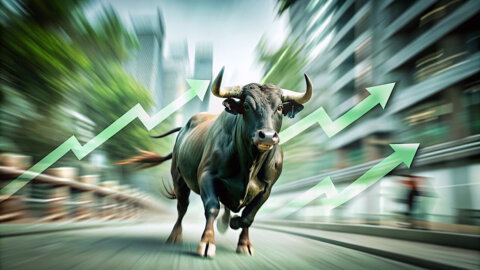
Wall Street as at the Pamplona Bull Run
Today, for the first time in 2025, the index has positioned itself in the so-called “Extreme Greed” territory. “The week opens where we closed last Friday: with greed back in the spotlight on the markets. The Fear & Greed Index has reached 78, marking for the first time in 2025 entering the territory of “Extreme Greed” observes Gabriel Debach, market analyst at eToro. “A signal that is not surprising, but which confirms the climate change registered from April onwards: I'euphoria has taken the place of prudence, momentum has supplanted inertia.”
Wall Street: Fear or Greed in 2025?
And just as at Pamplona this week the traditional kicks off running of the bulls for the San Fermin festival, the markets seem to be living their own personal fiesta. “A bull market launched in full sprint, legs forward, head down and no desire to look back” says Debach. “Greed leads the group, fear stays behind. But as in the Navarra race, the same logic applies in the stock market: the longer the push, the narrower the spaces become. It doesn’t take a fall to change the pace. Sometimes a curve, a breath, a pause is enough. It is in the speed of the race that the first sign of tiredness hides. But you always notice it afterwards, never while you are running”.
Yet 2025 has not been a monolith so far. “It has been a year of two faces,” says Debach. This is clearly shown by the trend of the S&P 500 to Stoxx 600 ratio: ten consecutive weeks of weakness for Wall Street between January and the end of March, followed by seven weeks of rebound uninterrupted. The key fact is that the ratio has fully recovered the ground lost in the previous three months. This is not a symmetry, it is a demonstration of strength. It took a 11% increase to cancel out an 16% loss.
That rebound, not by chance, is left the week of April 9th: the day the White House announced a 90-day suspension on new tariffs. A trade truce that marked thestart of the american rally, and which closes this very week. It is not just a chronological detail. It is a reminder. Because while the US indices update all-time highs and the sentiment goes beyond theeuphoria, one of the most sensitive variables for the markets is back on the radar: trade policy.
The S&P 500 rally itself, born from an emotional shock and fueled by repositioning, is already among the most quick returns at historic highs in the last fifty years. Faster than 2019, more orderly than 2020, more direct than 1991. But it is precisely in moments of enthusiasm that the market becomes more demanding. Confidence is high, positioning is aggressive. But indulgence is also increasingly low, concludes the analyst.