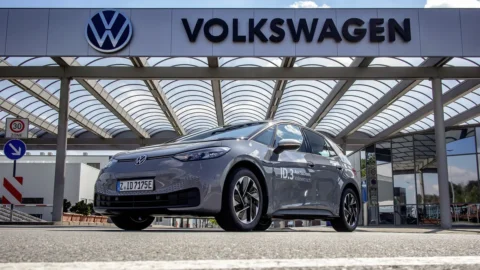
2025 was a complex year for major European automotive groups. Volkswagen he saw the profitability collapse under the weight of Costs growing, duties commercial and one competition increasingly aggressive global, all the while investing in the transition to electricTo remedy the situation, the German group has launched an industrial reorganisation plan which includes the around 50 jobs to be cut in Germany by 2030, a figure higher than initial estimates, aiming to make the structure leaner and ready to restart with more solid margins.
The Renault look to the future with a clear strategy: electrification, new models and technological innovation. With the futuREAdy plan 2026-2030, the group aims to grow in Europe, South America and India, optimize costs and build customer loyalty, while preparing the ground for future expansion to compete with China and the United States.
Volkswagen 2025: Profits and Dividends Down
In the 2025 budget, the German car manufacturer recorded revenues equal to 321,9 billion euros, substantially stable compared to the previous year but with a operating profit fell by 53% to 8,9 billion euros, bringing the edge operating to 2,8% from 5,9% in 2024. The group's difficulties emerged even more clearly in the final part of the year, with revenues falling by 4,7% to 83,25 billion euros and operating profit falling to 3,46 billion, lower than analysts' expectations, which estimated operating profit of 4,13 billion on revenues of 85,16 billion.
The decline in profits reflects factors such as tariffs in the United States, unfavorable currency effects and strong international competition, especially in China. The slowdown in the Porsche's electric transition, whose operating profit fell by 98%, falling to just 90 million euros, with an operating margin of 0,3%.
On the shareholder remuneration front, the board of directors will propose a dividend of 5,26 euros per preferred share and 5,20 euros per ordinary share, a reduction of 17% compared to the previous year, consistent with the minimum payout policy of 30% of net profit.
Sales and orders: Europe up, China and North America down
From a commercial point of view, the sales Volkswagen's global sales remained essentially stable at around 9 million vehicles, but the trend was highly differentiated geographically: Europe and South America recorded growth of 5% and 10% respectively, while North America and China have registered a drop, respectively 12% and 6%, due to the increasing competitiveness of these markets. Despite this, orders in Europe increased by around 13%, driven by 100% electric models, which now represent around 22% of the group's order book.
Volkswagen to cut 50 jobs in Germany by 2030
To address these difficulties, Volkswagen has initiated an industrial reorganization plan that includes a downsizing of the workforce. in Germany around 50 thousand jobs by 2030, higher than the initial estimates of 35 thousand, as part of a program aimed at generating annual savings of approximately 15 billion euros. The market reaction was immediately positive: the title Volkswagen to the Frankfurt Stock Exchange rose about 2,6%, exceeding 90 euros, signaling that investors appreciate the cuts plan and the prospects for greater efficiency, despite the decline in profits recorded in 2025.
For 2026, the group foresees revenues stable or growing up to 3% and a edge operating between 4% and 5,5%, while in the medium-long term it aims for an operating margin between 8% and 10% by 2030.
Renault focuses on electric vehicles and technological innovation
Renault has presented the futuREady strategic plan 2026-2030, confirming its course towards the electric e the hybrid and aiming at operating margins between 5% and 7%, with a cash flow from the automotive division of at least 1,5 billion euros per year. The strategy combines product relaunch, cost reduction and focus on key markets, with attention to Europe, South America and India, while China e United States They will be evaluated later, possibly through alliances. According to the CEO Francois ProvostThe plan is based on growth and product, acceleration of key technologies, maximizing operational performance through artificial intelligence, and cooperation with teams, dealers, and partners. Renault will launch 36 new models by 2030, developing innovative modular platforms such as the Rgev medium 2.0, with 10-minute fast charging thanks to 800 Volts, and the Rgea, an adaptation of the Chinese Gea platform for electric, plug-in hybrids and range extenders, while the E-Tech technology will continue to support small hybrid models.
International growth and customer loyalty
The plan also concerns individual brands: Renault will strengthen its presence in Europe with 12 new launches and will keep the hybrid beyond 2030, while internationally it will launch 14 models and aims to sell over 2 million vehicles per year by 2030, half of which outside Europe. Dacia will continue with its competitive offering, accelerating electrification to cover two-thirds of sales and strengthening the compact sedan segment, while Alpine will relaunch the new generation A110 and the A290 and A390 models, focusing on exclusivity and customization.
From an operational point of view, Renault aims to have a two-year development cycle, reduce quality incidents by 50% and cut approximately 400 euros per year in variable costs per vehicle, while strengthening loyalty and value over the second and third life of the vehicle. analyst Oddo Bhf considers the plan a strategic continuation, but with a clear acceleration towards innovation, international expansion and competitiveness against Chinese producers. The reaction of the market it was positive: at Paris Stock Exchange, title Renault rose about 1% to 28,44 euros per share.