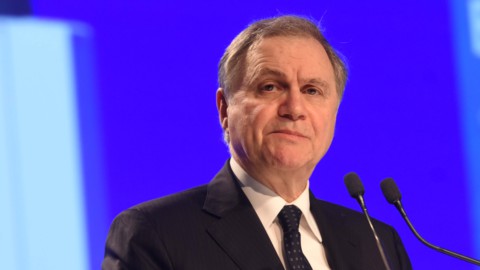
"We've had two recessions, some say there will be another one, it's possible." Ignazio Visco, confronted yesterday at Bocconi with the elite of finance and industry, tries to raise the tone with respect to the petty controversies in which the political news is debated in these "Difficult Years", to refer to the title of his latest book. The recession mentioned by the governor of the Bank of Italy is not the technical one into which the Italian economy has plunged, but a new type of phenomenon.
“Previous recessions – he explains – were of a financial nature, this one is of a real nature for reasons that are partly geopolitical and partly technological”. An epochal phenomenon that also affects Italy, also vulnerable because, the theme of the day at Bocconi, it suffers from the fragility of an overly bank-centric financial market. “Never come to say – he argues in his speech at the presentation of the study on corporate bonds by Professor Stefano Caselli promoted by Equita – that the governor of Bank of Italy comes here to say that banks are of no use. No, banks are essential. But the credit system, while remaining an essential source of financing, alone will not be able to support the growth of investments, especially those necessary to innovate and compete on international markets".
In short, there is no shortage of things to do. Better not to lose course despite the torpedoes arriving from the front of the majority. On the central bank independence front. "I believe that Bankitalia is independent and autonomous, I don't see any attack on autonomy". Then he adds, however, that “there is instead a sometimes uncertain vision of responsibilities. There are those who say that there cannot be independence and irresponsibility at the same time: I agree, we need to be accountable”. And on the question of the ownership of the gold kept in via Nazionale there is no matter for discussion because "the law already exists".
Better to talk about how to kick-start investments, a fundamental ingredient for restarting the economy which "maintains on a stable growth path if companies are able to invest to rapidly evolve their business models according to changes in demand , in technology, in the availability of resources”. A virtuous path that the Bel Paese, even before the current political turbulence, has lost: "In the experience of recent decades, this capacity has been limited overall". The result? “The collapse of private investments, which was accompanied by the no less serious one of investments in infrastructures and other public works, has made manifest the difficulty of our production system in responding to the challenges posed by globalisation, by the extraordinary affirmation of new technologies, by demographic trends". A gap that has emerged mercilessly in the years of the recession. “Growth difficulties were exacerbated by the double-dip recession that followed the global financial crisis. Between 2007 and 2013, investments fell by 30 per cent; are still well below the pre-crisis level”.
In short, to get out of the shallows, there is only one recipe: invest. “To this end, it is essential to ensure that companies operate in a favorable macroeconomic context in terms of the level of the tax burden, the functioning of the labor market, the availability of infrastructures and the efficiency of the public administration. An essential factor for investments is the availability of financial resources for businesses, adequate in quantity and quality".
Is government action going in the right direction? Visco understandably avoids raising the tension further, but allows himself a reference, only one, to the choices of the Executive: the legislation on the ACE, the Aid to economic growth, had the effect of reducing the fiscal disadvantage of the risk capital rather than debt, providing incentives to strengthen corporate capital". It is a pity that the provision was abolished by the Maneuver to finance the flat tax. Indeed, Visco underlined that "measures in favor of risk capital similar to those adopted in Italy form an integral part of the proposal for a Community directive on the common taxation of companies", while "the abolition of the ACE this year, with the law budget, risks going in the opposite direction. A more accurate assessment can only be made when the alternative mechanism linking the tax benefit to self-financing, to the increase in production capacity and to employment is operational”.
However, there is a common thread that links today's problems to the historical vice of the excessive dependence of companies on banks and to the preponderant role of debt over risk capital”. As early as the 1984s, recalls Visco, Piero Sraffa observed that in Italy financing by banks "represents an absolute necessity for industry". And Carlo Azeglio Ciampi recalled in his Final Considerations on XNUMX that "the reluctance to seek resources on the share capital market, dictated by the fear of losing ownership control, has been at the origin of crises in companies still endowed with good production capacity and sale, but weakened in the financial structure".
But the shortcomings of the Italian system are much more significant and deeply rooted. It is increasingly urgent to develop non-bank finance segments capable of providing resources in the most suitable forms, from business angels to restructuring operations, from venture capital to access to equity and bond markets. "It is necessary - the Governor underlines - a wider diffusion, compared to the currently very limited one, of the investment banking activity". But the path is complicated by the very structure of the production system: “The prevalence of small and medium-sized enterprises corresponds to that of banking intermediation, while recourse to the capital market is historically limited. This is not an efficient configuration”. Nor does the will to equip itself with adequate tools for governance and transparency in line with international challenges emerge from below. "It is indicative - he comments - the fact that only about 500 Italian companies participate in a Borsa Italiana program aimed at supporting companies in the realization of their growth projects and in improving their visibility with investors".
Italian companies thus continue to be characterized by a high degree of dependence on bank credit. Despite having decreased by over 7 percentage points since the end of 2011, the incidence of bank loans on total financial debt is now close to 60 per cent, the highest value among the main countries of the area and still higher by over 25 and 30 per cent points to those of the United States and the United Kingdom. The share of bonds, although rising to 13 per cent (a value in line with the euro area average), is still around 4 points lower than that of the United Kingdom and more than 5 points lower than that of the United. The degree of development of stock markets also remains insufficient: at the end of 10 the capitalization of listed non-financial companies was equal to 25 per cent of GDP, compared with 2017 per cent in Germany, over 25 per cent in France and the United Kingdom and about 60 in the United States.
In summary, despite various innovations (from the introduction of minibonds to the birth of PIRs) in Italy the substitution between bank credit and other forms of financing has been limited overall and has involved a limited number of businesses. And yet, concluded Visco, “a diversified financial system allows the economy to contain the effects of adverse shocks. In countries where market finance is more developed, the reduction in credit triggered by the global financial crisis was more easily compensated for by the greater recourse of companies to the bond market and non-bank intermediaries and the negative effects on the economy were overcome more quickly”.