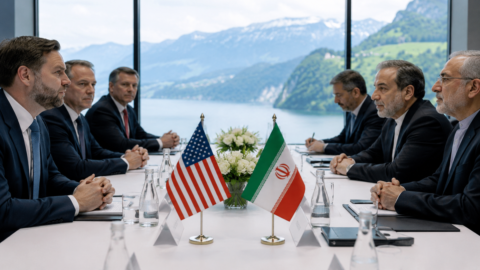
They were supposed to postpone, perhaps even jump. They remained suspended for hours on the Israeli attacks in Lebanon, Tehran's furious reaction, the threat to close the Strait of Hormuz, and the risk that the negotiating table would collapse before it even opened. Instead, today, June 21, the first talks between the United States and Iran they leave in Switzerland, in the Bürgenstock resort, overlooking Lake Lucerne. American Vice President J.D. Vance has arrived in Switzerland for theofficial start of negotiations with Iranian leaders. At the center of the table are Tehran's nuclear program and the attempt to strengthen the fragile interim agreement which should stop the war and stabilize the Lebanese front.
"We need to continue managing the situation between Israel and Lebanon," Vance said. The vice president will stay in Switzerland for a day or two and hopes the summit will yield progress on both the nuclear issue and the ceasefire in Lebanon. "Those are the two things I think we're focused on. I'm sure the Iranians will have issues they want to discuss," he explained.
The day should open with a emergency discussion on the conflict between Israel and Hezbollah, indicated by a diplomat to CBS as the first dossier on the table. Lebanon, even more than nuclear power, has become the immediate test of the negotiations' viability.
US-Iran: Full delegations, low expectations
The diplomatic machinery had already been in motion in the preceding hours. The White House special envoy Steve Witkoff arrived yesterday in Switzerland, welcomed by Jared Kushner, son-in-law of President Donald Trump and another American mediator in the dossier. The two worked on the technical aspects of the negotiation, made more uncertain by the ongoing clashes between Israeli forces and Hezbollah.
From Tehran A high-profile delegation has arrived. It is led by the President of the Parliament. Mohammad Bagher Ghalibaf, together with the Foreign Minister Abbas Araghchi, to the Governor of the Central Bank Abdolnaser Hemmati and to the Deputy Minister of Oil Hamid Bovard. The Pakistan confirmed the participation of the Prime Minister Shehbaz Sharif and the head of the army, the field marshal Syed Asim Munir. Also expected is the Qatar, which together with Islamabad played a role in the mediation.
Expectations, however, remain lowVance himself admitted that the agenda is still fluid. "We'll schedule the talks when representatives of the Iranian, Qatari, and Pakistani governments arrive," he said, adding that "these things are always evolving."
The Iranian side's tone is no less cautious. Foreign Ministry spokesman Esmail Baghaei made it clear that Tehran will use its trip to Switzerland to demand that the United States honor its commitments. "This trip serves to demand that the American side fulfill its obligations," he warned, "if this does not happen, the entire memorandum risks being jeopardized."
Hormuz and Lebanon, the mines on the table
The move by the Pasdaran, who declared that the negotiations were made more fragile, Strait of Hormuz closed in response to what Tehran calls Israeli violations in LebanonThe decision came as the United States and Iran are trying to flesh out a 60-day ceasefire and a memorandum of understanding signed Wednesday by Presidents Donald Trump and Masoud Pezeshkian. For Washington, however, Hormuz is not truly closed. The US Central Command said that 55 merchant ships passed through the Strait on Saturday, carrying over 17 million barrels of oil to global markets. Vance, before departing the United States, said he had seen no evidence of the Strait's closure.
Pressure remains extremely high on the Lebanese front as well. The ceasefire appears fragile, with Israel and Hezbollah continuing to accuse each other of attacks and violations. The US Vice President claimed that the situation in Lebanon is "improving" and that the escalation is under control, but Washington's stated objective remains "stabilize the situation in Lebanon".
Opposite signals are coming from IsraelFinance Minister Bezalel Smotrich promised that the Israeli army would remain in the security zone in Lebanon for years and would not withdraw even at an explicit request from the United States. "We will remain there until Hezbollah disarms, and I believe even longer, because we need defensible borders," he said.
Frozen assets and nuclear power: the real game
Behind the emergency management remains the more political and economic part of the negotiations. The first round should also address the Iranian assets issue frozen abroad. Tehran aims to quickly recover some of the approximately $100 billion blocked worldwide, starting with the $6 billion currently held in Qatar.
The plan being studied by the United States and Qatar aims to make billions of dollars available for "humanitarian expenses", a formula designed to allow the purchase of food, medicine, and other essential goods through the Central Bank of Iran, using frozen oil sales revenues abroad. The €6 billion would represent the first tranche of the €24 billion that Iran is demanding be released quickly.
On the political level, Washington aims to base the confrontation on two levels: talks between delegation heads and technical round tables between working groupsThe nuclear issue remains the most sensitive issue. The United States wants to limit Tehran's program, while Iran demands concrete guarantees regarding compliance with its commitments and the interim memorandum.
The Swiss summit was therefore born under pressure. But precisely for this reason, it weighed more heavily than expected. After postponements, threats, and new regional tensions, the fact that the delegations arrived in Bürgenstock marks the first real test of the truceThe negotiations begin today. And their success, or failure, immediately hinges on Lebanon, Hormuz, and nuclear power.