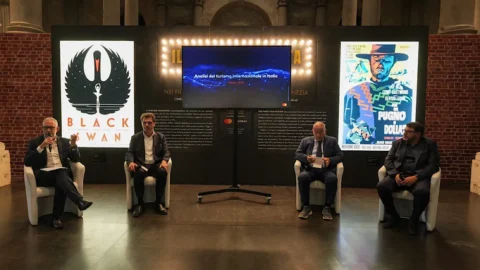
Italian tourism is registering record flows. In 2023, Istat data confirm 133,6 million arrivals. In 2024 the trend grows by 2,5%, marking another record: 458 million tourist presences. Italy positions itself second only to Spain in terms of registered flows, France is third. Clean Economy, the Italian initiative that promotes environmental and social sustainability, through his conference held in Bologna, delivers an analysis on a theme that is the other side of the tourism coin: mobility. If in recent years there has been much talk about overtourism and related phenomena, such as overcrowding in cities, the controversy over keyboxes in the main Italian tourist cities and the risk of degradation of historical sites, the Bologna conference instead focuses on a central and directly connected aspect: How is mobility organised?
How tourists arrive in Italy: cars and planes dominate
Clean Economy provides some clear data to explain the tourism phenomenon, starting from the means used by tourists to reach the Belpaese: 50% of travellers arrive by car, 47% by plane. Only 1,7% arrive by sea and 1,9% by train.
But once we arrived in Italy, for travellers the matter gets complicated. From what emerges, Clean Economy presents a problem linked to the organization of the national transport system which, at present, it would not be sufficient to manage the large flow caused by the phenomenon, and by extension from overtourism.
Sustainable mobility and digitalization: the vision of Clean Economy
Rethinking mobility is “a fundamental task”, especially given the growing demand for transport. The risk is that if this transformation is not completed, the results could damage one of the key sectors of the Italian economy: tourism. A sector that, according to estimates, brings in up to 368 billion euros, Or the 18% of GDP.
Among the indications that emerged during the conference, the main need is that of invest in the digitalization of systems to make services increasingly integrated. With a view to a more heterogeneous distribution of tourist flows, it has also been hypothesized that promotion of lesser-known sites in the area as well as one re-evaluation of mobility along the paths, to bring travellers back to nature tourism.
Rethinking mobility: an opportunity for sustainability
Although Istat data confirm that the 59% of those who travel in the country use their own car, the trend is decreasing. The reason can be traced back to the increase in the use of public transport.
Secondo Pierluigi Coppola, Professor of Transport Planning at the Polytechnic University of Milan, it is therefore necessary to further develop the connections between ports, airports and stations towards cities, for an increasingly intermodal country.
For Alessio Claroni, Professor of Transport and Tourism Law at the University of Trento, the ongoing review of mobility can represent an opportunity for orient it towards greater sustainability and more responsible respect for the environment.