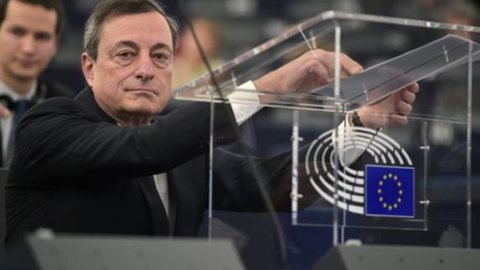
There are several "global forces conspiring to keep inflation down" in the global economy. The president of the ECB, Mario Draghi, said today during a conference organized by the Bundesbank in Frankfurt, referring to topics such as the cyclical weakening of oil and raw materials.
“These forces may slow the return of inflation to our target values – continued Draghi -, but there is no reason why they should lead to permanently lower inflation. What matters is that central banks act within their mandates. In the euro area, this can create challenges different from those posed in other jurisdictions, but these challenges can be mitigated and do not justify inaction. If necessary, we will adopt further expansionary policies to support the recovery of the economy”.
INFLATION: THE GOAL, THE CURRENT SITUATION AND OUTLOOK
Statute in hand, the first objective of the ECB is to maintain price stability, with an inflation target "lower but close" to 2% per annum. To restart prices, the ECB has already launched substantial monetary policy measures (from quantitative easing to rate cuts), yet, according to the latest Eurostat flash estimate, in January the annual inflation rate in the euro area should have settled at 0,4%. Not only that: Yves Mersch, member of the executive committee of the ECB, said in a recent interview with the Wall Street Journal that the Eurozone could return to deflation between spring and early summer.
DRAGHI: "WE WILL NOT SURRENDER TO LOW INFLATION, THE RISK OF SIDE EFFECTS WILL NOT STOP US"
“There can be no doubt that, if we decided to adopt even more accommodating policies, the risk of side effects would not stop us – continued Draghi today -. We always have in mind the need to limit the distortions caused by our policies, but the priority is the objective of price stability. This is the meaning of the principle of monetary dominance which is enshrined in the Treaties and which makes monetary policy credible”.
In short, “if we don't surrender to low inflation, and we certainly don't do it – underlined the number one of the ECB – on balance, the figure will return to levels in line with our objective. On the other hand, adopting a 'wait-and-see' stance and extending the time horizon of our policies carries risks, namely inflation expectations that are not durably anchored and, consequently, ever lower inflation rates. If that were to happen we would need much more accommodative monetary policy to reverse this process. From this point of view, the risks of acting too late are greater than those of acting too soon.
BANKING UNION: DRAGHI PROMOTES EU COMMISSION PROPOSAL FOR A EUROPEAN DEPOSIT GUARANTEE
Draghi also spoke of banking union, recalling that “an agreement on the third pillar is still missing: the European guarantee on deposits, a fundamental element for a true single currency. For this reason, the Commission's proposal to create a European deposit guarantee scheme is welcome: on the one hand it defines the ambitious goal of creating a real European system of protection of account holders, which favors the emergence of an internal market for deposits in the which the availability of the same is guaranteed regardless of jurisdiction with a level of trust in deposits that is the same everywhere; on the other, it is realistic and offers a series of guarantees against 'moral hazard', so that risk sharing does not become risk distribution”.
Draghi then reiterated that "risk reduction and risk sharing are two sides of the same coin and should be pursued at the same time: they are both essential to protect the stability of the European banking sector and to guarantee a homogeneous transmission of our monetary policy".
ECB NEWSLETTER: "NEW MONETARY POLICY MEASURES POSSIBLE IN MARCH"
Meanwhile, in the monthly bulletin published today, the European Central Bank reiterates that the risks of a weakening of economic growth and inflation in the euro area "have started to increase again at the beginning of the year, in the presence of heightened uncertainty regarding the growth prospects of emerging economies , volatility in the financial and commodity markets and geopolitical risks. The Governing Council will therefore have to review and possibly reconsider the monetary policy stance at the beginning of March, when the new macroeconomic projections also for 2018 will be available”.