Over 21 billion in investments in 10 years, a new network, called hypergrids, which will exploit the technologies of direct current energy transmission, five new ones electrical backbones which will make it possible to double the trading capacity from South to North e 30 strategic works to help achieve the decarbonisation targets. All for the purpose of centering five macro objectives: enabling the achievement of the European objectives of the package "Fit-for-55”, favor the integration of sources renewable, develop the interconnections with overseas, raise the level of security and resilience of the electricity system and invest in it digitization of the network.
These are the cornerstones of the new Terna's 2023 development plan presented in the morning by the president Valentina Bosetti and by the CEO Stefano Donnarumma, in the presence of the Minister of the Environment and Energy Security, Gilberto Pichetto Fratin and the president of the Authority for Energy, Networks and the Environment, Stefano Besseghini.
Terna: over 21 billion in investments, Donnarumma: "The highest ever expected"
The new 2023 development plan presented by Terna envisages an increase in investments of 17 percent compared to the previous plan, to 21 billion, 11 of which will be allocated to the five new electricity backbones. A huge outlay which, calculating the entire life of the works included in this Plan, will exceed 30 billion euros.
“The investments included in the 2023 Development Plan are the highest ever forecast by Terna and will make it possible to decisively enable the energy transition and the achievement of the objectives that Europe and Italy have set for themselves", declared the CEO of Terna, Stefano Donnarumma. “Never before, in a particularly challenging context, is a long-term planning effort necessary, a coordination between the institutions that allows Italy to seize all the opportunities that the transition brings. The sources renewables represent our oil: enabling its diffusion and integration is part of our mission as directors of the electricity system and will be decisive for the energy security of our country'”.
The Hypergrid project and the five new power backbones
The most important novelty foreseen by the new plan is the hypergrid network which will exploit the technologies of energy transmission in direct current to achieve the objectives of energy transition and security. Added to this are five new backbones, which will serve to integrate renewable capacity into the infrastructure of the peninsula, for a total value of approximately 11 billion.
“This is a massive operation by modernization of power lines already existing on the Tyrrhenian and Adriatic backbones of the peninsula and towards the islands, which provides for new 500 kV submarine connections, an element, the latter, which represents an absolute novelty for the company. With Hypergrid it will be possible double the exchange capacity between market zones, going from the current 16 GW to over 30 GW. In addition, the development of direct current backbones will make it possible to minimize land consumption and the impact on the territory”, Terna explains in a note.
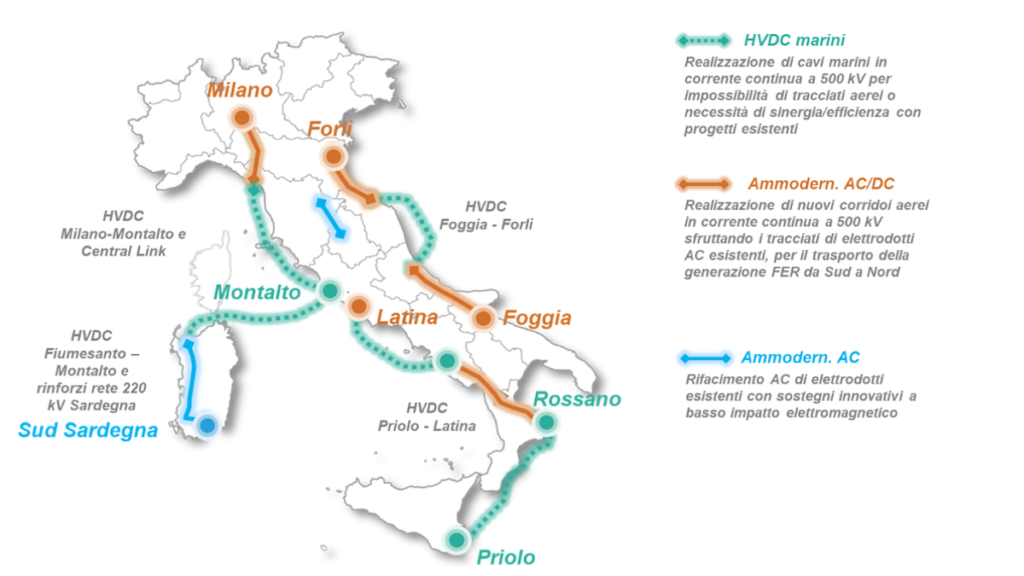
Le five backbones of the Hypergrid network, which will involve most of the Italian regions, will be: HVDC Milan-Montalto, (2,7 billion investments), Central Link, (300 million investment) Dorsale Sarda and Sardinian Link (the total investment for both infrastructures will be 1,4 billion), Ionian-Tyrrhenian ridge (two sections, the HVDC Ionian Link, from Priolo to Rossano and the HVDC Rossano – Montecorvino – Latina, for a total investment of around 4,1 billion euros), Adriatic ridge, HVDC Foggia-Villanova-Fano-Forlì (2,4 billion).
Network connection requests
In Italy, the energy produced from renewable sources will have to cover at least 65% of final consumption in the electricity sector by 2030, with an increase of 10% compared to the 55% previously indicated by the Integrated National Plan for Energy and Climate ( Pniec), for a total of dthe 70 GW of additional power. According to Terna data, in January 2023, requests for connection to the high voltage grid of new generation plants from renewable sources reached around 340GW, a value equal to approximately 5 times the objectives that Italy has set itself for 2030.
The investments envisaged by Terna in the electricity transmission grid "will serve to increase the mesh and the reliability of the grid, to strengthen the backbones between the South (where the production of electricity from renewable sources is greater) and the North (where the demand for electricity), to strengthen the connections between the islands and the mainland, to develop the infrastructures on the two major islands, as well as to improve the resilience, efficiency, sustainability and integration of renewables”, communicates the company.
In this scenario, underlines Terna, the time of authorization and realization of the works compared to the evolution speed of the electricity generation and demand scenarios. For this reason, the company that manages the national electricity grid will adopt a modular approach which will make it possible to build future network infrastructures according to the actual energy scenario. To this end, the new works of the Hypergrid network will be designed and launched in the authorization process "immediately", highlights Terna, to then be implemented according to system priorities.
By 2040, thanks to the interventions included in the Plan, a total reduction of CO2 emissions is expected up to almost 12.000 kt/year.
The Tyrrhenian Link
There are 30 infrastructure projects included in the new plan. Among the most important works, the Tyrrhenian Link, the 500 kV submarine link which will link Sicily to Campania and Sardinia, thanks to an investment of around 3,7 billion euro. The East Branch "Campania-Sicily" was authorized by the Ministry of the Environment and Energy Security in September 2022, while the authorization procedure was started for the West Branch ("Sicily-Sardinia"). The work will be completed by 2028.
In the plan, Terna also provides updates on theAdriatic Link, the HVDC connection between Abruzzo and Marche with a capacity of 1000 MW along approximately 250 km, the authorization process for which was recently launched and whose entry into operation is scheduled for 2028, two years ahead of initial estimates. Finally, as regards the planned interventions for the new electricity grid of the Olympic and Paralympic Games "Milan-Cortina 2026”, Terna has planned 12 interventions, which envisage the construction of approximately 130 km of lines.
Interconnections with foreign countries
Terna has earmarked an investment of around 2 billion euro to strengthen and develop interconnections with foreign countries. The interconnection project between Italy and Tunisia, an intervention of strategic importance which will guarantee the optimization of energy resources between Europe and North Africa. The 2023 Development Plan also confirms the project Sa.Co.I.3, the connection between the electricity systems of Sardinia, Corsica and the Italian peninsula, for a total investment of 950 million euros. Furthermore, in the second half of 2023 Terna will launch the public consultation for the new submarine cable with Greece, 200 km long and 500 MW, which will double the exchange capacity between the two countries. “These interconnections, together with the power lines between Italy-France, Italy-Switzerland and Italy-Austria, will allow our country, by virtue of its strategic geographical position, to strengthen its role as an energy hub in Europe and the Mediterranean area, becoming a leading player on an international level”, concludes Terna.