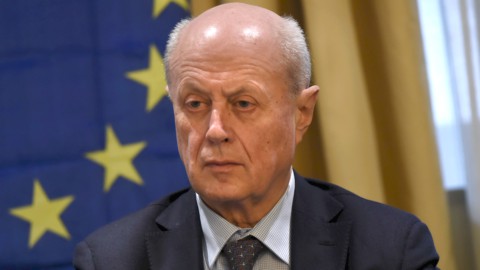
“The Prime Minister Giorgia Meloni He should seriously reflect on the setback his majority suffered in terms of preferences. He can't get away with a tasteless irony. What is certain is that the electoral law just approved by the Chamber does not move in the direction of a balance of powers envisaged by the Constitution and if the electoral law proposed by Alcide De Gasperi in 1953 was unfairly branded as a fraudulent law despite providing for a modest majority bonus, what should we say about the Meloni law? The truth is that this Electoral law is a randellum against representative democracy”. Bruno Tabacci, president of the Democratic Center, an ally of the center-left, and a longtime parliamentarian, has not lost his passion for political battles, and he is not shy about the electoral law, recently approved by the Chamber of Deputies (the Stabilicum will now move to the Senate), he does not hold back from harsh judgments. But his reflections on building a center within the center-left coalition he is working on with Enrico Maria Ruffini are also interesting. Here is his interview with FIRST online.
With the approval of the electoral law in the Chamber of Deputies, the center-right is tending to downplay the defeat in the preferences, dismissing it as a simple parliamentary mishap to be overcome in the Senate. But is this really the case, or is Tuesday's vote against in Montecitorio a sign that Prime Minister Giorgia Meloni's honeymoon with the country is over—as evidenced by the referendum—but also with her majority, which appears to be internally divided into at least six groups (FdI, Vannacci, Lega leaning towards Salvini and Lega leaning against Salvini, Forza Italia leaning towards Tajani, and FI leaning towards Marina Berlusconi)?
The vote in the Chamber on preferences, as envisioned by the FdI amendment, was certainly not a simple parliamentary mishap within the majority. When 50 parliamentarians, in a secret ballot, overturn the balance of power expressed in the same session through repeated open votes, it indicates profound discontent within the majority itself. Instead of making thinly disguised jokes about the parliamentary quagmire, it would have been better for President Meloni to have initiated a discussion among her coalition forces, given that the proposed amendment raised questions about the exclusion of the top candidate from the vote on preferences and the lack of gender equality in the selection of the top candidates. It appeared to be a mockery, aggravated by the elimination of single-member constituencies, effectively erasing any residual connection with the electoral public, which had already expressed discontent with growing disaffection with voter turnout.
How do you think the Prime Minister will address what you yourself have called the parliamentary "swamp"? Will she try to govern until the end of the legislature, risking wear and tear day after day, or will she try to convince the President of the Republic to dissolve Parliament early?
"In such a delicate parliamentary transition, President Mattarella's wisdom could be useful: the dissolution of Parliament does not occur at the simple request of the incumbent Prime Minister. It is a complex procedure that fortunately rests with the Head of State, whose prerogatives must be respected. And this new electoral law with its hidden premiership does not advance the balance of powers established by the Constitution."
What do you think will happen with the Senate electoral law? What is your overall assessment of the law?
I don't know what will happen in the Senate. I hope there will be a surge of responsibility. But I'm under no illusions. The nature of the parliamentary Republic cannot be changed with a simple electoral law. The comparison with the so-called "fraudulent" law, which was not one, promoted by De Gasperi is merciless. That would have been triggered at 50% plus one of the coalition with a bonus of 25 votes for every 100 validly cast. This one kicks in when the coalition reaches 42%, and therefore President Meloni demands a bonus of 42 votes for every 100. But, unlike in 1953, the voters have fled. In 1953, there were 1.8 million non-voters; in 2022, there were 16.6 million. If what foreshadowed a bonus was called a fraud, this one is wicked because the bonus appears to be a randellum against representative democracy”.
Recently, while remaining in the center-left, you left the Democratic Party group to join the mixed group. Why? What no longer convinces you about the Democratic Party?
I've never joined the Democratic Party. I was elected in Milan in a single-member constituency representing the entire center-left coalition when I founded the Democratic Center in December 2012, after participating in the center-left primaries with Bersani, Renzi, and Vendola. The parliamentary group is called the Democratic Party – Democratic and Progressive Italy. If the new electoral law abolishes single-member constituencies, the Mixed Group is more appropriate.
You've stated that from now on you intend to focus primarily on organizing the Center, which Campo largo lacks: on what political basis, and with whom? Don't you think there are too many dissidents within the Center, making it difficult to achieve unity? In your opinion, what programmatic criteria should be used to build a Center capable of negotiating an alliance with the Left without subservience?
For months, I've been working on a political and institutional program that will apply to the entire country with Ernesto Maria Ruffini. In September, we'll define the modalities of our contribution to the center-left coalition, also in light of recent developments, including the electoral law. As the Naples initiative demonstrates, the broad scope of that configuration isn't enough. More convincing was Magi's initiative on Wednesday in Piazza Montecitorio on the electoral law, which saw the participation of the entire opposition to the Meloni government. What is certain is that we need to define a serious and profound programmatic foundation, centered on Europe with its institutional, economic, social, and productive problems, and on foreign policy, including defense and security. At that point, with that platform, we can envision open coalition primaries to choose the leadership.
Are you in favor or against primaries to choose the center-left's candidate for prime minister? In that case, would you vote for Schlein, Conte, or a third party?
"We'll see how the program develops. We certainly can't start with preconceptions about names."