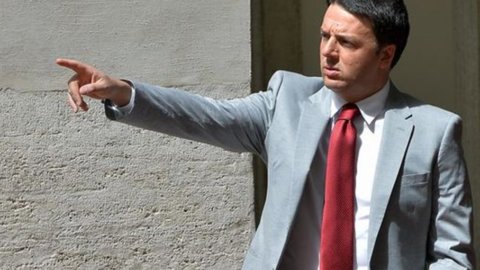
Anti-corruption measures, reform of the Public Administration and cutting of electricity bills. Three crucial measures in a single Council of Ministers, that of Friday, which presents itself as an important turning point for the Renzi government. The Premier, engaged in a series of visits to Asia in recent days, has instructed his men who remained in Rome to finalize the texts of the measures, so that they can be submitted to the Executive already during the next meeting. An activism that the Prime Minister deems necessary also because, as he explained when commenting on the results of the recent ballots for the administrative elections, "there are no longer positions with electoral income".
But the goals are different. First of all, with the new anti-corruption law, the Government intends to give an immediate response to the Expo and Mose scandals, sending a clear signal with which to recover part of the lost credibility, especially at an international level, after the results of the maxi-investigations of Milan and Venice. The reform of the public administration, on the other hand, must be implemented this month to respect the time schedule set by Renzi already at the time of taking office at Palazzo Chigi. As for the electricity bill, reducing it means helping the competitiveness of businesses, focusing the lens on growth and jobs, or rather the two polar stars that starting from July XNUMXst should guide Italy's European presidency semester.
ANTI-CORRUPTION
On the first front, the decree expected on Friday in the CDM contains the attribution of powers over the Expo to Raffaele Cantone, the number one of the new national anti-corruption authority: "It is not a super prosecutor or a man with superpowers who solves everything - he underlined Renzi last week -, but he must have the real possibility of affecting both supervision and procedures ”.
The overall justice reform will arrive two weeks later, and will guarantee “the certainty that a politician who has violated the law can no longer set foot in a public office except to issue a certificate – continued the Premier -. We radically change the administrative process, the setting up of the public procurement procedure. Now is the time for a radical reform. You do me the favor, you who have bribed or extorted someone, by not setting foot in public procurement again".
PA REFORM
Meanwhile, PA minister Marianna Madia has summoned the unions on Thursday 12 June at 10.30 for a meeting on the reform that the Government will discuss on Friday. The Executive proposes to introduce a single managerial role, overcoming the division between first and second band. There should be no redundancies, but one of the Government's objectives is a "selective and strategic rejuvenation" of personnel, perhaps also through early retirement.
However, the measures under study are different: from the modification of voluntary and compulsory mobility to the repeal of detention in service once the retirement age is reached, which would make it possible to free up over 10 thousand places for young people in the PA at no cost. There is also talk of subsidized part-time and the so-called "women's option" for female workers who choose the contributory scheme to retire with the pre-Fornero requirements. Madia also proposes a simplification of the turnover to ensure more admissions and allow more discretion in planning.
Renzi then wants to aggregate the "more than twenty research bodies that perform similar functions, to give life to poles of excellence", and reorganize the Authorities with the aim of abolishing Covip. The "Citizen's Pin" is also on the way, with which it will be possible to access the bureaucratic procedures "from the fines down", explained the Premier, specifying that a year will be needed for the technical implementation.
CUTTING ELECTRICITY BILLS
As for measures to support industry and the competitiveness of SMEs, at the end of May the Minister of Economic Development, Federica Guidi, had responded to requests from Confindustria, assuring that a plan to "reduce the energy bill" will be launched by 20 June: a fundamental step that will make it possible to reduce the electricity bill of small and medium-sized enterprises by over 10%, thus launching a plan to reduce a series of extra costs that have no reason to exist and which weigh down our companies".
Guidi had added that he wanted to “carry out for the first time a wide-ranging work of tariff equality, eliminating all forms of over-remuneration that many actors still enjoy. It is necessary to reduce the amount of cross-subsidies between categories of consumers by asking everyone to give up something to avoid that someone has to give up everything”.