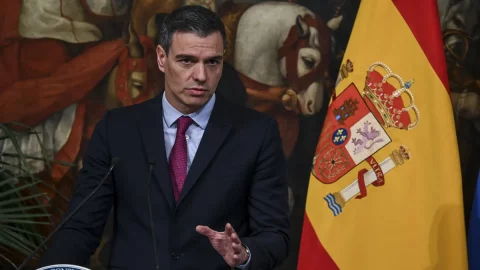
Pedro Sanchez could soon return to Moncloa from the main door. Almost four months after the elections and after the failed attempt of the People's Party Alberto Nuñez Feijóo, the socialist party has reached the agreement that will guarantee it the numbers necessary to govern. Not without effort and not without major concessions. Because it will be the one who provides the PSOE with the external support it needs Catalan secessionist party Junts per Catalunya of the former president of the Generalitat Carles Puigdemont who will soon be joined by the Basque nationalists of the PNV.
Psoe-Junts: the (high) price of the agreement
There were essentially two requests from Junts to the PSOE: a new independence referendum for Catalonia after the – illegitimate – one in 2017, and the total amnesty for all politicians involved in the consultation from six years ago: convicted, accused and investigated for the attempted secession.
On the first point the Catalans failed to win, but on the second they did. The new government will promote an amnesty law in favor of Catalan independence activists with open court cases.
The agreement will be signed by today evening, Thursday 9 November, in Brussels, and it will be in that context that the details of the agreement will be announced and above all of a future law that has already caused a lot of hype in Spain.
In reality, already last Thursday it seemed that the white smoke was close, but then the two parties decided to take more time to establish the details of a law which, in all likelihood, will be contested in every possible forum.
If the signature arrives today, Pedro Sanchez's investiture as Prime Minister and Parliament's vote of confidence could already arrive early next week. It should be taken into consideration that - at least officially - the agreement with the PNV, the Basque nationalist party, is still missing, but the PSOE assures them that the agreement is already in place.
In the meantime, the deadline is approaching: if by November 27 there will not be a new government, Spain will return to the polls. The date already exists: January 14, 2024.
The street clashes and the accusations from the right
In recent days, thousands of people have gathered in front of the PSOE headquarters in Madrid with the aim of protest against the future amnesty in favor of the secessionists. During the demonstrations, violent clashes also occurred between neo-fascist groups and the police which led to the arrest of several people.
Also blowing on the wind of the protests are the parties of the future opposition who accuse Sanchez of "coup against the Constitution”, defining the agreement between PSOE and Junts as “shameful and humiliating”.
“Today the Spaniards will witness a shameful day when they see what Sanchez is doing to stay in power,” said PP general secretary Cuca Gamarra in an interview with Telecinco. Citizens will see “how a fugitive” will show up abroad to explain "how he managed, in exchange for his seven votes, to manage the Spanish justice system" and to prevent "the rule of law" from applying to him.
The There is no shortage of discontent in the judiciary: The CSM has already expressed a negative opinion on an amnesty law, while the European Commissioner for Justice, Didier Reynders, has sent a letter to two ministers of the interim government, in which Sánchez's executive is asked for detailed information on the measure.
The summary of the previous episodes
Last July 23, the polls yielded a substantially ungovernable result. Officially the party that obtained the highest number of votes was the Pp, but it was immediately understood that the main centre-right political force would never have the numbers to govern. Popular Party leader Alberto Nuñez Feijóo could count on 172 deputies: 137 from the PP, 22 from the ultra-right Vox and 2 belonging, respectively, to the Coalición Canaria and the UPN of Navarra. For the majority (equal to 176 seats), another 4 were missing which Feijóo - having received the investiture from King Felipe - tried to find in every way, even going so far as to propose an agreement to the PSOE, only to then have to surrender.
Sanchez instead had a base of 171 certain seats: the 121 of his party, the 31 of Sumar, and the 19 overall obtained by the various Catalan, Basque and Galician nationalist and separatist groups. With Junts' 7s we reach 178.