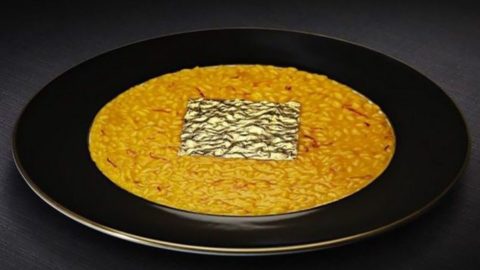
Saffron and Gold: Gualtiero Marchesi's unforgettable risotto
It was a dish that marked an era, the only dish that has remained uninterruptedly on the menu since 1981 when, Gualtiero Marchesi, the great master and father of modern Italian cuisine, at the time two Michelin stars, proposed it, causing a sensation and admiration . And even now that Marchesi has been missing for three years, the gold and saffron risotto continues to be offered in his restaurants, the Marchesi alla Scala restaurant in Milan and the La Terrazza restaurant of the Grand Hotel Tremezzo).
A dish that can be considered the yardstick of Gualtiero Marchesi's great cultural revolution, a dish that introduces simplicity, the essentiality of the raw material, the formal elegance of the presentation (concepts that are more current today than ever for the greatest Italian chefs) while presenting it in the luxury of gold leaf and its iconic black plate conceived, with an artist's touch, as a frame for an abstract painting.
“I find the radiance of rice and gold towering – Marchesi loved to say – It is the dish that best reproduces my concept of beauty. Essential, no frills”.
A perfect and untouchable dish like a work of art. To the point that when one of his former trusted collaborators appropriated it by replacing it - horror! Carnaroli rice with Basmati creating a serious vulnus to the harmony of the dish, Marchesi did not hesitate to drag it into a judgment. There was a sort of trial and the CTU appointed by the judges deduced that the variety of rice used is not suitable for preparing risotto and that the quality of the rice used does not meet the standards set by the regulations'.
It should be added that in 2002 Marchesi had registered the design of the dish to which the CTU of the court agreed that 'the image of the dish together with the wording rice, gold and saffron or even considered individually can be protected as a trademark. Moral of the story the ungrateful chef was condemned and forced to remove the dish from his menu.
And we come to the recipe. Let me be clear, it is not a classic Milanese risotto. The great chef was keen to point out that he worked backwards for this risotto, in the sense that instead of making a base of onion and white wine in which to sauté the Carnaroli rice, he made a base of butter and onion, he cooked it by adding wine and letting it evaporate from which he obtained an acid butter that gave the sense of the great revolution of the dish.
Ingredients for people 4
For the risotto
320 g of Carnaroli rice
20 g of grated Parmesan
20 g of butter
0,5 g of saffron pistils
1 liter of meat broth
1 glass of white wine
salt
4 sheets of edible gold
For the sour butter
1 onion
80 g of butter
1 glass of white wine
Method
Soak the saffron in a glass of hot broth
Fry 20 g of butter in a saucepan, add the chopped onion and cook for a few minutes, then deglaze with the white wine.
When the liquid has cooled, filter it with a sieve by removing the onion.
Now prepare the butter cream with the acid liquid and the remaining 60 g of butter softened at room temperature.
Toast the Carnaroli rice in a saucepan with 20 g of butter for two minutes, deglaze with the white wine and let it evaporate.
Then continue cooking, being careful to add a ladle of broth only for risotto because it is too dry.
Halfway through cooking, add the saffron stigmas. Then proceed to cream the risotto "all'onda", keeping it rather slow, with the Parmesan cheese and the acid butter obtained previously.
Arrange the risotto on plates and place an edible gold leaf on top of each, in a central position. And then it was recommended, let it rest in the dishes for two minutes because it suffered violence during cooking