The very tender skin makes it suitable for the preparation of appetizers and soups, but also excellent side dishes to be served with meat main courses. In Lucanian cuisine it is used in numerous traditional recipes ranging from the classic fettuccine and beans, to beans alla pignatta, to pasta, beans and ditelle soup, up to bean puree with cruschi peppers.
Tender skin and tasty, excellent for soups, fettuccine and purees
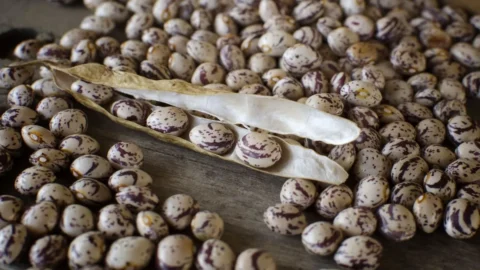
Let's talk about Red bean written from the Pignola Marsh – a curious name that comes from the fact that it is characterized by red streaks that seem to have been drawn with a brush, hence the name “written” – which had a fundamental function in the nutrition of the ancient disadvantaged populations of this geographical area until it became the protagonist of trade fairs at the beginning of the last century. It had been almost forgotten, either due to the migration of the local inhabitants or due to the change in the eating habits of the population, which had relegated cultivation to family gardens only. But now it has been recovered thanks to the commitment of Alsia Basilicata, the Slow Food Foundation and some producers from the municipality of Pignola who have become its Custodians.
Located a few kilometers from Potenza, the Pantano di Pignola lake extends in a large basin surrounded by the Maddalena mountains, over 1.000 meters high and arranged like a natural amphitheater.
Certain news about the presence of this body of water – explains a Slow Food note – can be traced back to a print from 1702 which places the lake at the foot of the town of “Vigniola”, in the immediate vicinity of the church of the Madonna del Pantano.
Already in the 24th century they were a fundamental diet for monks who could afford XNUMX kg per capita per year.
But the written red bean seems to have developed in this area of the upper Basento valley even earlier, introduced by the Spanish returning from the Americas around 1500-1600. Perfectly acclimated to the area, it immediately became a fundamental element of the local diet. In fact, there are documents from conventual orders dating back to the 24th-1811th century, which explain how even then the average annual quantity available for the diet of a single religious person was around 1923 kg. Later in the Napoleonic era, the beans of the area became a fundamental support for peasant families as can be read in the Murattiana Statistical Report of XNUMX, commissioned by Gioacchino Murat which describes the living conditions in the Kingdom of Naples. This brings us to the beginning of the last century when the red bean of Pignola became the protagonist of the Third International Trade Fair of Naples in XNUMX.
It is now a Slow Food presidium and must follow a strict specification that safeguards its characteristics.
What makes its flavor special is the climate of the Pantano di Pignola, where the maximum temperatures in the months of July, August and September never exceed 30°C, while the relative humidity is around 70%. The soil also contributes, rich as it is in water and thanks to its predominantly clayey composition.
The plant, climbing, produces a round ovoid seed, with a beige background and dark red streaks. Over time, however, its cultivation gave way in the post-war period to livestock farming and young people gradually abandoned the countryside, going to work in the city or in the chemical industry that developed in the area.
The fact that it has become part of the Slow Food Presidia has given it a long life expectancy. Following a specification that producers who have joined together in the Association of Custodian Cultivators have adopted, the red bean written is sown in May and harvested in October.
Cultivation, given recent studies and registration in the PAT register, is slowly recovering after years of abandonment that had relegated it to family vegetable gardens only. Cultivation guided by experience handed down from generation to generation, following environmentally friendly agronomic practices that together with the ideal climate, abundant irrigation and soil rich in organic matter, give this legume a low percentage of tegument and a high biological value of proteins
Slow Food Presidium Producers
Alessandra Ferretti Pignola (Pz)
Pantano District, 54
P. 335 8353359
John Bianconi Pignola (Pz)
Petrucco District, 12
P. 328 1660719
Nazarene Colucci Pignola (Pz)
Contrada Archpriest
P. 347 9962990
Rocco Vincenzo Pink Pignola (Pz)
Contrada Pantano
P. 338 4559519
Vincenza Rosa Pignola (Pz)
Tintera district
P. 333 7822449
Valentino Hungarian Pignola (Pz)
Contrada Tintera 12 C
P. 340 8998560