The European summit on the Recovery Fund begins, to say the least, uphill for Italy. After a day of quarrels, the heads of state and government have not reached any conclusions: on the contrary, if possible they have even distanced themselves from the idea of an agreement. At the moment, therefore, no one can say either what the amount of the Recovery Fund will be, or how the governance will work, i.e. the mechanism for approving the national reform plans on the basis of which, from 2021, the funds will be distributed. After an unsuccessful night, we start again from a restricted meeting between Germany, France, Holland, Italy and Spain.
RECOVERY FUNDS: GOVERNANCE
- The "emergency brake" proposed by Michel
On Friday evening, the president of the European Council, Charles Michel, in agreement with the current president of the EU, Angela Merkel, brought to the table a compromise proposal. The main novelty is the introduction of the so-called "emergency brake". Under this mechanism, the approval of the national reform plans would be the responsibility of Ecofin (the meeting of EU finance ministers), but - in the event of disagreement - each country would have the power to transfer the discussion to the Council European. The heads of state and government would not vote on the single plan, but the discussion would still have political weight and would slow down the procedure. The activation of the "brake" would be possible both in the approval phase of the PNR and in the subsequent disbursement of funds.
Too bad that Michel's proposal was rejected by both Italy and the Netherlands, for opposite reasons.
- The position of Italy
The hypothesis of an "emergency brake is not expendable - said the Prime Minister, Giuseppe Conte, at the end of the works - For this reason I have presented an alternative Italian proposal which aims to develop an involvement also of the Council, but in respect of the prerogatives of the Commission, which, on the basis of Community forecasts, is responsible for implementing the budget. We cannot compromise on this: it is a function that the treaties attribute to the Commission”.
- The right of veto requested by Holland
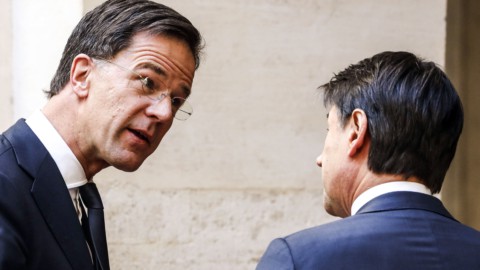
The Dutch premier, Mark Rutte, on the other hand, demands not only that the approval of the national reform plans be entrusted entirely to the European Council, but also that unanimity is required for the green light. In this way, each member would have veto power over the strategies of all the others and could block the disbursement of aid to countries whose political line it does not share. A governance structure that allows the Nordics to impose measures unpopular with the Mediterraneans: in the case of Italy, first of all the labor and pension reforms (with the interruption of Quota 100 and a complete farewell to the old wage system, still in force for contributions paid before 1995).
- The clash in the Council
Nobody likes the Dutch proposal (not even the other three frugal countries: Austria, Sweden and Denmark), but Merkel has kept the hypothesis on the table by avoiding partnering with the leaders of Italy and Spain. For hours Conte and Sanchez argued with Rutte: “His proposal – said Conte – is incompatible with the treaties and impracticable on a political level”. Rome and Madrid have come to threaten the veto on rebates, that is, the discounts to the Northern countries on the EU budget, which for the Netherlands are worth around one and a half billion euros.
RECOVERY FUND: FINANCIAL ENDOWMENT
- The (paradoxical) 30% mechanism
But that's not all: European leaders also disagree on the financial endowment to be attributed to the Recovery Fund and on the criteria for disbursing the money. Michel's proposal envisages granting the last 30% of resources for projects starting in 2023, but only if GDP growth has been reduced in the previous two years. Otherwise, paradoxically, the money would remain in Brussels. Even the Mediterraneans don't like this mechanism, Italy in the lead.
- The Italian trench
However, the most delicate battle (and significant in front of public opinion) concerns the total amount of resources. Conte defends the Commission's approach: 750 billion, of which 500 in grants and 250 in loans. "It is a symbolic problem - says the Italian Premier - a signal that we cannot fail to give: I do not want to give up on this". However, there is little hope of retaining the initial figure.
- The demands of the Nordics
The Finnish premier, supported by the Frugals, is asking to cut non-repayable transfers by less than half, while Germany and France defend the 500 billion (which corresponds to the plan presented by Merkel and Macron even before the Commission's proposal), but are willing to reduce the loans.
The problem is that Holland is not giving up on anything and for Rutte, in theory, a postponement of the negotiations to September would not be a tragedy. Conte, on the contrary, is in a hurry to close by July to avoid spending the rest of the summer being targeted by the opposition and the markets.